MAM
Distinct shift from OTS to OTC, says WPP media research

MUMBAI: WPP Media worldwide head of consumer insights Sheila Byfield emphasised that media research has also changed with more emphasis on ROI (return on investment). There is a greater emphasis on mixed media solutions and integrated marketing communications. There is also a distinct shift from OTS (Opportunity to see) to OTC (Opportunity to convince).
On 24 February 2003, Byfield made a presentation on “reaching the consumers who count” at an event organized by the Advertising Club Bombay and sponsored by The Hindustan Times and ETV Network. Byfield presented some findings from WPP Media’s latest tool named 3D to a discerning audience comprising of media and marketing professionals.
3D is an integrated single source data that gets into the consumers’ psychographics, demographics and the psychological profile. It was derived as a result of a global research effort covering a sample size of 80,000 people globally.

The following are some excerpts from her presentation:
Changes in the current media scene
Earlier, media was predictable and media vehicles were limited. The tried-and-tested methods used by ad professionals succeeded. There was less confusion in the minds of the consumer and the media specialist.
Currently, everything has become complex and cluttered. Factors such as social change and technology have brought about a paradigm shift in the media landscape. Media research has also changed with more emphasis on ROI (return on investment).
There is a greater emphasis on mixed media solutions and integrated marketing communications. There is a distinct shift from OTS (Opportunity to see) to OTC (Opportunity to convince). There is also a demand from clients who desire personalized and customised media solutions rather general ones.
The rules of the game remain the same – right environment, right messages, multiple points of contact and respecting target audiences. Media experts must realise that advertising is merely one of the things which touch a person’s life. On top of this, there is a bombardment of messages and media leading to further confusion.
Media revolution and evolution is part and parcel of the changing scenario. There is a shift from traditional media to new economy media – for instance from radio to web radio; publications to e-publishing; cinema screens to DVDs and Home VOD (video on demand).
There is more clutter and fragmentation. There is an upsurge in new media such as beach-advertising, field advertising, carton packs, advertising on leaves, skins, faces so on and so forth.
The number of ads or TVCs (TV commercials) seen every week by TV viewers is reducing. In fact, it is at odds with the awareness index. In the past decade or so, the ability of programmes to deliver audiences has reduced dramatically. More than 53 per cent of the programmes in 2001 delivered less than five per cent of the TV viewing universe. The figure was 28 per cent in 1991.
Brands
Logos were discovered 100 years ago and were used to identify brands. Brands then were co-related to their physical attributes (features, advantages, benefits). Subsequently, it was believed that brands connected to consumers at an emotional level.
Currently, brands are all about “meaning” and “experience”. However, brands have become the foundation stones of corporate wealth even as intangible assets and account for 70 per cent of the corporate wealth of the world.
Changing relationships of TV viewers with TVCs
Research shows that those people who have a high degree of involvement with the programmes watch ads and remember them too. More than 49 per cent of such people watch ads or TVCs without walking away during breaks; more than 30 per cent of these people remember or recall the ads. The need of the hour is to ascertain the quality value for each programme – what we term Purple GRP.
The number of ads or TVCs (TV commercials) seen every week by TV viewers is reducing. In fact, it is at odds with the awareness index. In the past decade or so, the ability of programmes to deliver audiences has reduced dramatically. More than 53 per cent of the programmes in 2001 delivered less than five per cent of the TV viewing universe. The figure was 28 per cent in 1991.
Future of media:
No media will disappear completely and most of the existing media will survive. What will change is the way in which consumers embrace the media and use it. People don’t stop using media when alternatives arrive – they just use them differently. However, it is important to recognize and act on the underlying trends which manifest with change.
During the dotcom boom, there were predictions that several media will fail to survive. Experts tend to overestimate the speed of change in the short term and underestimate its impact on the long term.
Research
Qualitative and quantitative surveys, which give the broader picture of brand shares, will continue to be conducted at regular frequencies. However, industry surveys will be woefully inadequate as they won’t be able to predict consumer behaviour accurately. They just focus on “who” is buying “what” but don’t answer questions related to “why” or “how”. There is a strong need for marrying research and accountability.
The Internet is all about delivering content. Research has to provide insights whether the Internet is being used to “save time” or to “spend time”. If users want to save time, then ads will be viewed with resentment. Marketers need to explore the sponsorship route for internet content.
Research specialists shouldn’t give in to media hype. They must predict after taking the social milieu into consideration.






Brands
KKR sixes to power EV charger rollout under VIDA campaign
Cricket meets clean mobility as big hits spark India’s charging growth
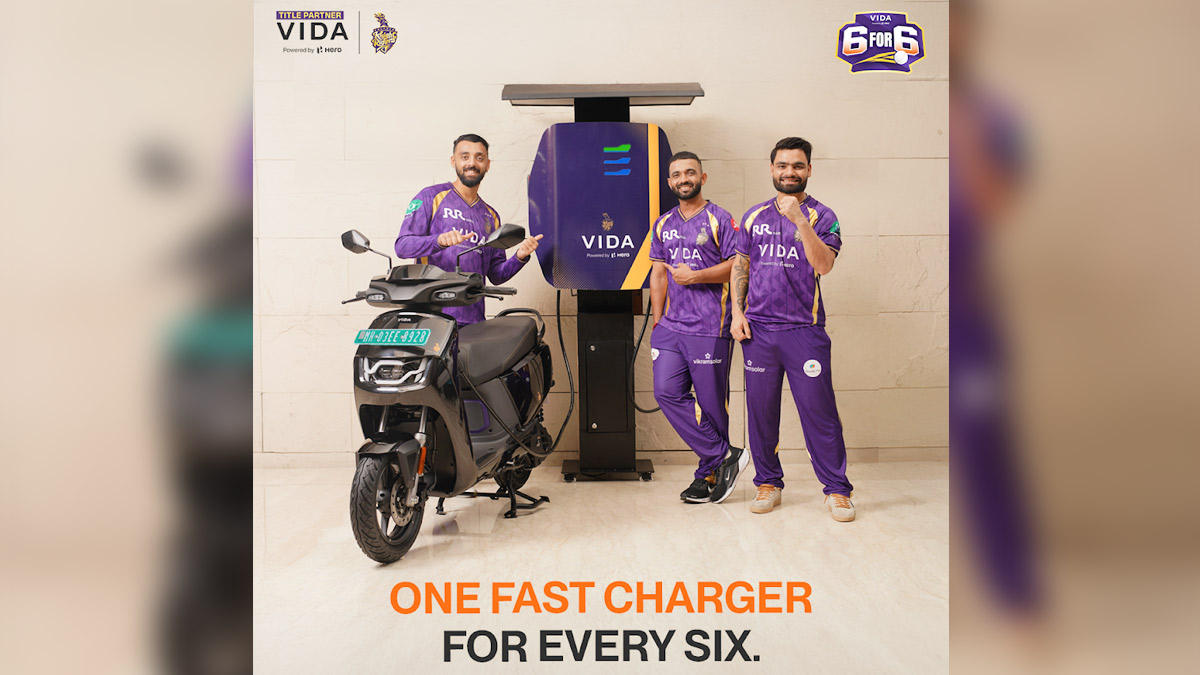
NEW DELHI: VIDA, the electric mobility arm of Hero MotoCorp, has teamed up with Kolkata Knight Riders to launch a campaign that turns cricketing flair into real-world impact.
Titled ‘6 for 6’, the initiative promises to install a 6kW fast EV charger for every six hit by KKR during the ongoing Indian Premier League season. The idea is simple but powerful, as each big hit on the field contributes directly to expanding India’s fast-charging infrastructure.
The campaign builds on VIDA’s growing network, which already spans over 5,300 fast-charging points across more than 430 cities. With EV adoption gaining pace, the brand is using cricket’s mass appeal to accelerate both awareness and infrastructure growth.
Explaining the thinking behind the move, Hero MotoCorp emerging mobility business unit chief business officer Kausalya Nandakumar said, “Cricket has an incredible ability to unite and inspire millions across the country. With the ‘6 for 6’ campaign, we are turning every big hit on the field into a step towards a cleaner and a more accessible mobility future.”
She added that VIDA’s expanding fast-charging network and removable battery technology are designed to make EV ownership more convenient and practical for everyday users.
From the franchise’s side, the campaign is also about giving on-field moments a larger purpose. Kolkata Knight Riders chief executive officer Venky Mysore said, “The ‘6 for 6’ campaign exemplifies the potential of sport as a platform for meaningful, real-world impact. By linking every six to the expansion of EV charging infrastructure, this partnership transforms fan excitement into tangible progress.”
As part of the rollout, VIDA has introduced co-branded charging stations in KKR’s signature colours, with a flagship installation unveiled alongside team players. The chargers are designed for quick top-ups, powering VIDA scooters from zero to 80 percent in about an hour, while also being positioned along key highways to support longer journeys.
The initiative also taps into VIDA’s removable battery system, which allows users to charge using standard household plug points, adding flexibility to the charging ecosystem.
By blending the thrill of cricket with the urgency of clean mobility, VIDA and KKR have found a neat way to make every six count twice, once on the scoreboard and again on India’s road to an electric future.








