MAM
Digital warfare: Political parties sink over ₹56cr into ads ahead of crucial Maharashtra civic polls

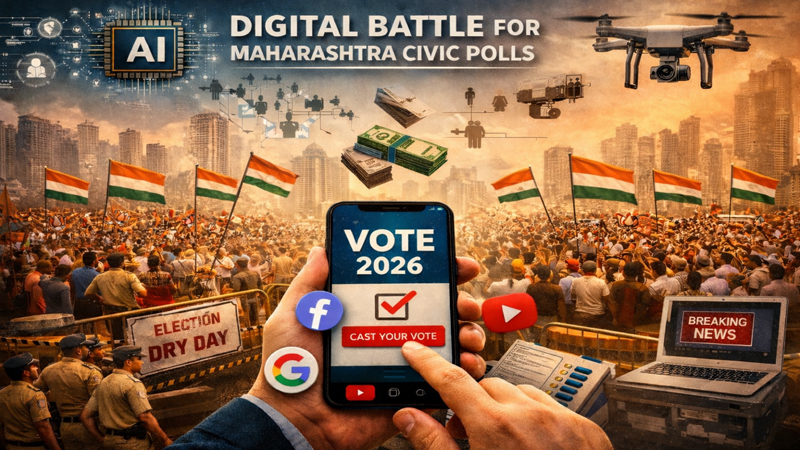
MUMBAI: As Maharashtra prepares for one of its most high-stakes local elections on 15 January, political parties have shifted their primary battleground from the streets to the smartphone screen. Combined disclosures from Meta’s Ad Library and the Google Ads Transparency Centre reveal that political entities have spent a staggering ₹56–₹57 crore on digital advertising between mid-December 2025 and January 2026.
With polling set for 29 municipal corporations, including the “cash-rich” Brihanmumbai Municipal Corporation (BMC), the surge in digital outlays reflects a strategic shift toward last-mile voter outreach in urban India.
The spending breakdown: BJP’s digital dominance
The ruling Bharatiya Janata Party (BJP) and its allies have emerged as the heavyweights in the digital arena, significantly outspending the opposition Maha Vikas Aghadi (MVA).
• Meta platforms (Facebook & Instagram): The BJP Maharashtra unit accounted for the lion’s share, spending approximately ₹36.15 crore. When including linked pages like “DevGatha” (promoting Deputy CM Devendra Fadnavis) and the official BJP Mumbai page, the total party-linked spend on Meta crossed ₹37.7 crore.
• Google & YouTube: The BJP and its aligned agencies (such as Dreamworth Solutions) spent roughly ₹11.1 crore.
• Opposition outreach: The Shiv Sena (UBT), led by Uddhav Thackeray, utilized a more concentrated approach, spending approximately ₹2.46 crore on Google platforms and maintaining a steady presence on Meta to counter the ruling alliance’s narrative.
Key campaign strategies: AI and video content
Industry experts tracking the 2026 polls note that the nature of political advertising has evolved. This election cycle is characterized by:
• AI-driven micro-targeting: Parties are using sophisticated algorithms to deliver personalized messages to specific demographics—targeting first-time voters in Mumbai, the working class in Thane, and the agrarian-urban mix in Nashik and Pune.
• Short-form video surge: A significant portion of the budget is being funneled into Instagram Reels and YouTube Shorts. “Video delivers higher recall in dense urban markets,” noted a digital consultant.
• Third-party surrogates: A notable trend this year is the rise of “shadow spending,” where third-party agencies and “community” pages run ads that align with party ideologies without using official party handles.
Election logistics: A state at a standstill
The scale of the election has prompted unprecedented administrative measures. Beyond the digital noise, here is how the state is preparing for the 15 January vote:
• Public and market holiday: The Maharashtra government has declared a public holiday tomorrow. In a rare move, the BSE and NSE will also remain shut for trading to allow employees to exercise their franchise.
• Dry days & security: A four-day “dry spell” (liquor ban) is in effect across all 29 corporation areas until the counting concludes on 16 January.
• Voting infrastructure: Over 3.48 crore voters are eligible to vote. In Mumbai alone, 10,231 booths have been set up for its 1.03 crore voters.
Why these polls matter
These elections are being held after a significant delay of nearly 34 months, during which most corporations were run by state-appointed administrators. For the Mahayuti (BJP, Shinde Sena, Ajit Pawar NCP) and the MVA (Congress, UBT Sena, Sharad Pawar NCP), these results are seen as a litmus test for the state leadership ahead of future legislative battles.
With the digital campaign window now officially closed, the fate of the 2,869 seats across Maharashtra now rests with the voters, as counting begins early morning on 16 January.