Digital Agencies
Digital Brand Fest 2022: Tracking the post-pandemic shift to digital marketing

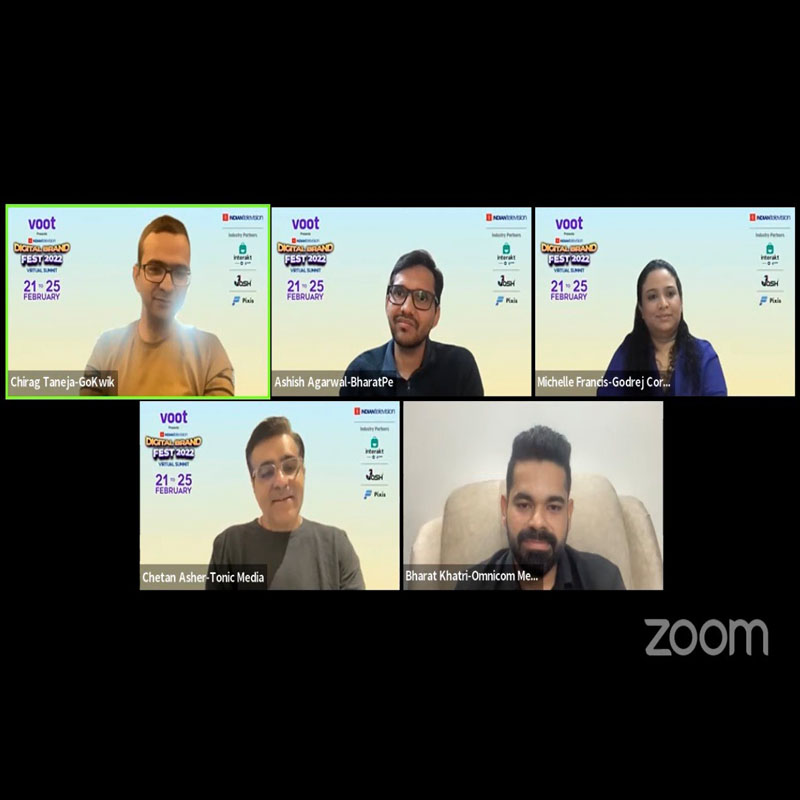
Mumbai: The pandemic has brought a change in the marketer’s playbook over the last two years, challenging the existing guidelines on brand building and customer relationships. The second day of the ‘Digital Brand Fest 2022’ organised by Indiantelevision.com saw an interesting discussion centered on this new-found marketing reality in a session on ‘Digital Marketing – The New Dynamic Shift Post Pandemic.’
The panelists included industry executives and marketers – BharatPe VP – Growth Ashish Agarwal, Omnicom Media Group Asia Specific chief digital officer Bharat Khatri, GoKwik co-founder & CEO Chirag Taneja, and Godrej Corporate brand and communications general manager Michelle Francis. The session was moderated by Tonic Worldwide Media CEO Chetan Asher.
The week-long virtual summit is presented by Voot, and Interakt, Josh, and Pixis have joined as industry partners.

Changing patterns of content consumption
Today consumers are spending an increasing amount of time on their smart devices and connected TVs, compelling businesses to take a relook at their digital marketing goals. “There has been an increase in Digital spending by brands over the last two years,” said Omnicon media’s Bharat Khatri. “The Indian market is in the midst of the narrative where Linear Television is increasingly being replaced by Connected TV.”
But, how have the large and legacy consumer brands dealt with this shift in the marketing paradigm? Are they still seen as a traditional marketing function?
According to BharatPe’s Ashish Agarwal, earlier traditional marketers had a tendency to look at Digital marketing as just another channel, but now they have realised that it requires a different skillset. “You need to think of it as a product and a technology function when you are processing such a huge amount of data. It requires a ‘product manager approach’ and more technical expertise to handle it,” he added.
Brands should consider digital marketing as a separate function that needs a specialised team, the panelists contended.
“We also need to define the ROI and business metrics,” said Godrej Corporate brand and communications general manager Michelle Francis, adding that digital also played a critical role in reputation building, and building a connect with consumers. In the case of digital, ROI is performance-oriented and one that usually gives instant gratification, he added.
The panelists also discussed the role of technology in marketing, on whether brands are building a marketing stack with MarTech, and if it is with a planned and sustained approach. They highlighted that most brands are open to the concept of additional tools to measure ROI, especially if a tool is able to decrease the brand’s cost per lead, and harvest a spike in sales and conversions by 10-15 per cent- which works as a good pointer for the brand. “You will see a lot of tools emerge which will cover up for talent gaps – or enablement products. Similarly, in the e-commerce space in India there are many companies trying to improve the funnel,” noted GoKwik’s Chirag Taneja.
Omnicom Media Group Asia Specific chief digital officer Bharat Khatri said the investment is already happening from the agency’s point of view. “We have a separate division called analytic, which works mostly on the martech deployment tools, technology, etc. The new truth now is- marketing begins if you know your customer segment well, as opposed to ‘knowing your customer’ previously,” he added.
With all the chatter going around on Web 3.0, NFTs, and the Metaverse, will brands be able to leverage the buzz? It’s a “marketers’ paradise” and it’s here to stay – just like the new normal of the virtual world we have gotten used to, highlighted the panelists, adding that its scope goes beyond gaming. “Metaverse is going to be more powerful, when it comes to Web 3.0, digital economy, more so, creator economy,” said Michelle Francis. “Although I don’t see many brands integrating themselves as of now with it, it’s a great opportunity for the brands that are navigating it, for sure.”
According to panelists, the challenge for brands now is to outdo themselves each time. They need to deliver better than what they delivered last time. “The ‘Test & learn’ kind of approach- that’s something that works better in a Digital world because you know what works and by how much. So keep testing, learn from it and incorporate it,” said BharatPe VP – growth Ashish Agarwal.
There is also a need for stronger measurement metrics. To summarise what we need in this fast-paced, constantly evolving digital ecosystem is agility, flexibility, value-added customer experience, and constant iteration, the panelists concluded.



BENGALURU: For years, creative teams have learned to live with ambiguity. Vague comments, last-minute changes, feedback that arrives without context, clarity, or conviction. It became part of the job – something teams worked around rather than getting it solved.
But as we head into 2026, that tolerance is wearing thin.
Creative work today moves faster, scales wider, and involves more stakeholders than before. Teams are producing more content across more formats, often with distributed collaborators and tighter timelines. In this environment, guesswork is no longer a harmless inconvenience. It’s a cost – to time, to budgets, and to creative mindspace.
The real problem isn’t feedback, it’s how it’s given
Most creative professionals you see today will tell you they’re not against feedback. In fact, they rely on it. Good feedback sharpens ideas, strengthens execution, and pushes work forward. The problem is ‘unclear’ feedback. When someone says “this doesn’t feel right” without context, they aren’t just revising – they’re basically decoding. They’re guessing what the problem might be, trying different directions, and burning time in the process. Multiply that by a few stakeholders and a few rounds, and suddenly days disappear.
In 2026, when teams are expected to deliver faster without compromising quality, interpretation is a luxury most can’t afford.
Scale has changed rverything
Creative projects used to be smaller and simpler. A designer, a manager, maybe one client contact. Feedback loops were short, even if they weren’t perfect.
Today, the same project might involve internal marketing teams, agencies, freelancers, brand reviewers, and regional teams. Everyone has a say. Everyone leaves comments. And often, those comments don’t agree. More people reviewing work means alignment matters more than ever. Clear feedback isn’t just about being nice to creative teams, it’s about keeping projects moving when complexity increases.
Guesswork quietly wears teams down
One of the less talked-about impacts of unclear feedback is what it does to people.
When feedback is vague or contradictory, creatives second-guess their decisions. They hesitate. They overwork. They keep extra time buffers “just in case.” Over time, confidence drops. Ownership fades. Work becomes safer, not stronger. Creative energy gets spent on managing uncertainty instead of pushing ideas forward. And in an industry already grappling with burnout, unclear feedback adds unnecessary mental load.
Actionable feedback is a shared skill
Clear feedback doesn’t mean controlling creative decisions or dictating every detail. It means being specific enough that someone knows what to do next.
Actionable feedback answers three basic questions:
What exactly needs attention?
Why does it matter?
What outcome are we aiming for?
This applies whether you’re reviewing a video frame, a design layout, or a copy draft. The clearer the feedback, the fewer follow-ups it creates. In 2026, teams that treat feedback as a skill and not an afterthought, will move faster with less friction.
Tools shape behaviour (whether we admit it or not)
The way feedback is delivered is often dictated by the tools teams use. Comments buried in long email threads, messages split across chat apps, or notes detached from the actual work all contribute to confusion.
When feedback lives outside the work, context often gets lost. When it’s disconnected from versions and timelines, decisions get questioned. When it’s scattered, accountability disappears. More teams are starting to realise that feedback problems aren’t just communication issues, they’re workflow issues. How work moves between people matters just as much as the work itself.
From Opinions To Alignment
One of the biggest shifts happening in creative teams is a move away from purely opinion-driven feedback. Instead of “I like this” or “I don’t,” teams are asking better questions:
● Does this meet the brief?
● Does this solve the problem?
● Does this align with the goal?
This change reduces unnecessary back-and-forth and helps feedback feel less personal and more productive. It also makes decisions easier to explain and defend. As creative work becomes more strategic, feedback has to support that shift.
2026 Is About Fewer Loops, Not Faster Loops
There’s a misconception that speed means moving through feedback cycles faster. In reality, the most creative teams aren’t just accelerating loops, they’re reducing them. Clear, actionable feedback upfront leads to fewer revisions later. Clear approval stages prevent last-minute surprises. Clear decisions stop work from circling endlessly.
In 2026, efficiency won’t come from working harder or longer. It will come from designing workflows that respect creative time and attention.
Ending guesswork is a mindset change
Ultimately, ending creative guesswork isn’t just about better tools or processes. It’s about mindset. It’s about recognising that clarity is an act of respect – for the work, for the people doing it, for the time invested and for the mindspace used. It’s about moving from “figure it out” to “here’s what we’re aiming for.”
Creative teams that embrace this shift will find themselves not only delivering faster, but also enjoying the process more. And in an industry built on imagination, that might be the most valuable outcome of all.






