Brands
DB Corp Q3-2015 PAT up 54%; Radio segment posts 44% improvement in op results


BENGALURU: DB Corp Limited (DB Corp), home to flagship newspapers Dainik Bhaskar, Divya Bhaskar, Dainik Divya Marathi and Saurashtra Samachar, reported a 54.3 per cent increase in PAT at Rs 105.11 crore in Q3-2015 from Rs 68.11 crore in the immediate trailing quarter and 11.3 per cent more than the Rs 94.46 crore in Q3-2014. Year-to-date (YTD) for 9M-2015, the company’s PAT at Rs 252.34 crore was 9.4 per cent more than the Rs 230.72 crore in the corresponding period of the previous year. The company says that PAT grew in 9M-2015 after factoring forex loss of Rs 4.41 crore and incremental depreciation of Rs 17.25 crore, as per new Companies Act, 2013
DB Corp’s radio segment (MyFM) reported a 43.8 per cent growth in operating result in Q3-2015 at Rs 9.44 crore versus the Rs 6.57 crore in Q2-2015 and 11 per cent more than the Rs 8.51 crore in the corresponding quarter of 2014. For 9M-2015, the radio segment’s operating result improved 59.1 per cent to Rs 21.28 crore from Rs 13.37 crore in 9M-2014.
Advertising Revenues
The company said that advertising revenues grew by 7.8 per cent in 9M-2015 to Rs 1162.3 crore as against Rs 1077.8 crore during corresponding period last year. Revenues from advertising reported a growth of 6.2 per cent y-o-y to Rs 428.3 crore in Q3-2015 from Rs 403.5 crore in Q3-2015, which had a high base of the third quarter of last year, benefitting from state election impact in Madhya Pradesh, Chattisgarh and Rajasthan.

The company added that radio advertising revenues grew by 7.8 percent to Rs 25.7 crore in Q3 -2015 against Rs 23.9 crore in Q3-2014 on a high base of last year, mixed with state election impact.
Let us look at the other results reported by DB Corp:
DB Corp’s consolidated income from operations in Q3-2015 increased 15.5 percent to Rs 554.57 crore from Rs 480.21 crore in Q2-2015 and was 7 percent more than the Rs 518.20 crore in Q3-2014. For 9M-2015, income from operations at Rs 1523.97 crore was 8.4 percent more than the Rs 1405.56 crore in 9M-2014.
The company’s total expenditure (TE) in Q3-2015 at Rs 392.19 crore was 3.9 percent more than the Rs 377.53 crore in Q2-2015 and 3.4 percent more than the Rs 379.21 crore in Q3-2014. In 9M-2015, TE at Rs 1144.71 crore was 8.2 percent more than the Rs 1057.70 crore in 9M-2014.
Raw Material consumption (RMC) in Q3-2015 at Rs 167.90 crore was 3.6 percent more than the Rs 162.09 crore in Q2-2015 and 2.6 percent lower than the Rs 172.41 crore in Q1-2014. RMC in 9M-2015 at Rs 495.87 crore was 6.3 percent more than the Rs 466.36 crore in 9M-2015.
Segment Revenue
Printing segment: Printing and publishing of newspaper and periodicals’ revenue at Rs 518.9 crore was 15.5 percent more than the Rs 449.32 crore in Q2-2015 and 6.2 percent more than the Rs 488.63 crore in Q3-2014. In 9M-2015, printing segment revenue at Rs 1429.29 crore was 7.1 percent more than the Rs 1333.95 crore in 9M-2014.
Printing segment reported operating result of Rs 157.76 crore in Q3-2015, which was 57.7 percent more than the Rs 100.07 crore in Q2-2015 and 11.7 percent more than the Rs 141.23 crore in Q3-2014. In 9M-2015, the segment reported operating result of Rs 375.78 crore, 3.4 percent more than the Rs 363.39 crore in 9M-2014.
Radio segment: The company’s radio segment operating results have been mentioned above. The segment’s revenue in Q3-2015 at Rs 25.69 crore was 12.8 percent more q-o-q versus Rs 22.77 crore and 11 percent more y-o-y compared to Rs 23.82 crore in Q3-2014. In 9M-2015, radio segment’s revenue increased 19.1 percent to Rs 69.19 crore from Rs 58.07 crore in 9M-2014.
Digital segment: DB Corps’s digital business revenue grew by 75 per cent to Rs 9.2 crore in Q3-2015 from Rs 5.25 crore in Q3-2014 while incurring EBITDA loss of Rs 2.17 crore.
DB Corp managing director Sudhir Agarwal said, “This quarter we diligently focused on three core areas: product, content and distribution, which demanded all our hard work and efforts. Through an exciting mix of a high quality product led by innovative content, focus on better local news coverage in each region, various ground activation initiatives to intensify reader engagement, events to welcome greater corporate partnerships, have all contributed to improving our reach to readers across our legacy and emerging markets. We continue to progress well through Jharkhand, Bihar and Maharashtra making good headway in the readership profiles of SEC A and B categories, particularly Bihar and Maharashtra, even on the back of a higher cover price. In Jharkhand, we are working doubly hard to move towards our break-even target in this fiscal. Our focus on stronger internal operating efficiencies has ensured our financial health through better expense management while newsprint costs have also seen a correction, which has contributed to the strong bottom line.”
“Our non-print business continues to make steady strides. The environment within the digital, mobile and radio world in Tier 2 and 3 cities is exciting and there’s much to explore and study in consumption behaviour and trends in regional language in these areas, which we have already undertaken very actively. Our digital properties have been gaining larger viewership numbers due to real time region specific coverage, our mobile app has been developed with best-in-class engineering to serve audiences struggling with slow connectivity issues in 2 and 3 Tier cities and we expect good response from it. Several initiatives are in progress to enable us to take advantage of future growth opportunities,” he added.
“The government has been working towards speeding up the needed reform implementations required to boost industrial and economic growth and we expect to observe some visible impact on better GDP numbers over the next two years. We are confident of our operating strengths and continue to execute to plan while maintaining stability in our profitability outlook,” Agarwal concluded.






Brands
Samsung certifies 1,000 Maharashtra students in AI and coding
The South Korean electronics giant marks its first large-scale skilling push in the state, with women making up nearly half the national programme’s enrolment
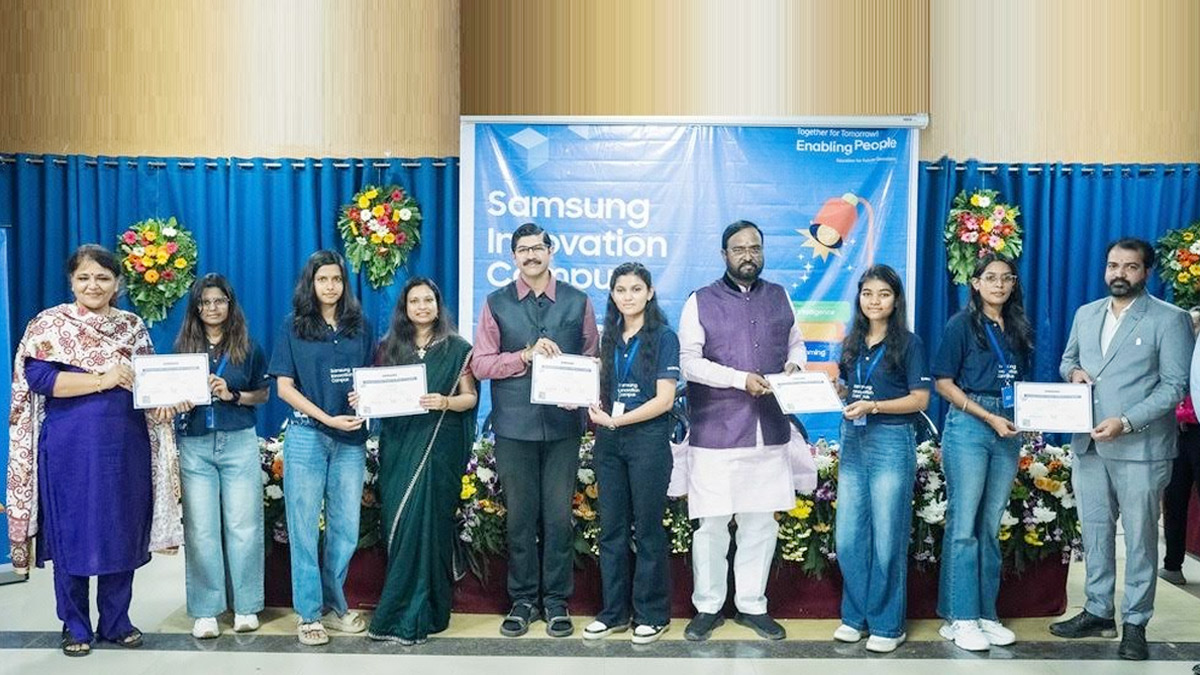
PUNE: Samsung has put 1,000 students in Maharashtra through a certified training programme in artificial intelligence and coding, the largest such drive the South Korean electronics company has run in the state and a signal that corporate India’s skilling ambitions are moving well beyond the boardroom brochure.
The certifications were awarded under Samsung Innovation Campus (SIC), the company’s flagship corporate social responsibility programme, which launched in India in 2022 with the stated aim of democratising access to future-technology education. The 1,000 graduates were drawn from four institutions: 127 from Savitribai Phule Pune University, 373 from Pimpri Chinchwad University, 250 from D.Y. Patil University’s Ramrao Adik Institute of Technology and 250 from Anjuman-I-Islam’s Kalsekar Technical Campus. All completed training in either AI or coding and programming, the two disciplines Samsung has identified as the critical pillars of the digital economy.
The programme does not stop at technical training. Soft-skills development and career-readiness modules are baked into the curriculum, a deliberate attempt to close the gap between what universities teach and what employers actually want.
“India’s digital growth story will ultimately be shaped by the quality of its talent pipeline,” said Shubham Mukherjee, head of CSR and corporate communications at Samsung Southwest Asia. “As technologies like AI move from the periphery to the core of industries, skilling must evolve from basic training to building real-world capability. This milestone in Maharashtra reflects how industry and academia can come together to create a future-ready workforce that is both globally competitive and locally relevant.”
The Maharashtra drive sits within a rapidly scaling national effort. Samsung Innovation Campus trained 20,000 young people across India in 2025, hitting its stated target for the year. Women account for 48 per cent of national enrolments, a figure the company cites as evidence of its push for an inclusive technology ecosystem. The programme is implemented in partnership with the Electronics Sector Skills Council of India and the Telecom Sector Skill Council.
Samsung, which is marking 30 years in India this year, runs SIC alongside two other initiatives, Samsung Solve for Tomorrow and Samsung DOST, as part of a broader effort to build what it calls a generation of innovators with both the technical depth and the problem-solving mindset to thrive in a fast-moving digital world.
A thousand certified students is a tidy headline. Whether they find jobs that match their new skills is the harder question, and the one that will ultimately determine whether corporate skilling programmes like this one are genuine pipelines or well-photographed gestures.






