Brands
DB Corp higher PAT on higher print, radio, and digital media ad revenue, business adjustments in FY-2014


BENGALURU: DB Corp Limited (DB Corp), home to flagship newspapers Dainik Bhaskar, Divya Bhaskar, Dainik Divya Marathi and Saurashtra Samachar reported improved results in Q4-2014 and its board has recommended a final dividend of Rs 4.25 per share for FY-2014.
Note: (1) Rs 100 lakh = Rs100,00,000 = Rs 1 crore = Rs 10 million.

The company reported a higher PAT at Rs 306.6 crore in FY-2014 as compared to the Rs 218.1 crore in FY-2013, which includes a onetime tax gain of Rs 14.9 crore, on account of demerger of digital media business.
The company says that its FY-2014 consolidated advertising revenue grew by 17.4 per cent to Rs 1417.8 crore as against Rs1270.5 crore is FY-2013. The company says further that its radio business ad revenue grew by 19.2 per cent to Rs 80.1 crore from Rs 67.2 crore in FY-2013 and that its digital media ad revenue grew by about 54 per cent to Rs16.3 crore in Fy-2014 from Rs10.8 crore in FY-2013.
Let us look at the figures for FY-2014 and Q4-2014 reported by DB Corp
DB Corp’s Total Operating Income (Op Inc) in FY-2014 at Rs1895.76 crore was 16.8 per cent more than the Rs 1592.32 crore in FY-2013. Q4-2014 Op Inc at Rs 454.17 crore was (-12.36) per cent lower than the Rs 518.20 crore in Q3-2014 and 14.08 per cent more than the Rs 398.10 crore in the last year quarter Q4-2013.
Total Expense (Tot Exp) in FY-2014 at Rs 1423.72 crore was 11.94 per cent more than the Rs 1271.91 crore in FY-2013. In Q4-2014, Tot Exp at Rs 366.02 crore was (-3.48) per cent lower than the Rs 379.21 crore in Q3-2014 and 14.67 per cent more than the Rs 319.19 crore in Q4-2013.
Raw Material consumption (RM cost) forms a major portion of DB Corp’s expense (Between 33 and 37 per cent of Tot Inc). In FY-2014, DB Corp’s RM cost at Rs 632.95 crore (34.03 per cent of Op Inc) was 16.4 per cent more than the Rs 544.54 crore (34.20 per cent of Op Inc) in FY-2013. RM cost in Q4-2014 at Rs 166.59 crore (36.68 per cent of Op Inc) was (-3.37) per cent lower than the Rs 172.41 crore (33.27 per cent of Op Inc) in the immediate trailing quarter Q3-2014 and 24.57 per cent more than the Rs133.74 crore (33.57 per cent of Op Inc) in the corresponding quarter of last year.
PAT in FY-2014 at Rs 306.64 crore (16.49 per cent of Op Inc) was 40.58 per cent more than the Rs 218.14 crore (13.7 per cent of Op Inc) in FY-2013. In Q4-2014, PAT at Rs 7.59 crore (1.67 per cent of Op Inc) was 1.67 per cent more than the Rs 9.45 crore (1.82 per cent of Op Inc) in Q3-2014 and (-86.26) per cent less than the Rs 55.26 crore (13.88 per cent of PAT) in Q4-2013.
Segment Results
Printing and Publishing of Newspaper and Periodicals segment
Printing and Publishing of Newspaper and Periodicals (Printing) segment contributes more than 94 per cent to DB Corp’s total revenue. During FY-2014, Printing segment revenue of Rs 1762.16 crore (94.75 per cent of Op Inc) was 17.02 per cent more than the Rs 1505.86 crore (94.57 per cent of Op Inc) in FY-2013. Printing segment revenue in Q4-2014 at Rs 421.21 crore (94.28 per cent of Op Inc) was (-12.37) per cent lower than the Rs 488.63 crore in Q3-2014 and 13.87 per cent more than the Rs 376.06 crore (94.46 per cent of Op Inc) in Q4-2013.
DB Corp’s Printing segment results in FY-2014 at Rs 458.9 crore was 32.63 per cent more than the Rs 345.97 crore in FY-2013. The company’s Q4-2014 result at Rs 95.5 crore was (-32.38) per cent less than the Rs 488.63 crore in Q3-2014 and 2.35 per cent more than the Rs 93.31 crore in Q4-2013.
Radio Business segment
DB Corp’s radio segment reported revenue of Rs 79.45 crore (4.27 per cent of Op Inc) in FY-2014 was 19.2 per cent more than the Rs 66.65 crore (4.19 per cent of Op Inc) in FY-2013. This segment’s Op Inc in Q4-2014 at Rs 21.37 crore (4.99 per cent of Op Inc) was (-10.28) per cent lower than the Rs 23.83 crore (4.88 per cent of Op Inc) in Q3-2014 and 17 per cent more than the Rs18.27 crore (4.59 per cent of Op Inc) in Q4-2013.
This segment returned a positive result of Rs 20.56 crore in FY-2014 which was 89.18 per cent more than the Rs 10.87 crore in FY-2013. In Q4-2014, DB Corp’s radio business reported a result of Rs 7.19 crore which was (-15.47) per cent less than the Rs 8.51 crore in Q3-2014 and 75.73 per cent more than the Rs 4.09 crore in Q4-2014.
The other segments –events, internet and power have reported very low numbers and have eroded the profits generated by DB Corp’s Printing and Radio business segments.
DB Corp managing director Sudhir Agarwal, said, “We have delivered a robust operating performance this year amidst a challenging market environment. Our focus on sustaining and extending leadership in core markets, consistent focus on operational efficiencies as well as strong performance across non-print segments have enabled us to report significant growth.
The Bhaskar way of journalism places the reader at the center. Our growth strategy revolves around this philosophy and as we have successfully done in the past – we have ensured that our strategies combine ‘knowledge enhancement’ for the reader and ‘product differentiation’ towards growth. Therefore, our earlier associations with leading media brands for exclusive, unique content have started delivering exciting results. This quarter, we re-aligned our corporate sales and marketing strategy supported by key senior management appointments – with the aim of providing greater focus to advertisers at every state level. Our Un-Metro – Markets Driving India initiative extensively analysed the potential of high-growth non-metro regions with inspiring participation by marketing stalwarts across Bengaluru, Mumbai and New Delhi, have also contributed significantly towards broadening our horizons. Our Bihar-Patna launch was an exciting challenge in that region and we are encouraged by an overwhelming response and wide acceptance; while our progress in Maharashtra continues well on course.
DBCL’s non-print media segments have been making strong headway as we report commendable
developments across our digital and radio properties. We have been leveraging our leadership strengths in print media – extending our editorial excellence and deep readership insights to make steady progress across digital and radio platforms. We are excited with the potential of post Phase 3 licensing and are well poised to strengthen our radio footprint.
While the macro outlook does remain undefined, we are hopeful that, as we move towards political
certainty, the consumer sentiment will become more positive and result in better growth across sectors. I am confident that with our clear strategic focus, strong business fundamentals, superior execution capabilities supported by a talented team, we will strive towards our vision to be the largest and most admired media brand as well as active socio-economic change agents.”






Brands
Samsung certifies 1,000 Maharashtra students in AI and coding
The South Korean electronics giant marks its first large-scale skilling push in the state, with women making up nearly half the national programme’s enrolment
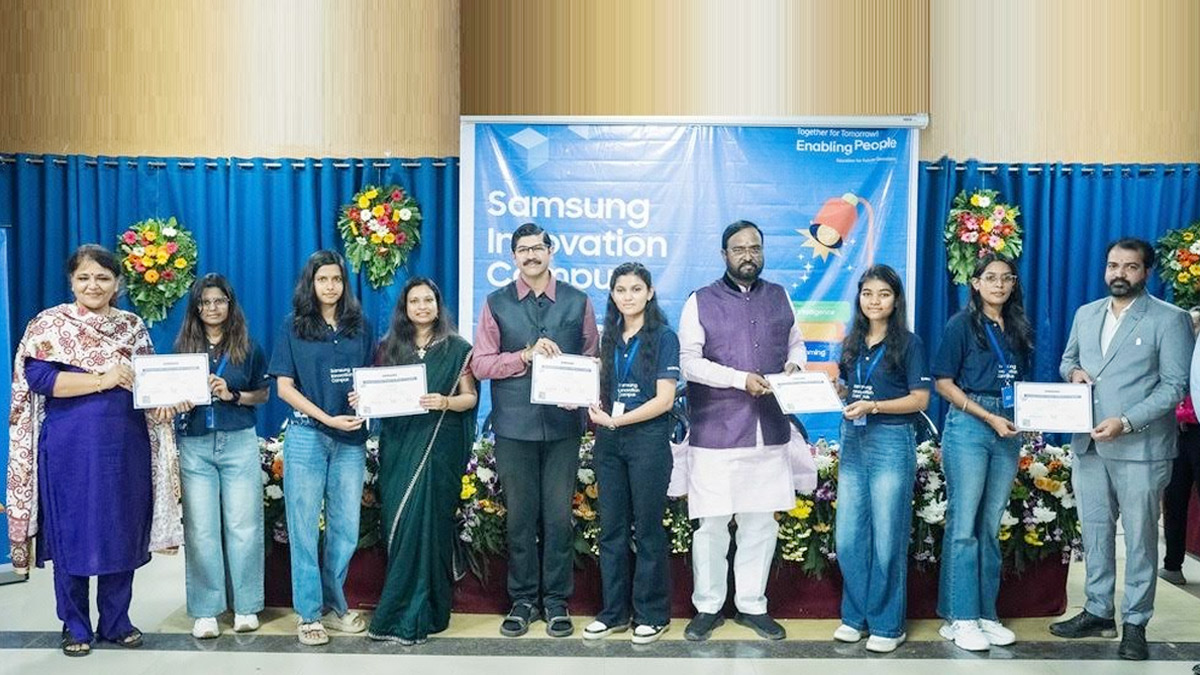
PUNE: Samsung has put 1,000 students in Maharashtra through a certified training programme in artificial intelligence and coding, the largest such drive the South Korean electronics company has run in the state and a signal that corporate India’s skilling ambitions are moving well beyond the boardroom brochure.
The certifications were awarded under Samsung Innovation Campus (SIC), the company’s flagship corporate social responsibility programme, which launched in India in 2022 with the stated aim of democratising access to future-technology education. The 1,000 graduates were drawn from four institutions: 127 from Savitribai Phule Pune University, 373 from Pimpri Chinchwad University, 250 from D.Y. Patil University’s Ramrao Adik Institute of Technology and 250 from Anjuman-I-Islam’s Kalsekar Technical Campus. All completed training in either AI or coding and programming, the two disciplines Samsung has identified as the critical pillars of the digital economy.
The programme does not stop at technical training. Soft-skills development and career-readiness modules are baked into the curriculum, a deliberate attempt to close the gap between what universities teach and what employers actually want.
“India’s digital growth story will ultimately be shaped by the quality of its talent pipeline,” said Shubham Mukherjee, head of CSR and corporate communications at Samsung Southwest Asia. “As technologies like AI move from the periphery to the core of industries, skilling must evolve from basic training to building real-world capability. This milestone in Maharashtra reflects how industry and academia can come together to create a future-ready workforce that is both globally competitive and locally relevant.”
The Maharashtra drive sits within a rapidly scaling national effort. Samsung Innovation Campus trained 20,000 young people across India in 2025, hitting its stated target for the year. Women account for 48 per cent of national enrolments, a figure the company cites as evidence of its push for an inclusive technology ecosystem. The programme is implemented in partnership with the Electronics Sector Skills Council of India and the Telecom Sector Skill Council.
Samsung, which is marking 30 years in India this year, runs SIC alongside two other initiatives, Samsung Solve for Tomorrow and Samsung DOST, as part of a broader effort to build what it calls a generation of innovators with both the technical depth and the problem-solving mindset to thrive in a fast-moving digital world.
A thousand certified students is a tidy headline. Whether they find jobs that match their new skills is the harder question, and the one that will ultimately determine whether corporate skilling programmes like this one are genuine pipelines or well-photographed gestures.






