Brands
Dabur dons Kovirakshak kit, as ASCI doffs Chyawanprash ad

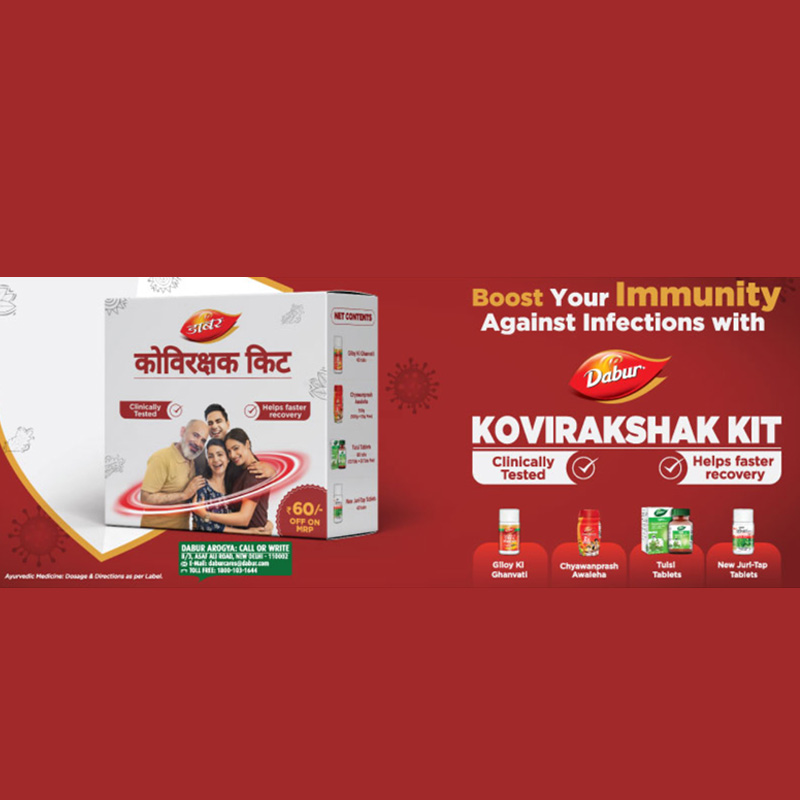
Mumbai: India’s leading FMCG major Dabur India Limited Tuesday announced the launch of Dabur Kovirakshak Kit that includes Chyawanprash, Giloy, Tulsi and Juri-Tap products.
A company message said the product is “A combination of time-trusted ayurvedic medicines to help in faster recovery from ongoing respiratory infections. Dabur KoviRakshak Kit was developed and launched based on (the) Indian Council of Medical Research (ICMR) guidelines and after (a) thorough study on infected patients”, the company has claimed.
@DaburIndia launches ‘Dabur Kovi Rakshak Kit’, a combination of time-trusted Ayurvedic Medicines that help in faster recovery from ongoing respiratory infections. #Dabur #KoviRakshakKit has been developed, launched based on ICMR guidelines and thorough study on infected patients. pic.twitter.com/N4MBnC1MXo
— Dabur India Ltd (@DaburIndia) May 25, 2021
The company’s website also prominently claims: “Get your Dabur Kovirakshak kit – As part of our commitment to fight the COVID-19 pandemic, Dabur is distributing free Kovirakshak kits to the first 200 people who register with us. Sign up to get your immunity shield.”

The new audience interactive advertisement comes only a day after the Advertising Standards Council of India (ASCI) pulled up the brand for making misleading claims through its advertisement for Dabur Chyawanprash. ASCI had asked the ayurveda major to modify or withdraw the Chyawanprash ad that claimed to offer protection against the Corona virus. The print ad published in March this year claimed that taking two spoons of the product daily provided protection against COVID-19.
ASCI secretary general Manisha Kapoor told IndianTelevision that while she’s yet to see the new Dabur Kovirakshak ad, “Each product and advertisement will have to be examined on its own merit, if they are able to prove what they are claiming then its fine.” She added that they have not received any complaint about the newer advertisement so far.
The ad featuring actor Akshay Kumar stated that the claim is backed by “clinical studies conducted in 5 centres”.

The advertisement ran into controversy on social media after several people tagged ASCI to look into the matter. Brand consultant & strategist, Ambi Parameswaran had also tweeted and alerted ASCI about a possible violation:
Alerting @ascionline ! How reliable and valid is the study @DaburIndia is quoting? Please find out and pass your verdict. @rameshnarayan @skswamy @beastoftraal @calamur @bhatnaturally Two spoons vs Two shots of vaccine? pic.twitter.com/UgKAc2MZxn
— Ambi Parameswaran (@ambimgp) March 26, 2021
ASCI launched an investigation after a formal complaint was lodged and noted, “Dabur Chyawanprash has immunity building properties, however, it is not established whether the product could protect one against (the) Corona virus.”
In its report to Dabur, as reported by online media afaqs, ASCI stated that the claim made in the advertisement “could be construed literally by an ordinary consumer, that consuming the product would protect one from COVID-19”. Following the investigation of reports and data provided by Dabur, the Consumer Complaints Council (CCC) of ASCI in turn maintained that the “claim is misleading by ambiguity and exaggeration and is likely to lead to widespread disappointment in the minds of consumers.”
ASCI has advised Dabur to suitably modify or withdraw the advertisement by June 4, 2021.
The ad had attracted major trolling on social media after its brand ambassador Akshay Kumar announced that he has tested positive for covid-19.
— Akshay Kumar (@akshaykumar) April 4, 2021
The irony of the situation was not lost on net users who trolled the brand as well as the actor over the apparently false COVID-19-protection claims.
A section of the online community had also red flagged the actor and the company for being reckless while promoting products through incorrect claims.
#AkshayKumar becomes #Coronapositive .
But, isn’t he one who advertises a chyawanprash promising protection against #COVIDー19 ?
Will advertising council now make the actor announce that he doesn’t consume the product?#dabur#coronavirus#@ascionline @DaburIndia pic.twitter.com/t1eHl6TYj3— Adwait Ainapure (@adwaitainapure) April 4, 2021
While the Covid-19 outbreak has brought some businesses to a grinding halt, it has also served as a business opportunity for others. Several FMCG giants cashed in on the health-related fear induced into the general public by the pandemic by launching a plethora of immunity-boosting products ranging from beverages comprising of juice, tea, coffee to probiotic shots and supplements in capsule form, mixes and powder, even food items.
The Indian Immunity Boosting Packaged Products Market is projected to reach $ 347 million by FY 2026, as per a report, owing to increasing consciousness and focus among Indian consumers towards sickness preventing health foods.
Major players operating in the immunity boosting packaged products market include The Himalaya Drug Company, Dabur India Ltd., Patanjali Ayurved, among others, which have capitalised on their ayurvedic lineage. Dabur India is a remarkable case in point, with the home-grown FMCG major overhauling its go-to-market strategy.
While Brand strategist Ambi Parameshwaran believes the brand has played it safe this time by avoiding any blatant mention of COVID-19 protection in the ad copy, he still feels the product name may get it into trouble once again. He said, “Just on the basis of the name Kovirakshak Kit they can be taken to ASCI again. Rakshak in Hindi means protector, which again implies COVID-19 protection, not just immunity. So, while the copy is correct, I still have an issue with the brand name. They could be hauled up once again.”
In either case, the controversy has meant piqued audience interest inadvertently for a second time, not necessarily in the interest of public health. Bad publicity is also good for publicity.