AD Agencies
Contract Advertising wins the mandate for Haldiram’s


Mumbai: In a strategic partnership with Wunderman Thompson, Contract Advertising has won the mandate for Haldiram’s, an Indian multinational sweets and savouries company headquartered in Delhi.
The mandate was awarded to Contract Advertising India after a multi-agency pitch in which about 16 agencies participated. Contract Mumbai will handle the account.
Haldiram’s has manufacturing plants in several states of India, including UP, Uttarakhand, Haryana, Bihar, J&K, and Guwahati. A plant is also located in the UK.

The mandate includes brand strategy and creatives for the domestic market, the export market, and retail/QSRs.
Welcoming Contract Advertising, Haldiram’s managing director Pankaj Agarwal said, “Haldiram’s has always been trusted for their quality offerings. As a key player in the snack, sweets, and restaurant sectors, we are known to generate excitement amongst the consumers. We, as a brand, are constantly innovating and trying to raise our high-quality standards. To make consumers aware of our wide brand portfolio, we needed an advertising agency that understood our constant rise and the consumer’s changing mindsets. And that is why we are excited to partner with Contract Advertising to build effective marketing communications and reach new heights.”
Adding to this, Divya Batra marketing head Haldiram’s commented, “Over the years, Haldiram’s has expanded its range from traditional namkeens to western snacks, frozen snacks, ready to eat, ready to cook, chocolates, and many more food categories. To communicate the same to our consumers, we needed an agency passionate about reaching and engaging with consumers impactfully. After an extensive process and multiple pitch rounds, we are exhilarated to partner with Contract. Together with the data & consumer insights approach, we target to build effective marketing communication and increase brand footprint.”
Started in 1937 in Bikaner, today, Haldiram’s is a household name across multiple states in India. It also supplies 400 plus SKUs internationally, with its trademark being registered in 80 countries, spanning six continents. The company is famous across the globe and is available at various international stores such as Walmart, Tesco, Spinney’s, Carrefour, Metcash, Costco, Woolworth, etc.
“Haldiram’s is an iconic brand, and it is a household name in India. We are proud of being the agency that has been given the responsibility to craft the narrative for this brand in India and abroad,” added Contract Mumbai EVP and general manager Ayan Chakraborty.
Contract Mumbai SVP and executive creative director Rahul Ghosh commented, “At Contract, we have a bit of history with Made in India powerhouses. Haldiram’s is one such global success story. Getting to work on the narrative of this iconic brand is the kind of challenge that is a part of our DNA.”






AD Agencies
Kevin Vaz opens FICCI-EY report with a declaration: India’s M&E industry set to breach Rs 3 trillion mark by 2027
In a keynote address at the FICCI-EY report launch, Kevin Vaz says sport, AI and the connected TV boom are driving a multi-screen revolution with no signs of slowing
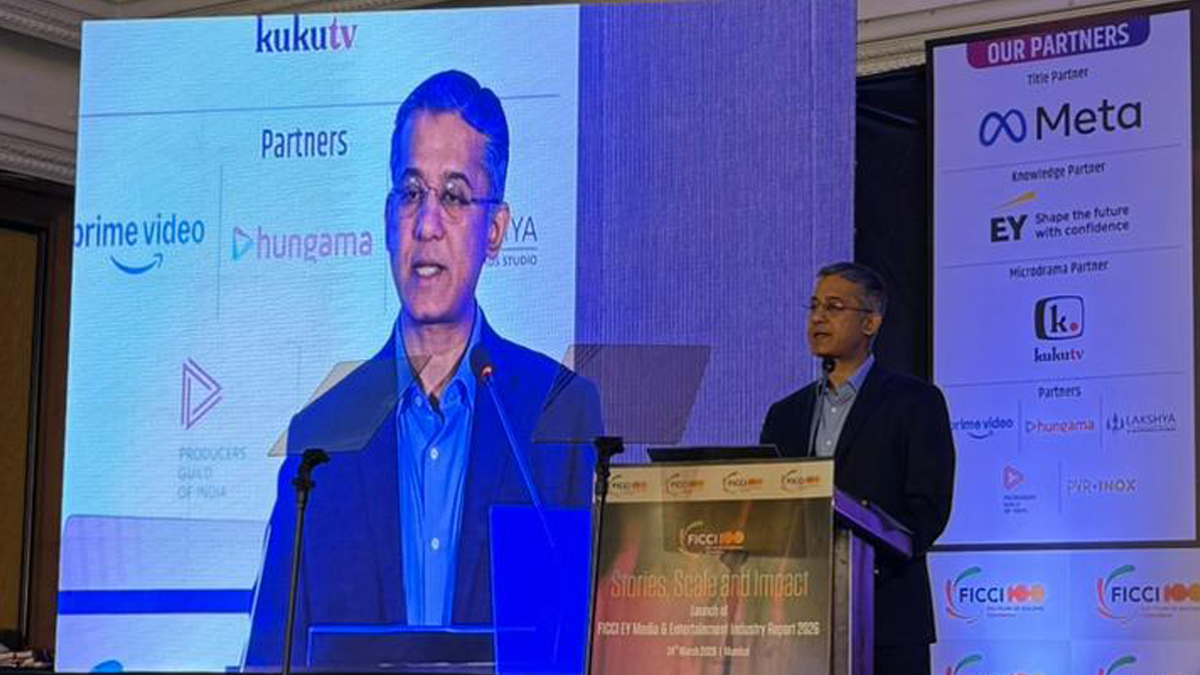
MUMBAI: India’s media and entertainment industry is growing faster than the economy, reshaping global benchmarks and is on course to blow past Rs 3 trillion by 2027. That was the headline message from Kevin Vaz, chairman of the FICCI Media and Entertainment Committee and chief executive of entertainment at JioStar, who delivered the opening keynote at the launch of the FICCI-EY Media and Entertainment Report 2026 in Mumbai on Monday. He did not waste much time on caveats.
The industry hit Rs 2.78 trillion in 2025, outpacing GDP per capita growth and surpassing even last year’s bullish forecasts. Vaz described the year in three words: scale, convergence, transformation. The numbers, he suggested, were only half the story. The other half was how that growth was happening.
Digital has become the industry’s largest segment, driven by advertising, subscriptions and commerce. But Vaz was quick to puncture the familiar narrative of digital killing everything else. India, he argued, is not an either-or market. It is an AND market. Connected TV is surging. Linear television, mobile, films and print are all still expanding. AVGC, the animation, visual effects, gaming and comics sector, is emerging as a serious growth engine, opening new storytelling formats and new global revenue streams. Nothing, he said, is replacing anything. Everything is reinforcing everything else.
Nowhere is that more vivid than in sport. In an on-demand world where audiences can watch anything, anytime, Indians still show up live. “Sports don’t fragment audiences,” Vaz said. “They unite them, just on different screens.” The ICC Men’s T20 World Cup 2026 made the point emphatically. During the final, JioHotstar delivered 72.5 million concurrent streams, a global record. Group chats exploded. Families renegotiated control of the television. Advertisers, Vaz noted with undisguised relish, stopped asking where audiences were and started asking how fast they could get in.
Cinema had its own landmark year. More than 1,900 films were released, with several crossing the Rs 1 billion mark. Dhurandhar was singled out as proof that Indian audiences will still turn up in large numbers for content that grips them. Live experiences, too, are getting bigger and more immersive, though Vaz suggested the surface has barely been scratched.
Then there is artificial intelligence, which he described as quietly, and sometimes not so quietly, reshaping everything. AI is enabling personalisation, efficiency and scale, but Vaz argued its deeper significance lies in what it is doing to creativity itself. He pointed to Mahabharat: Ek Dharmayudh, billed as the world’s first AI-produced show, as evidence that the technology can amplify creative ambition rather than hollow it out. He also used the platform to call on Indian policymakers to engage seriously with the creative industry on AI and copyright, ensuring that creators are fairly compensated as the technology spreads.
The picture that emerges from the report, and from Vaz’s keynote, is of an industry that has stopped thinking of itself as a fast-growing emerging market and started thinking of itself as a global template. Scale, diversity and innovation, he said, are no longer in tension in India. They are coexisting, and the rest of the world is taking notes.
The Rs 3 trillion milestone is two years away. As the man who chairs the committee that shapes the industry’s policy agenda and runs the country’s most powerful entertainment platform, Vaz set the tone for the day with characteristic directness: India’s media business is not just chasing growth. It is deciding what the country talks about at dinner. That is a different kind of power altogether.








