Brands
Can India become a sports merchandising haven?

MUMBAI: The entire business fraternity in India gets buoyed by 500 plus cumulative reach of a sporting event or a movie grossing over Rs 300 crore, but hardly puts any effort in translating this success into other formats. One of the most reached sporting event in India, the Indian Premier League (IPL) over eight years of operation, faltered to develop the merchandising business in India. The story is quite similar in movies too. Star Wars holds the record of largest selling merchandises in movies as it has garnered $12 billion over the years and is still evolving. Indian super hero movies like Krrish and Ra:One hardly managed to scratch the surface of the huge merchandising industry.
Since last year, PUMA has been pumping some much needed energy into the dormant merchandising industry in India. The sports apparel giant signed a five year deal for approximately $51 million per year with London based English Premier League (EPL) football club Arsenal FC in 2014. Arsenal is ranked seventh in the list of top Soccer team valuations, which is lead by Spanish giants Real Madrid FC.
This year, PUMA flew all time Arsenal legends Ray Parlour and Sol Campbell to India and made them launch the Home and Away kit. A screening of historical Invincibles documentary was organised alongside road shows. Mehboob Studios in Mumbai turned into a battalion of gunners wearing red and white, welcoming the legends wholeheartedly by cheering out loud and clear.

Parlour and Campbell were mesmerised, and the eagerness in fans’ eyes to see the new kit unveiled was an encouraging sight for PUMA India managing director Abhishek Ganguly. “India holds 10 per cent of Arsenal’s social media fan base and we feel, we are stronger together. This year’s campaign is named ‘Powered By Fans,’ to make fans feel special to celebrate with them. The new kit is an elevated version of last year, more comfortable, more stylish” he said.
Speaking to Indiantelevision.com about the merchandising market in India, PUMA India executive director product and merchandising Atul Bajaj says, “The market is still at a nascent stage. However, the growth potential is huge and as long as the brands involved have synergies it is a win-win situation. Though the size of licensed merchandise globally is much bigger, the growth rate for this segment is in the range of 80-90 per cent.”
To add to PUMA’s delight, the team broke its trophy jinx by winning the FA Cup in 2014 and wearing PUMA apparel they defended it by winning again in 2015. The fans are more excited now as they believe the league title is inching closer. Sharing PUMA’s aspirations in the second year into the deal Bajaj asserts, “We expect a huge growth in this second year of our association, exceeding 200 per cent. Arsenal has a huge and loyal fanbase, the performances are great with much more to follow and to top it all we have a great merchandise range for the fans. It also helps that Indian fans comprise close to 10 per cent of overall Arsenal fans on social media.”
As can be seen below in the graph, the sports merchandising market globally grew to $20.07 billion in 2015 compared to $19.57 billion in 2014.

The other factor that predominantly hampers the merchandising industry is piracy. Substantial number of football fans are often spotted all over the country wearing club jerseys but seldom are they original. Though for PUMA the target audience is totally different, Bajaj feels knockouts do damage a brand.
He says, “While knockouts damage a brand, however in terms of business, the target group is completely different. The Arsenal fan and PUMA consumer would never want to buy or wear a cheap fake knockoff. We also have a legal cell in place, which proactively ensures that this menace is minimised.”
Merchandising is not only limited to jerseys, which is the most expensive one but other exclusive products like training kits, wrist bands and stockings used by the players also attract fans. However, brands do not pay enough attention to those, feels Arsenal’s officially recognised Delhi fan club admin Nishant Singhal.
Speaking to Indiantelevision.com, Singhal says, “Powered By Fans delight every fan and the ones that I interact with wear the official jersey of the team. The problem with merchandising is the range of products. Apart for home jerseys, it is very difficult to find anything available and I would request PUMA to change that. Special thanks to them for getting Ray Parlour and Sol Campbell in India. Pricing is not an issue as it is identical globally and people can buy online to avail many discounts.”
Speaking on the range of products, Bajaj claims, “PUMA has a complete range of Arsenal products including Replicas, fanwear, footwear, accessories and more. An Arsenal fan will have the complete range of products available to choose from and enough options to showcase his love for the club.”
Bangalore Arsenal FC official fan club admin Vinay CP is also buoyed by the fact that this year the campaign is named Powered By Fans. He oversaw the proceedings of the 2014 jersey launch. Vinay feels that PUMA is giving adequate visibility to Arsenal products. “In every PUMA store that you enter, you will see Arsenal merchandise everywhere and that’s something I like as a fan. The reason why the merchandising business is not picking up in India is because of the pricing and piracy. Still the number of original jerseys is going up substantially.”
PUMA has also tied up with Amazon India to enhance its reach. The home jerseys, which are priced at Rs 4299, can be purchased from PUMA outlets, in.Puma.com and Amazon India. “Amazon helps us reach to a far wider group of consumers and markets, which were earlier inaccessible. The ease of purchase encourages people – who either do not have access or do not want to travel, but be able to get the latest products sitting in their homes. Above all, it provides us a great platform to engage with the fans. Our event related posts on Amazon’s social media for example drove top tier engagement rates,” adds Bajaj.
Baseline co-founder and director R Ramakrishnan feels that in India, merchandising and licensing has huge growth potential. “India is a lucrative market and that’s why PUMA is aggressively promoting Arsenal merchandises by getting in legends in the country. Football merchandising is always a style quotient, the jerseys are always elegantly designed with one title sponsor on it, which one can wear and flaunt unlike those in IPL where it becomes more billboard and less apparel because of the number of sponsors. Given the youth population in the country, I think elegant merchandising will pick up in India,” he says.
A merchandising expert on condition of anonymity opines, “The merchandising partners never really ran an interactive on ground campaign be it WWE, football or cricket and hence the merchandising industry never picked up. It’s so ironical that a country like India, where cricket is considered as less sport and more religion, hardly has a substantial merchandising base. On one side, you have Sachin Tendulkar and on the other side Michael Jordan or Kobe Bryant. India never took merchandising seriously. PUMA is bringing in what was missing in merchandising industry, they got in Arsenal legends, organised a road show, screened Invincibles for the first time in Asia and that’s the way ahead. They have already started putting hoardings on prime locations. As a well wisher of the merchandising industry I feel all the licensed partners should put in more efforts and rejuvenate the industry.”
IPL chairman Rajiv Shukla in the recent past had said that the BCCI will sell IPL merchandise centrally to boost up the sector. Seven out of the eight teams agreed to that, whereas Kolkata Knight Riders (KKR) decided to sell their merchandise separately as they already invested a lot in developing the business. Overall, it remains to be seen if other big names will also join in and contribute to what PUMA has started for the merchandising industry in India to pick pace and reach its potential.






Brands
Lotus Herbals unveils HydroActivated sunscreen with high-impact campaign
Harnaaz Sandhu fronts digital push spotlighting breakthrough sun care tech
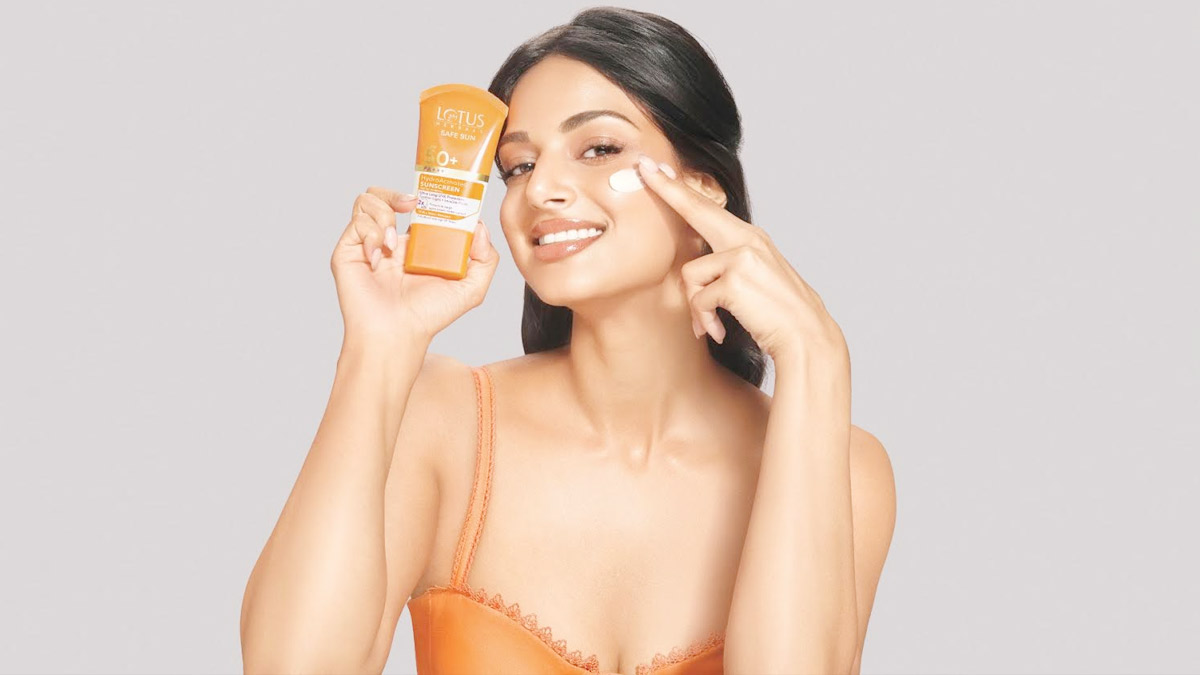
MUMBAI: Lotus Herbals has rolled out a high-decibel marketing campaign to introduce what it calls India’s first hydro-activated sunscreen, aiming to reshape how consumers think about sun protection.
At the centre of the launch is the Safe Sun HydroActivated Sunscreen SPF 50+ PA+++, a formulation built on a patent-pending Hydrosome Technology that activates on contact with moisture. Unlike conventional sunscreens that can weaken with sweat, this product is designed to do the opposite, boosting protection when the skin is exposed to water or perspiration.
The campaign is led by Harnaaz Sandhu and is being amplified across OTT platforms, social media and outdoor locations in key metro cities. The brand film takes a light, relatable approach to everyday sunscreen struggles such as uneven application and fading protection, while positioning the new product as a reliable, high-performance alternative for active lifestyles.
Beyond its core technology, the sunscreen features next-generation UV filters and Edelweiss Flower Extract, offering hydration alongside protection. The formula claims up to 10 hours of water resistance and even, all-round defence against sun exposure and tanning, targeting consumers who want both skincare and performance in one product.
Speaking about the launch, Lotus Herbals chairman and managing director Nitin Passi said, “We are excited to launch India’s first sunscreen with hydroactivated technology which is our most innovative product launch. This isn’t just a sunscreen; it’s a technological breakthrough that utilises a novel manufacturing process. We’ve created a product that stays invisible on the skin yet becomes a performance powerhouse when the user is most active.”
Sharing her experience, Lotus Herbals brand ambassador Harnaaz Sandhu said, “I am thrilled to be associated with Lotus Herbals Safe Sun for their new sun protection campaign. In my world, there is no room for shortcuts, and I need functional and reliable products that work as hard as I do. The hydroactivated sunscreen is a game-changer because it blends with my skin and protects me better when I’m pushing my limits.”
The campaign is being distributed across platforms including JioStar connected TV integrations and ZEE5, along with television placements such as Sa Re Ga Ma Pa in West Bengal. A large influencer push involving over a thousand creators, along with in-store branding and retail activations, is also part of the rollout.
With a blend of science-led positioning and mass-market storytelling, Lotus Herbals is betting on innovation to stand out in the crowded sun care segment, hoping its moisture-powered promise strikes the right chord with today’s always-on consumers.






