AD Agencies
Breaking the ad code ASCI Global Adda 2025 sparks bold brand conversations

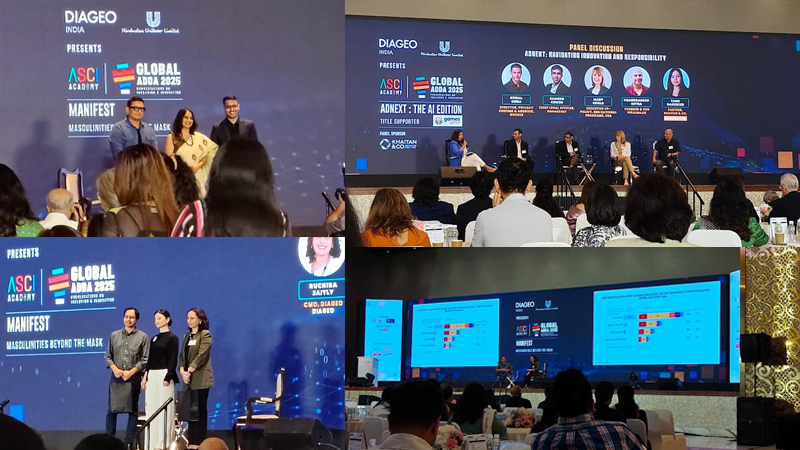
MUMBAI: Advertising isn’t just about selling products anymore, it’s about shaping the world we live in. That was the resounding message at Asci Global Adda 2025, where industry leaders, marketing pioneers, and policy experts gathered to discuss the power of advertising to drive meaningful change. From redefining masculinity in Indian media to harnessing AI’s potential responsibly, the event sparked thought-provoking discussions on the evolving role of brands in an increasingly complex digital world.
Masculinity in advertising is getting a reality check, The event kicked off with a powerful discussion on gender representation in Indian advertising with the unveiling of Manifest: Masculinities Beyond the Mask. The report, presented by Arvind Mohan of Religious Brands, explored how masculinity has evolved in Indian media and the advertising industry’s role in shaping it.
Taking the conversation further, renowned mythologist Devdutt Pattanaik analysed how traditional archetypes of masculinity rooted in mythology and historical narratives continue to influence modern media. He argued that while Indian advertising has made progress in challenging outdated gender roles, the industry still has a long way to go in truly redefining masculinity for contemporary audiences.


A panel discussion followed, featuring actor Abhishek Banerjee, filmmaker Paromita Vohra, and Unilever’s Anila Vinayak. They debated whether advertising should simply reflect societal changes or actively drive progress. With Indian cinema still dominated by hyper-masculine narratives (like Kabir Singh and Animal), the advertising industry faces a critical choice, should it play it safe or push for progressive storytelling?
The consensus? Stereotypes might sell, but inclusivity builds long-term brand loyalty. As the panelists pointed out, modern audiences—especially Gen Z—are demanding more authentic, diverse, and inclusive portrayals of gender in advertising.
How brands Can Drive Real Change? Well, brands have immense power in shaping culture, but inclusivity in advertising must go beyond token gestures. That was the key takeaway from the Insights & Action: Brand Case Studies session, featuring Diageo India’s Ruchira Jaitly and L&K Saatchi & Saatchi’s Kartik Smetacek.
Jaitly highlighted Diageo’s commitment to unstereotyping, showcasing campaigns that do more than just tick diversity checkboxes. For example, Royal Challenge’s gender-equitable jersey campaign broke stereotypes in sports marketing, while Johnnie Walker’s ‘Keep Walking’ campaign told stories of resilience and reinvention that resonated across diverse identities.

“We’re not just talking about representation,” Jaitly stated. “It’s about depth, agency, and authentic storytelling—because consumers can see through empty gestures.”
Joining the discussion, Bajaj Auto’s Sumeet Narang and Ogilvy’s Sukesh Nayak explored how brands can strike the right balance between mass appeal and progressive storytelling. In a country where traditional masculinity still dominates pop culture, brands must navigate the fine line between commercial success and meaningful representation.
The discussion underscored that progressive storytelling isn’t just ethical, it’s profitable. Diageo’s research with Kantar and Asci revealed that ads promoting inclusivity drive higher brand distinctiveness, purchase intent, and long-term sales. However, the challenge lies in ensuring authenticity, as performative inclusivity can backfire and damage a brand’s credibility.
As the day progressed, the spotlight turned to AdNext: The AI Edition, a deep dive into how artificial intelligence is reshaping the advertising industry.
Kunal Guha (Google) set the tone, describing AI as both “overhyped and underappreciated”. He compared it to having “the world’s greatest polymath in your pocket”, a tool that enhances human creativity, decision-making, and efficiency at an unprecedented speed.
But with great power comes great responsibility. Sameer Chugh (Games24x7) raised concerns about AI-driven hyper-personalisation, warning that while AI can enhance consumer experiences, it also poses risks from privacy violations to manipulative targeting.
Meanwhile, Mary K Engle (BBB National Programs, US) highlighted the urgent need for self-regulation in AI-driven advertising, arguing that proactive industry standards must be established before government intervention becomes inevitable.

One of the most heated debates of the day revolved around whether AI-generated content should be labelled.
While panelists agreed that AI-generated content in high-risk industries (like healthcare and finance) should be clearly labelled, they cautioned against over-labeling in advertising. Excessive disclaimers could create consumer fatigue, making audiences less likely to trust AI-generated content altogether.
AI is set to contribute nearly $1 trillion to India’s digital economy, but for India to lead globally, panelists emphasised the need for strong collaboration between businesses, regulators, and policymakers.
To truly harness AI’s potential, the advertising industry must prioritise the development of ethical AI frameworks that strike a balance between innovation and responsibility, ensuring that technological advancements do not come at the cost of consumer trust. Additionally, AI literacy among consumers must be actively promoted, helping them understand how AI-driven content and recommendations work, thereby fostering greater transparency and trust in digital interactions. Equally important is the commitment to inclusive, unbiased AI-driven advertising, ensuring that automated decision-making does not reinforce stereotypes or exclude marginalised voices. By integrating these principles, the industry can leverage AI’s transformative power while maintaining ethical integrity and consumer confidence.
Whether it was Diageo’s commitment to breaking gender stereotypes in advertising or the transformative role of AI in reshaping marketing strategies, Asci Global Adda 2025 made one resounding point, brands are no longer just selling products; they are actively shaping the world we live in. The discussions at the event underscored how companies must move beyond traditional storytelling and embrace purpose-driven marketing to connect meaningfully with modern consumers. With AI becoming the driving force behind hyper-personalised advertising, ethical considerations around transparency, bias, and consumer trust took centre stage. Industry leaders agreed that AI is as disruptive as the internet was in its early days, bringing both unprecedented opportunities and complex challenges.
As Tanu Banerjee of Khaitan & Co. aptly put it, “AI is the new internet, we must decide now how we want it to shape our lives.”
This powerful statement highlighted the urgency for businesses to take proactive steps in defining ethical AI frameworks, ensuring inclusive narratives, and fostering consumer education to build trust in AI-powered advertising. With marketing standing at a pivotal crossroads, the question remains: will brands take charge and lead this transformation, or risk being left behind? Judging by the insights and commitments made at Asci Global Adda 2025, the industry is already racing towards a future where innovation and responsibility must go hand in hand.






AD Agencies
Tribes and Omnicom Media win Gold for HSBC Living Hexagon at ET Awards
Kinetic OOH installation turns HSBC’s iconic logo into a living landmark

MUMBAI: Tribes Communication and Omnicom Media have secured a Gold win at the ET Design & Creativity Awards for their innovative out-of-home installation, The Living Hexagon, created for HSBC.
Awarded in the Most Creative Traditional OOH category, the project reimagines one of the world’s most recognisable banking symbols into a dynamic, ever-evolving structure. Designed for HSBC’s International Financial Services Centre presence, the installation was conceived to do more than simply grab attention. It aimed to seamlessly blend into the fast-growing ecosystem of GIFT City.
At the heart of the idea is HSBC’s iconic hexagon, typically associated with precision and consistency. Tribes transformed this static identity into a kinetic structure that responds to natural elements such as wind and light, creating a sense of continuous motion. The result is a visual experience that shifts throughout the day, echoing themes of adaptability and momentum.
Constructed using modular triangular units arranged along a precise geometric axis, the installation moves in synchrony, giving the illusion of a fluid, living form. While the structure evolves with its surroundings, it retains the unmistakable identity of the HSBC brand, striking a balance between innovation and familiarity.
Strategically placed at a key entry point into GIFT City, the installation functions as both a landmark and a statement. It reflects the pace and dynamism of global finance while embedding the brand into the city’s architectural narrative.
With this win, Tribes Communication and Omnicom Media underline the growing role of experiential and design-led thinking in traditional media, proving that even the most established brand assets can find new life when reimagined with creativity and context.







