MAM
Brands unveil their inner cupid ahead of Valentine’s Day


Mumbai: Love is in the air.. it is on your smartphone screen.. it is on the biggest hoardings, it is everywhere! It is that time of the year when romance takes centre-stage and whether one likes it or not, one cannot escape the blitzkrieg of mushiness coming our way. This Valentine’s Day, brands rekindle the love with their consumers with something for everyone- from singletons to pet parents, and of course, for the lovebirds, as they try to break away from the traditional and clichéd V-day concepts.
Here are some that caught our eye:
Mondelez India

Recognising the reality that with V-day just around the corner there are going to be two kinds of people – The ones in love and the ones who are sick of the ones in love aka, The singles, chocolate company, Mondelez India’s two major brands have launched campaigns that are at loggerheads too! So, on one hand, we have Cadbury Dairy catering to those in love and on the opposite end, there is Cadbury 5 Star cheering on and backing the singles with two innovative tech-savvy campaigns.
Cadbury Dairy Milk Silk
Conceptualised by Ogilvy, Cadbury Dairy Milk Silk’s ‘How Far Will You Go To Make Them Blush’ campaign set to its popular jingle, aims to get young hearts aflutter across the country with a special pack- QR Codes on the Silk Valentines’ Day packs, that lead consumers to a microsite where they can create and share custom messages with their special someone.
In a first, the brand has introduced real-time personalisation of augmented reality experience with help from its tech partner, 8th Wall, that enables consumers to unlock the advert to see custom messages sent by their loved ones in a fully immersive 360-degree virtual environment. By scanning any Cadbury Dairy Milk Silk hoarding, print advertisement etc with the special AR filter, the receiver will be able to see the secret message come alive on the ad.
Cadbury 5 Star
On the other hand, Cadbury 5 Star has launched an innovative campaign that attempts to save singles from the dreaded question – ‘What Are You Doing on Valentine’s Day?’. The brand has planned the perfect getaway for them by crafting ‘The Perfect Alibi’ campaign. For this, the brand has gone to the extent of taking over an island located off the coast of Karnataka and renamed it ‘My Cousin’s Wedding’ – as the perfect alibi for singles looking to get away from the pressure of having a Valentine or of going on a date. Consumers can join the fun by scanning the special Valentine’s Day Cadbury 5 Star packs, which will give them a chance to win a trip to the Island to enjoy a host of ‘Do-Nothing’ experiences.
Skinn by Titan
Skinn, a fine fragrance brand from the house of Titan, released a digital film featuring the Bollywood actor Sanya Malhotra and upcoming OTT star Suhail Nayyar on the special occasion. Conceptualised by Ogilvy South, the #BestSaidWithSKINN campaign celebrates imperfectly perfect relationships by capturing the finer nuances of love which are not only about sparks flying in the air but more about the familiarity and deep sense of assurance that comes over a period of time.
FreshToHome
FreshToHome attempts to give a fresh spin on Valentine’s Day with its #FreshValentines campaign. The online brand in fresh fish and meat e-commerce seeks to break the V-Day stereotype by replacing traditional and cliched ways of proposing with newer, quirky ways of expressing love. The brand’s V-Day spot showcases a sea-food-loving couple that find ways to ‘keep it fresh.’ The film has the foodie protagonist proposing with a twist- calamari rings, instead of with a regular ring. It also got food blogger Influencers to replace a bouquet of roses with a bouquet of skewered kebabs.
Mobilla
The Lifestyle and mobile accessories brand in India announced its latest brand campaign ‘Tale of Two- Trilogy’ ahead of Valentine’s day. Conceptualised by the brand’s internal creative team, and featuring digital creators Virti Vaghani and Samkit Shah the digital marketing campaign consists of three slice of life films created around light-hearted everyday moments.
PokerBaazi.com
Homegrown online poker platform from the house of Baazi Games is celebrating the season of love with its unusual campaign “Don’t Be Single, Be The Golden Single.” For this, the gaming platform added the age-old question- “What To Do on Valentine’s Day When You Are Single?” to its FAQs section and made it rewarding with a fun integration on the application. Players stand a chance to win a free ticket to the Golden Rush Tournament at the National Poker Series 2022 to be held in March.

Wiggles.in
For all the pet parents out there, the D2C preventive pet care brand has launched #LoveIsInTheCare, a digital marketing campaign dedicated to feline love ahead of Valentine’s Day, in a bid to encourage pet parents to never give up on caring for their pets. Crafted around the core thought that the ultimate form of love is care, the campaign brings to light different aspects of pet care.





MAM
India’s financial sector spent less on TV ads in 2025 but flooded the internet
Banks, insurers and lenders cut tv ads as digital jumps, LIC and Muthoot lead tv and Axis Bank tops online
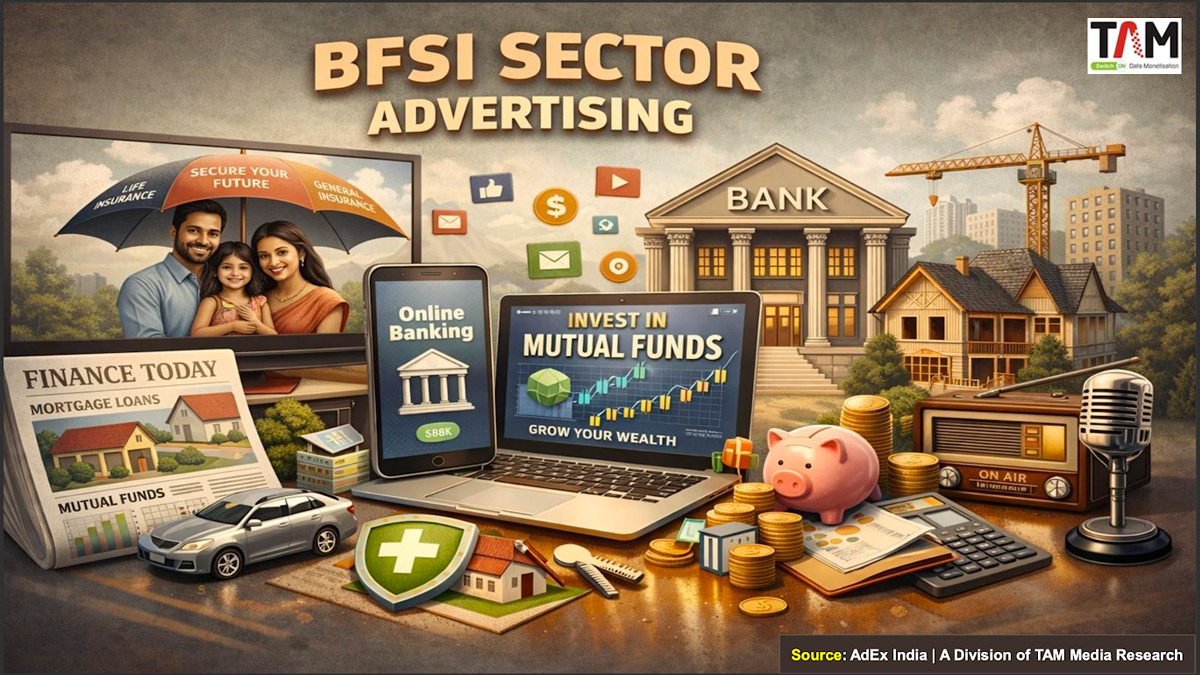
MUMBAI: India’s banking, financial services and insurance sector, one of the most prolific advertisers in the country, delivered a split verdict on media in 2025. It spent less on television, held its nerve in print, turned up the volume on radio and deluged the internet with a ferocity that left every other medium looking pedestrian. The picture that emerges from TAM AdEx’s cross-media report for the BFSI sector is of an industry in transition, still wedded to the news bulletin but increasingly seduced by the algorithm.
Television: a retreat with caveats
TV ad volumes for the BFSI sector fell 16 per cent in 2025 compared with 2024, a sharp reversal after two years of consistent growth that had pushed volumes 16 per cent above 2021 levels by 2023 and a further 7 per cent higher by 2024. Within 2025 itself, the drop was concentrated in the middle of the year: the second and third quarters saw ad volumes slide 35 per cent each against the first quarter, with a partial recovery of 13 per cent in the fourth.
The retreat did not reshuffle the deck. Life insurance retained first place among TV categories with 19 per cent of ad volumes, mortgage loans held second with 16 per cent, and the top ten categories together accounted for 82 per cent of all BFSI television advertising. The dominance of news channels was equally pronounced: news claimed 68 per cent of ad volumes, general entertainment channels a distant 14 per cent and movies 12 per cent. Together, news and GEC captured 82 per cent of the sector’s television spend. News bulletins alone took 48 per cent of programme-genre volumes, with feature films second at 12 per cent. Prime time, between 6pm and 11pm, drew 34 per cent of ad volumes, followed by afternoon at 22 per cent and morning at 20 per cent. A full 82 per cent of all ads ran between 20 and 40 seconds.
Life Insurance Corporation of India was the sector’s biggest TV spender with 11 per cent of ad volumes. Muthoot Financial Enterprises came second with 9 per cent, followed by National Payments Corporation of India at 6 per cent, Tata AIG General Insurance at 5 per cent and State Bank of India at 5 per cent. The top ten advertisers together accounted for 51 per cent of total TV volumes. Three names were new to the top ten in 2025: Tata AIG General Insurance, IIFL Finance and Tata Capital. At brand level, Muthoot Finance Loan Against Gold led with 9 per cent share, Tata AIG Health Insurance entered the top ten for the first time, and the top ten brands together contributed 35 per cent of ad volumes.
Print: the long climb continues
Print told a different story. Ad space for the BFSI sector has grown every year since 2021, rising 16 per cent in 2022, 30 per cent in 2023, 51 per cent in 2024 and 64 per cent in 2025, all measured against a 2021 baseline. Within 2025, ad space was flat in the second quarter but surged 46 per cent in the third and 33 per cent in the fourth compared with the first. Life insurance led print categories with 21 per cent of ad space, followed by mutual funds and banking services and products at 13 per cent each, and corporate financial institutes at 11 per cent. The top ten categories together took 82 per cent of print ad space. LIC led print advertisers with 6 per cent share, and the top ten together covered just 19 per cent of ad space, a reflection of how fragmented print spending remains. Three new entrants joined the top ten in 2025, with Billion Brains Garage Ventures the only exclusive presence not seen in 2024’s list. In the top ten brands, LIC dominated with a 2 per cent share, while Nippon India Mutual Fund rose to third position from fourth in 2024. English accounted for 62 per cent of print ad space, Hindi for 20 per cent. Business and finance publications took 59 per cent of the genre split. The south zone led regional spending with 33 per cent of print ad space, Bangalore topping that zone, while New Delhi and Mumbai were the leading cities nationally.
Radio: louder than ever
Radio ad volumes for the BFSI sector have climbed steadily, rising 12 per cent above 2021 levels in 2023, 36 per cent in 2024 and 45 per cent in 2025. The quarterly pattern within 2025 was volatile: a sharp drop of 43 per cent in the second quarter and 42 per cent in the third, followed by a near-full recovery in the fourth. Life insurance led radio categories with 22 per cent of volumes, banking services and products second at 14 per cent and corporate NBFCs third at 11 per cent. LIC of India held its position as the leading radio advertiser with 20 per cent of ad volumes; the top ten radio advertisers together covered 69 per cent. Muthoot Financial Enterprises led radio brands with 10 per cent share, five of the top ten brands belonged to LIC alone, and SBI Mutual Fund made a remarkable leap to fifth position from 272nd in 2024. Evening and morning time-bands together captured 84 per cent of radio ad volumes, with evenings at 44 per cent and mornings at 40 per cent. Maharashtra was the leading state for radio BFSI advertising with 18 per cent share; Maharashtra, Gujarat and Uttar Pradesh together accounted for 43 per cent.
Digital: the five-times surge
If one number defines the 2025 BFSI advertising story, it is five. Digital ad impressions for the sector multiplied fivefold between 2021 and 2025, having already doubled in 2023 and doubled again in 2024 before the 2025 leap. Within the year, impressions dipped 19 per cent in the second quarter and 12 per cent in the third before recovering 8 per cent above the first quarter by the fourth. Banking services and products led digital categories with 27 per cent of impressions, life insurance and credit cards tied at 19 per cent each, and securities and sharebroking organisations fell from first place in 2024 to fourth in 2025. Axis Bank was the runaway leader among digital advertisers with 12 per cent of impressions, followed by ICICI Bank at 9 per cent, IDFC First Bank at 7 per cent and Kotak Mahindra Bank at 6 per cent. The top ten digital advertisers covered 59 per cent of impressions, and seven of them were new entrants compared with 2024, signalling rapid churn in the digital spending hierarchy. At brand level, Axis Bank led with 9 per cent, ICICI HPCL Super Saver Credit Card vaulted to third place from 921st in 2024, and six of the top ten digital brands were new to the list. Programmatic buying accounted for 91 per cent of all digital BFSI transactions; combined with ad networks, it captured 96 per cent.
The data from TAM AdEx paints the portrait of a sector that still believes in the power of the television news bulletin to sell insurance to the masses, but increasingly knows that the next generation of borrowers, investors and cardholders is scrolling, not watching. The race is now on to reach them before the algorithm serves up someone else’s loan offer first.






