Brands
BonV Aero takes flight with defence honours
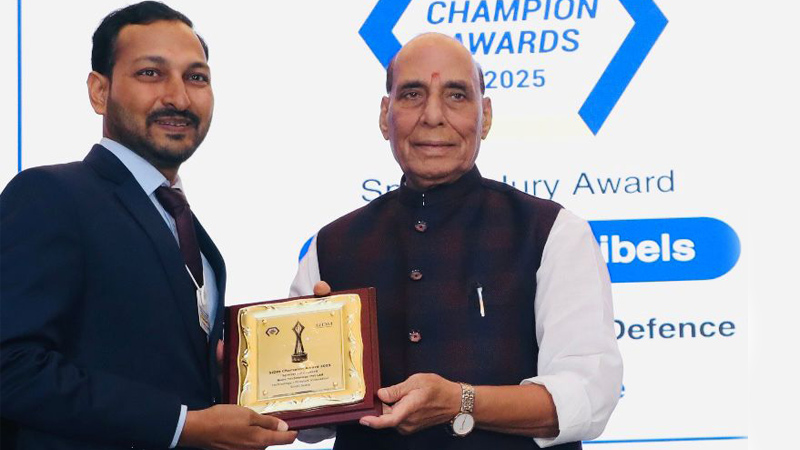
MUMBAI: When it comes to innovation, this startup isn’t just flying high, it’s soaring into the nation’s defence hall of fame. Odisha-based aerospace firm BonV Aero has clinched the SIDM Champion Award (Special Jury) under technology/product innovation to address defence capabilities gap, a proud recognition of its indigenous advances in aerial systems.
The award was presented by defence minister Rajnath Singh to BonV Aero co-founder and CEO Satyabrata Satapathy, who dedicated the win to the nation and the armed forces. The Society of Indian Defence Manufacturers (SIDM) instituted the awards to honour excellence in home-grown defence manufacturing and technology breakthroughs.
BonV Aero’s work in high-altitude, heavy-payload, and autonomous aerial systems has drawn national attention for expanding what unmanned aircraft can achieve in India’s tactical and logistics landscapes. The startup’s indigenous propulsion systems, rugged airframes, and self-flying technologies enable these drones to carry heavy loads, operate independently in complex terrains, and adapt to mission-critical defence operations.
As the only Odisha-based startup to receive this recognition, BonV Aero has put the state’s deep-tech ambitions on the national map. The company’s blend of design precision and operational reliability is creating aerospace solutions that are as strategic as they are self-reliant, aligning seamlessly with India’s Aatmanirbhar Bharat vision.
“This recognition from SIDM and the Ministry of Defence is a proud moment not just for BonV Aero, but for Odisha’s entire innovation community,” said Satyabrata Satapathy, adding that the firm’s mission is to “build systems that perform where it matters most, from high-altitude frontiers to rapid-response tactical environments.”
The awards jury, chaired by Satheesh Reddy, former DRDO chairman and scientific adviser to the Defence Minister, featured a distinguished panel including Prahlada Ramarao (padma shri), air marshal Anil Chopra (retd.), vice admiral S.K.N. Ghormade (retd.), and maj gen P.K. Saini (retd.), among others.
Endorsed by defence minister Rajnath Singh, the SIDM Champion Awards continue to highlight the power of collaboration between industry and the armed forces, spotlighting innovation as the new arsenal of modern defence.
With this recognition, BonV Aero has not just lifted off, it’s redefining flight itself, positioning India for a future where indigenous ingenuity leads the way in aerospace and defence technology.

Brands
Estée Lauder to shed 10,000 jobs as new boss bets on digital shift
The cosmetics giant raises its profit outlook but stays silent on a possible merger with Spain’s Puig, as job cuts deepen and a three-year sales slump weighs on the turnaround
NEW YORK: Stéphane de La Faverie is not done cutting. Estée Lauder announced on Friday that it plans to eliminate as many as 3,000 additional jobs, taking its total redundancy programme to as many as 10,000 roles, up from a previous target of 7,000 announced a year ago. The company, which owns La Mer, The Ordinary, Tom Ford, and Aveda, employs roughly 57,000 people worldwide. The mathematics of what is now being contemplated is stark.
The fresh round of cuts is expected to generate a further $200 million in savings, bringing the total annual savings from the programme to as much as $1.2 billion before taxes. That money, De La Faverie has made clear, will be ploughed back into the turnaround.
A CEO in a hurry
De La Faverie, who took the helm in January 2025, inherited a company that had endured three consecutive years of annual sales declines. His response has been to move fast and cut deep. A significant portion of the latest redundancies reflects his push to reduce headcount at US department stores, long a cornerstone of Estée Lauder’s distribution model but now a channel in structural decline. In their place, he is accelerating the shift toward faster-growing online platforms, including Amazon.com and TikTok Shop, a pivot that is reshaping not just where Estée Lauder sells but how it thinks about its customers.
The numbers are moving in the right direction
Despite the pain, there are signs the medicine is working. Estée Lauder raised its profit outlook for the remainder of the fiscal year, guiding for adjusted earnings per share in the range of $2.35 to $2.45, above analyst estimates and a notable step up from the $2.05 to $2.25 range it had guided for in February. Organic net sales growth is expected to come in at 3 per cent, the company said, at the high end of the range it set out in February.
The share price tells a mixed story. After De La Faverie took charge, the stock surged nearly 60 per cent, buoyed by investor optimism that a longtime company insider could finally arrest the decline. But 2026 has been rougher: the shares have fallen 27 per cent this year, weighed down by disappointing February results and the overhang of unresolved merger talks with Spanish beauty giant Puig Brands SA. The company gave no additional details about those discussions on Friday, leaving the market to guess.
Silence on Puig
The proposed tie-up with Puig remains the most consequential unknown hanging over Estée Lauder. A deal with the Barcelona-based group, which owns brands including Carolina Herrera and Rabanne, would reshape the global luxury beauty landscape. But with nothing new to say and a turnaround still very much in progress, De La Faverie is asking investors to trust the process.
Three years of sales declines, 10,000 job cuts, and a merger that may or may not happen. At Estée Lauder, the overhaul has barely started.