Brands
Birla Opus: A Bold New Player Emerges

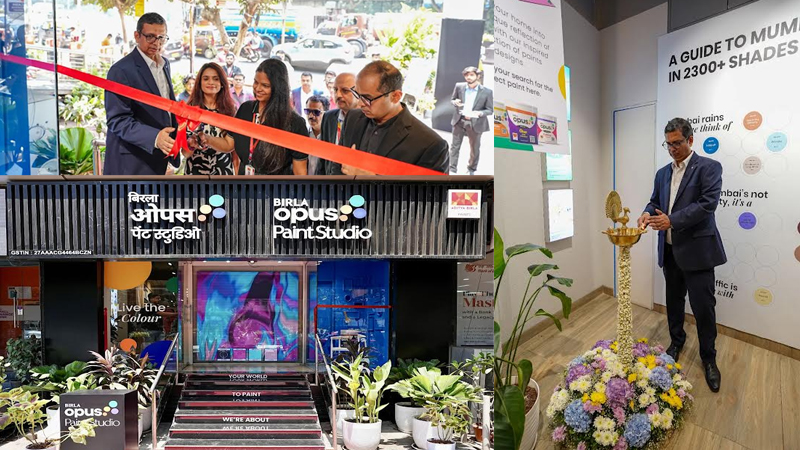
MUMBAI: Imagine an industry so settled, so entrenched, that innovation has become a foreign concept. For decades, India’s decorative paints market has been a closed ecosystem, a carefully guarded territory where a few giants played by unwritten rules. Consumers had limited choices, contractors followed established patterns, and the market seemed frozen in time.
Enter Birla Opus – a disruptor armed with more than just pigments and promises. And it’s led by RakshitHargave who isn’t your typical corporate executive. When he speaks about the paint industry, there’s a spark of rebellion in his voice. “The competitive intensity hasn’t been high,” he says, a statement that sounds more like a challenge than an observation.
This isn’t just another corporate expansion. It’s a calculated assault on an industry that has grown fat and lazy.

To understand Birla Opus’s strategy, one must first comprehend the unique ecosystem of India’s paint market. Unlike most consumer industries, this is a three-dimensional chess game involving contractors, dealers, and end-consumers. Each group has distinct motivations, distinct pain points.
Most companies focus on one – Birla Opus is playing a multi-dimensional game. And it’s doing it as though it’s on steroids. Numbers tell a compelling story. In just its first year, Birla Opus has reached 6,000 towns, established over 140 depots and hosted more than 150 exhibitions nationwide
These aren’t just statistics. They’re strategic footprints designed to dismantle existing market barriers.
Traditional paint companies treated contractors as mere distribution channels. Birla Opus sees them as partners.
“We’re the first to host nationwide exhibitions allowing painters and contractors to experience products firsthand,” Hargave explains. It’s an industry-first initiative that speaks volumes about the company’s approach.
India’s paint market has always had regional dynamics. South India traditionally belonged to one dominant player, while North and East remained multi-brand territories. Birla Opus has defied these traditional boundaries and has spread its colour nationally.
“The gap between our best and relatively slower regions is just 110 versus 90,” Hargave notes – a testament to thecmpany’snational appeal and availability.
In the paint industry, logistics isn’t a support function. It’s the backbone of the entire operation.Birla Opus has turned this into a competitive advantage. It has the record of fulfilling orders within four to six hours while it delivers in surrounding regions by the next day. To achieve that Hargave has five factories whipping up the paint with a sixth coming up in Kharagpur. Additionally, the company has strategically mapped depots near manufacturing facilities in order to ship out the product as quickly as possible.
Where traditional brands whispered, Birla Opus is screaming from every possible platform. It has taken marketing and branding to a totally different level for a debutante by going after tentpole properties on television. For starters, cricket which isn’t just a sport in India. It’s a religion. Birla Opus secured prime sponsorshipsfor the ongoing IPL, the T20 World Cup and all bilateral series. And it has dug its marketing heels into entertainment by partnering with reality shows like Indian Idol and Sa re ga ma pa. However, Hargave admits that “cricket remains a key driver for consumer traction,”
The brand has understood in modern consumption driven new India and Bharat there has been a crucial psychological shift. Painting is no longer a maintenance chore – it’s a lifestyle statement. And to pander to that the company’s campaign ‘Naya Zamane Ka Naya Paint’ isn’t selling colour. It’s selling aspiration, modernity, self-expression.
Rs 10,000 crore in three years might sound like corporate hubris. But Hargave is quietly confident. “We are exactly where we aimed to be at the end of our first year,” he states.
This isn’t just a corporate expansion. It’s a statement about Indian entrepreneurship. About challenging established narratives. About proving that with the right strategy, you can disrupt even the most settled industries.
Will Birla Opus sustain its momentum? The paint is still wet, the canvas still incomplete. But one thing is certain – the company has already redrawn the industry’s boundaries.
In a market long dominated by legacy brands more interested in protecting territory than innovating, Birla Opus is not just selling paint.
Hargave and his team are painting a revolution.





Brands
Dunkin’ Donuts to exit India as Jubilant FoodWorks ends 15-year franchise deal
The quick service restaurant giant is ending a 15-year franchise partnership with the American doughnut chain, even as it renews its Domino’s agreement for another 15 years
NOIDA: Dunkin’ is done in India. Jubilant FoodWorks Ltd, the country’s leading quick service restaurant operator, has decided not to renew its franchise agreement with the American coffee and doughnut chain, and will wind down its Indian stores in a phased manner before December 31, 2026, bringing a 15-year partnership to a quiet, loss-laden close.
The decision, approved by JFL’s board on March 30, 2026, ends a relationship that began with a Multiple Unit Development Franchise Agreement signed on February 24, 2011. JFL will now evaluate and undertake what it described in a regulatory filing as the “rationalisation and/or cessation of certain operations and/or sale, transfer or disposal of assets and/or assignment or transfer of franchise rights,” all in consultation with Dunkin’s brand owners and strictly within the terms of the original agreement.
The numbers tell the story bluntly. In the financial year 2024-25, Dunkin’ India posted a revenue of Rs 37 crore against a loss of Rs 19 crore — a haemorrhage that was always going to test the patience of a parent company recording revenues of Rs 6,104 crore and a profit of Rs 194 crore in the same period. Doughnuts, it turns out, were never going to move the needle.
The contrast with JFL’s handling of its other marquee franchise could hardly be sharper. Even as it walks away from Dunkin’, the company has just doubled down on Domino’s, signing a fresh Master Franchise Agreement on March 31, 2026, granting it exclusive rights to develop and operate Domino’s Pizza stores in India for 15 years, with an option to renew for a further 10.
JFL, incorporated in 1995 and promoted by the Bharatia family, operates a network of more than 3,500 stores across six markets — India, Turkey, Bangladesh, Sri Lanka, Azerbaijan and Georgia. Its portfolio includes Domino’s and Popeyes on the global side, and two home-grown brands: Hong’s Kitchen and COFFY, a café brand in Turkey.
For Dunkin’, India was always a stretch. The brand never quite cracked the cultural code in a market where filter coffee and chai command fierce loyalty and where the doughnut remains, at best, an occasional indulgence rather than a daily habit. Fifteen years, mounting losses and a parent with better things to spend its capital on was always going to be a difficult equation to solve.
The doughnut has had its last day. The pizza, however, is staying.






