Ad Campaigns
Bihar Election 2020 – Political ad spend analysis: TAM data

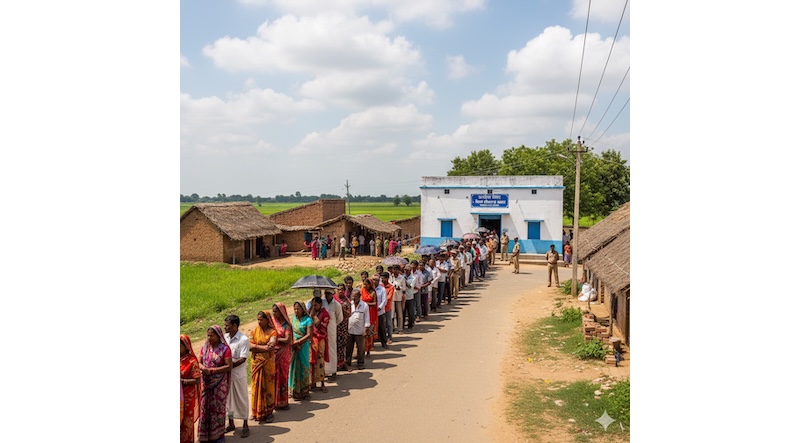
MUMBAI: The battle for Bihar in 2020 wasn’t just fought on dusty village squares and opposition rallies. It raged across television screens and newspaper columns, with political parties unleashing millions in advertising rupees to woo voters. TAM Media’s advertising expenditure data reveals a lopsided affair: television gobbled up a staggering 93 per cent of all political advertising spend, leaving print media to scrap over a measly 7 per cent.
The Bharatiya Janata Party emerged as the undisputed heavyweight, commanding 38.7 per cent of overall ad insertions—more than double its nearest competitor. On television, where the real money flowed, BJP’s dominance was even more pronounced at 41 per cent of all ad slots. The National Democratic Alliance, its coalition partner, secured 17.4 per cent overall, with an 18.6 per cent share on television.
Congress, despite its third-place finish in overall spending at 17 per cent, displayed tactical nous in print advertising. The party ranked second in newspapers with 7.1 per cent of insertions as a standalone advertiser, while a Congress-led coalition (Congress-I/RJD/CPI variants) topped print spending at 15.7 per cent—edging past a BJP-led alliance’s 14.1 per cent.
Rashtriya Janata Dal and Janata Dal United rounded out the top five, with 11.9 per cent and 8.9 per cent of overall insertions respectively. The fragmented opposition was evident in the numbers: 25 other parties collectively managed just 6.1 per cent of ad insertions, with print media seeing an even messier 44.6 per cent split among 15 smaller players.

But the real story lies in the timing. TAM Media’s week-by-week analysis reveals a campaign that began as a whisper and ended as a roar. For the first six weeks—from early September through early October—political advertising barely registered on television. Print maintained a modest but steady presence during this period, with a slight peak in week three.
Then came the deluge. From week seven onwards, television advertising exploded in a dramatic crescendo. By week nine (25-31 October), TV ad insertions hit their peak at 42 per cent of the entire campaign’s television spend—a staggering concentration just days before polling. Print advertising followed a similar trajectory, peaking at 31 per cent during the same crucial week nine, though it maintained a more consistent presence throughout the campaign compared to television’s late surge.

The pattern is unmistakable: parties held their fire until voters’ attention was sharpest, then carpet-bombed the airwaves in the final fortnight. Week ten saw a slight decline as polling day arrived, but by then the damage—or persuasion—was done.
The data, covering political advertisements across Bihar’s television channels and publications during the election period, paints a clear picture: in Bihar’s ad war, television was the main battleground, BJP brought the biggest guns, and everyone saved their ammunition for a final, frenzied assault on voters’ senses. Welcome to democracy, Bihar-style—where timing is everything and the biggest megaphone usually wins.






NATIONAL: Amazon Ads has laid out a sharply tech-led vision for the advertising industry in 2026, arguing that artificial intelligence, streaming TV and creator partnerships will combine to turn brand building into a more precise, performance-driven business.
At the heart of the shift, the company says, is the fusion of AI with Amazon’s vast trove of shopping, browsing and streaming signals, allowing advertisers to move beyond blunt reach metrics to campaigns designed around real customer behaviour.
“The future of advertising is not about reaching more people, but the right people with messages that resonate,” said Amazon Ads India head and vice president Girish Prabhu. “By combining AI with deep customer insights, we help brands move from broadcasting campaigns to having meaningful conversations wherever audiences spend their time.”
One of the biggest changes, according to Amazon Ads, will be the collapse of the wall between media planning and creative development. Retail media, powered by first-party data, is increasingly shaping everything from brand discovery to final purchase, pushing marketers to design campaigns around audience insight rather than internal instinct.
AI is also moving from a support tool to a creative engine. Agentic AI, which automates and accelerates production, is expected to make high-quality creative accessible even to small businesses, compressing weeks of work into hours and giving challengers the ability to compete with larger brands on speed and scale.
Behind the scenes, AI-driven analytics will take on a bigger role in campaign optimisation, identifying patterns, spotting opportunities and recommending actions that would previously have required teams of analysts.
Streaming TV is another big battleground. With India’s video streaming audience now above 600 million and connected TV users at 129.2 million in 2025, advertisers are set to treat streaming not just as a branding channel but as a performance engine, measured increasingly by sales, sign-ups and bookings rather than just reach.
Finally, Amazon Ads sees creators and contextual advertising reshaping how brands tell stories. Creators will act less like influencers and more like long-term partners, while scene-aware ads on streaming platforms will allow brands to insert hyper-relevant offers into the flow of what viewers are watching.
Taken together, Amazon Ads argues, these shifts mark a move towards advertising that is both more human and more measurable, where AI handles the complexity, and creativity does the persuading.








