Brands
Badshah’s Badboy Pizza slips into India’s QSR scene with a bold, desi twist


MUMBAI: Critically acclaimed rapper, singer-songwriter and serial entrepreneur Badshah has fired up the ovens and stormed into India’s booming quick service restaurant (QSR) sector with Badboy Pizza—a mass-premium pizza chain that promises bold flavours, slick branding, and a desi-meets-global attitude.
The artist, whose real name is Aditya Prateek Singh Sisodia, has teamed up with Ghost Kitchens India, one of the country’s largest cloud kitchen players led by serial founder Karan Tanna, to build what the duo claim will be “the most exciting QSR launch of the decade.”
Ahead of the opening, the internet was set ablaze with a cheeky viral campaign featuring Badshah being slapped—by a pizza. The stunt, designed to juice the brand’s tagline ‘pizza that slaps,’ racked up over eight million views across platforms and turbocharged buzz around the brand’s launch.

Badboy Pizza is now live with a flagship boutique outlet in Andheri, Mumbai, and is eyeing a footprint of 50 locations across India’s top five metros in the next three years. Built as a hybrid format of dine-in and delivery kitchens, the brand is chasing an ambitious Rs150 crore annual recurring revenue (ARR) target. The average bill: Rs 400 per person.
At the heart of the venture is a 50-item cosmopolitan menu that fuses global favourites with desi swagger—from Truffle Cacio-e-Pepe and Korean Spice to Tandoori Tikka and Chicken Keemalal. There’s even a cinematic special called the Pushpa Pizza, spicy enough to match its namesake’s fire.
Says Badshah: “Badboy Pizza is an extension of my personality — rooted, bold and real and this launch is special since I’ve always dreamt of having my own pizza chain! Drawing upon diverse culinary experiences from my travels over the years, my vision was to forge a brand that embodies international quality while resonating deeply with homegrown appeal. Partnering with Karan Tanna and Ghost Kitchens ensures we’re building not just a brand, but a truly world class and accessible culinary experience.”
The crust, however, is the true hero. Made with Italian flour and cold fermented for 48 hours, it promises that elusive combo of crispy outside and fluffy inside—a far cry from the usual QSR fare.
And the brand doesn’t stop at pizza. The menu includes garlic bread with butter chicken, spaghetti in bread bowls, flamboyant desserts like Fried Oreos with sea salt dark chocolate, and madcap sundaes in flavours such as Banaras Paan and Guava Masala.
The brand identity? Loud, rebellious and proudly Indie-an. Badboy Pizza’s packaging mimics smuggled contraband—zesty lime and purple boxes emblazoned with bold typography and the playful wink of Jugnu, the mischievous mascot who glows when things get bold. The boxes double up as collectible street-art souvenirs—because why should a pizza box be boring?
For Ghost Kitchens, the tie-up is a strategic masterstroke. Already home to brands like Starboy Pizza and Speak Burgers by Vicky Ratnani, the cloud-first company processes over 1.2 lakh orders monthly and is scaling fast after a $5 million Series A raise in 2024.
Tanna said, “Badboy Pizza is poised to be the most exciting QSR launch of the decade. The brand reimagines what scalable QSRs of the future will look like. Badshah’s ability to shape trends and influence youth culture gives this brand an unmatched edge. Together, we’re building the future of QSR experiences in India.”
India’s QSR market is surging—from $85.19 billion in 2025 to a projected $139.75 billion by 2030, growing at a CAGR of 10.41 per cent, according to a press release issued by the company. The pizza segment alone is forecast to more than double to $11.8 billion by 2033.
With the hype machine firing on all cylinders, a menu that dares to be different, and cultural cues baked into every bite, Badboy Pizza isn’t just selling food. It’s building a movement.
And yes—this pizza really slaps.







Brands
Samsung certifies 1,000 Maharashtra students in AI and coding
The South Korean electronics giant marks its first large-scale skilling push in the state, with women making up nearly half the national programme’s enrolment
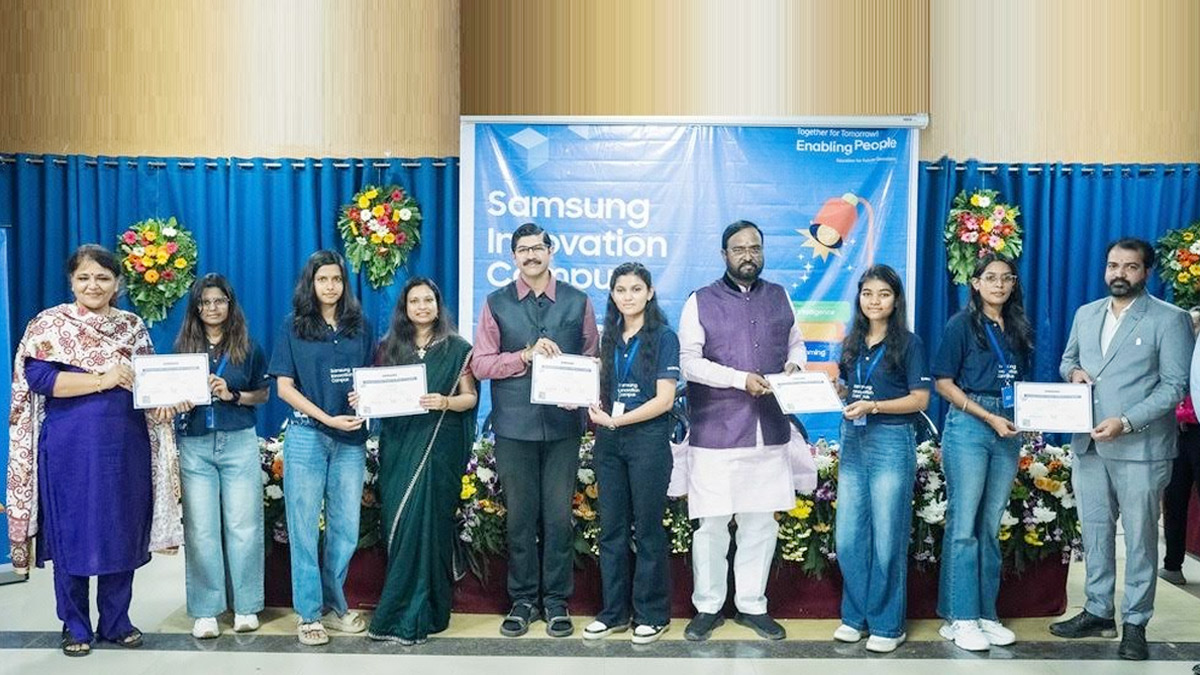
PUNE: Samsung has put 1,000 students in Maharashtra through a certified training programme in artificial intelligence and coding, the largest such drive the South Korean electronics company has run in the state and a signal that corporate India’s skilling ambitions are moving well beyond the boardroom brochure.
The certifications were awarded under Samsung Innovation Campus (SIC), the company’s flagship corporate social responsibility programme, which launched in India in 2022 with the stated aim of democratising access to future-technology education. The 1,000 graduates were drawn from four institutions: 127 from Savitribai Phule Pune University, 373 from Pimpri Chinchwad University, 250 from D.Y. Patil University’s Ramrao Adik Institute of Technology and 250 from Anjuman-I-Islam’s Kalsekar Technical Campus. All completed training in either AI or coding and programming, the two disciplines Samsung has identified as the critical pillars of the digital economy.
The programme does not stop at technical training. Soft-skills development and career-readiness modules are baked into the curriculum, a deliberate attempt to close the gap between what universities teach and what employers actually want.
“India’s digital growth story will ultimately be shaped by the quality of its talent pipeline,” said Shubham Mukherjee, head of CSR and corporate communications at Samsung Southwest Asia. “As technologies like AI move from the periphery to the core of industries, skilling must evolve from basic training to building real-world capability. This milestone in Maharashtra reflects how industry and academia can come together to create a future-ready workforce that is both globally competitive and locally relevant.”
The Maharashtra drive sits within a rapidly scaling national effort. Samsung Innovation Campus trained 20,000 young people across India in 2025, hitting its stated target for the year. Women account for 48 per cent of national enrolments, a figure the company cites as evidence of its push for an inclusive technology ecosystem. The programme is implemented in partnership with the Electronics Sector Skills Council of India and the Telecom Sector Skill Council.
Samsung, which is marking 30 years in India this year, runs SIC alongside two other initiatives, Samsung Solve for Tomorrow and Samsung DOST, as part of a broader effort to build what it calls a generation of innovators with both the technical depth and the problem-solving mindset to thrive in a fast-moving digital world.
A thousand certified students is a tidy headline. Whether they find jobs that match their new skills is the harder question, and the one that will ultimately determine whether corporate skilling programmes like this one are genuine pipelines or well-photographed gestures.






