Digital Agencies
Authentic brand promoters are far more rare and influential than sharers: Research

MUMBAI: Brands often boast about the number of “likes”, “followers” and “tweets” they garner, but are these measures of brand advocacy too crude? Are people that “like” and “follow” everything true brand promoters?
As companies grapple with the meaning and impact of social media on brands, Social@Ogilvy and SurveyMonkey join forces for a second year to study how to transform supporters into real, long-lasting advocates, who carry on the brand voice and promote it to others.

Just as last year’s study showed that brands producing high quality content is critical to engage with social media users, this year’s global, 11-country online survey of more than 5,000 social media users shows that just because people are saying positive things about your brand, doesn’t mean they are real brand advocates. But, if one uses the right approach and techniques, they can be, and this global research sheds light on how.
“Sharers”, “followers” and “retweets” are crude measures of true brand advocacy
Majority of users are actively noticing and engaging with brands via social media, with the research showing that 84 per cent of respondents across the 11 markets say they had “liked” or “followed” a brand, product or service. Of those that have “liked” or “followed” a brand, 58 per cent have interacted directly with a brand and 79 per cent received a response back (shout out to social media managers everywhere!).
The research did not observe any shortage of “social sharers” who not only follow a brand, but who proactively share their experiences: 58 per cent of respondents have communicated either positive or negative opinions about a brand with others.
These social addicts, who typically stay glued to the likes of Facebook, YouTube and Twitter on a daily basis, exhibit similar behaviors but there are still key differences and steps to transforming “sharers” into brand promoters – those respondents who self-identified as being extremely likely to recommend brands and products to friends.
While 58 per cent respondents are “sharers”, only 19 per cent are true brand promoters
Authentic brand promoters are far more rare and influential than sharers, with the global research revealing notable differences to watch out for between them when looking to identify the profile of a promoter.
How do promoters interact via social media?
. They are intrinsically more active followers: 66 per cent follow brands on a regular basis, compared to only 52 per cent of sharers.
. Promoters follow brands in order to interact directly with them. 42 per cent of sharers do this compared to 52 per cent of promoters.
Why do promoters interact with brands?
. A prime reason they follow brands is to be associated with them which 39 per cent do, versus only 28 per cent of sharers
. 46 per cent also believe a brand’s reputation is important, compared to only 36 per cent of sharers
. They prefer to link a brand to their own personal identity, with 45 per cent saying they feel better about themselves after using a brand; only 35 per cent of sharers say the same
What action do they evoke?
. The friends of promoters talk about brands much more: 59 per cent of promoters see their networks regularly mention brands and products, while only 47 per cent of sharers do the same
. They are much more likely to respond to their friends’ interaction with brands; 35 per cent would purchase a product if it was mentioned by a friend, compared to just 24 per cent of sharers
Globally, these promoters share broadly similar characteristics
True promoters have similar reasons for liking or following a brand, for example: 77 per cent want to hear about products, offers, or news, followed closely by 53 per cent who want to give direct feedback and 52 per cent who want to interact directly with an organisation. Promoters tend to surround themselves by like minds when it comes to their attitude towards brand interaction on social media: 91 per cent say their friends’ mentions of brands are largely positive.
Quality is paramount with virtually everyone (91 per cent) saying this is why they would be extremely likely to recommend a particular brand or product to friends or colleagues. And, it’s the main reason why 61 per cent promoters would not recommend a brand or product.
What brands should be careful of
While both sharers and promoters have posted about a great brand experience on social media, 71 per cent of sharers and 60 per cent of promoters have also discussed terrible brand experiences online.
Emerging economies breed a higher percentage of promoters
Countries with the highest percentage of promoters live in emerging economies, like Brazil and India, where 42 per cent and 33 per cent respectively, fall into this category. Japan revealed the smallest percentage by far with just 1 per cent of promoters, followed by Germany and France (14 per cent each), and UK, Indonesia and Australia (15 per cent each).
However, important cultural nuances are likely to be at play. For instance, Indonesia has a low number of promoters despite 70 per cent of respondents saying they’ve shared great brand experiences on social media. This could suggest that the more passive approach of advocacy via social sharing may be more popular in Asian countries. Equally, a low number of Japanese promoters could be attributed to the formal, more private culture – making them less willing to make personal recommendations online. To that effect, the majority of Japanese respondents (43 per cent) report in-person brand or product recommendations are most trustworthy.
While it is clear people are more connected than ever – demonstrated by the sheer breadth of networks available to us – the research from SurveyMonkey and Ogilvy shows that it is the depth of connections that change our lives and the world around us.
Ultimately, brands need to build relevance and trust through content and connections if they wish to use social media to transform their brand, business and reputation.
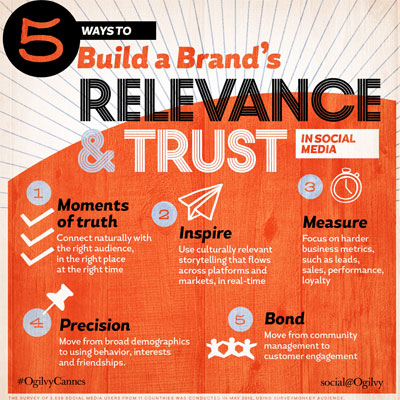
5 steps that the research insists to garner brand relevance and trust in social media
1 . Precision: Move from broad demographics to using behaviour, interests and friendships
2. Moments of truth: Connect naturally with the right audience, in the right place at the right time
3. Inspire: Use culturally relevant storytelling that flows across platforms and markets, in real-time
4. Bond: Move from community management to customer engagement
5. Measure: Focus on harder business metrics, such as leads, sales, performance, loyalty
“Companies need to move beyond collecting likes and retweets with meaningless content. Through genuine interaction and content designed to connect with true advocates, companies can drive forward their brand, business and reputation in ways not possible before this era of social media,” said Social@Ogilvy global managing director Thomas Crampton.
“Social media addicts may look like your most engaged consumers, but marketers need to stop looking at their data in silos to find their true advocates, By applying the Net Promoter Score methodology to social media users across the globe, we better understand the profile of a brand promoters: those who are extremely likely to recommend brands to friends and colleagues. To appeal to promoters, brands need to not only focus on quality but also reputation among friends or colleagues and that sense of worth that comes from being associated with a brand,” added SurveyMonkey vice president of marketing communications Bennett Porter.






BENGALURU: For years, creative teams have learned to live with ambiguity. Vague comments, last-minute changes, feedback that arrives without context, clarity, or conviction. It became part of the job – something teams worked around rather than getting it solved.
But as we head into 2026, that tolerance is wearing thin.
Creative work today moves faster, scales wider, and involves more stakeholders than before. Teams are producing more content across more formats, often with distributed collaborators and tighter timelines. In this environment, guesswork is no longer a harmless inconvenience. It’s a cost – to time, to budgets, and to creative mindspace.
The real problem isn’t feedback, it’s how it’s given
Most creative professionals you see today will tell you they’re not against feedback. In fact, they rely on it. Good feedback sharpens ideas, strengthens execution, and pushes work forward. The problem is ‘unclear’ feedback. When someone says “this doesn’t feel right” without context, they aren’t just revising – they’re basically decoding. They’re guessing what the problem might be, trying different directions, and burning time in the process. Multiply that by a few stakeholders and a few rounds, and suddenly days disappear.
In 2026, when teams are expected to deliver faster without compromising quality, interpretation is a luxury most can’t afford.
Scale has changed rverything
Creative projects used to be smaller and simpler. A designer, a manager, maybe one client contact. Feedback loops were short, even if they weren’t perfect.
Today, the same project might involve internal marketing teams, agencies, freelancers, brand reviewers, and regional teams. Everyone has a say. Everyone leaves comments. And often, those comments don’t agree. More people reviewing work means alignment matters more than ever. Clear feedback isn’t just about being nice to creative teams, it’s about keeping projects moving when complexity increases.
Guesswork quietly wears teams down
One of the less talked-about impacts of unclear feedback is what it does to people.
When feedback is vague or contradictory, creatives second-guess their decisions. They hesitate. They overwork. They keep extra time buffers “just in case.” Over time, confidence drops. Ownership fades. Work becomes safer, not stronger. Creative energy gets spent on managing uncertainty instead of pushing ideas forward. And in an industry already grappling with burnout, unclear feedback adds unnecessary mental load.
Actionable feedback is a shared skill
Clear feedback doesn’t mean controlling creative decisions or dictating every detail. It means being specific enough that someone knows what to do next.
Actionable feedback answers three basic questions:
What exactly needs attention?
Why does it matter?
What outcome are we aiming for?
This applies whether you’re reviewing a video frame, a design layout, or a copy draft. The clearer the feedback, the fewer follow-ups it creates. In 2026, teams that treat feedback as a skill and not an afterthought, will move faster with less friction.
Tools shape behaviour (whether we admit it or not)
The way feedback is delivered is often dictated by the tools teams use. Comments buried in long email threads, messages split across chat apps, or notes detached from the actual work all contribute to confusion.
When feedback lives outside the work, context often gets lost. When it’s disconnected from versions and timelines, decisions get questioned. When it’s scattered, accountability disappears. More teams are starting to realise that feedback problems aren’t just communication issues, they’re workflow issues. How work moves between people matters just as much as the work itself.
From Opinions To Alignment
One of the biggest shifts happening in creative teams is a move away from purely opinion-driven feedback. Instead of “I like this” or “I don’t,” teams are asking better questions:
● Does this meet the brief?
● Does this solve the problem?
● Does this align with the goal?
This change reduces unnecessary back-and-forth and helps feedback feel less personal and more productive. It also makes decisions easier to explain and defend. As creative work becomes more strategic, feedback has to support that shift.
2026 Is About Fewer Loops, Not Faster Loops
There’s a misconception that speed means moving through feedback cycles faster. In reality, the most creative teams aren’t just accelerating loops, they’re reducing them. Clear, actionable feedback upfront leads to fewer revisions later. Clear approval stages prevent last-minute surprises. Clear decisions stop work from circling endlessly.
In 2026, efficiency won’t come from working harder or longer. It will come from designing workflows that respect creative time and attention.
Ending guesswork is a mindset change
Ultimately, ending creative guesswork isn’t just about better tools or processes. It’s about mindset. It’s about recognising that clarity is an act of respect – for the work, for the people doing it, for the time invested and for the mindspace used. It’s about moving from “figure it out” to “here’s what we’re aiming for.”
Creative teams that embrace this shift will find themselves not only delivering faster, but also enjoying the process more. And in an industry built on imagination, that might be the most valuable outcome of all.






