Digital
Authbridge finds 5.61 per cent discrepancy rate in on-demand hiring
White-collar roles show 4.33 per cent overall as employment history leads at 11.15 per cent in H1 FY26.

MUMBAI: India’s hiring scene is pulling a classic bait-and-switch, candidates promise the world on paper, but the background check reveals the plot twist nobody saw coming. Authbridge, the country’s top trust and authentication tech firm, released its Workforce Fraud Files – H1 FY26 report (covering July–December 2025) around 16–17 February 2026, crunching data from millions of verifications across identity, address, employment history, education, criminal records, and CV validation.
The headline numbers paint a sobering picture: white-collar hires clocked an overall discrepancy rate of 4.33 per cent, while the on-demand ecosystem (gig and flexible roles) fared worse at 5.61 per cent showing that the faster, looser world of app-based work comes with extra red flags.
For white-collar folks, employment verification topped the trouble list at 11.15 per cent, followed by address checks at 7.68 per cent, education at 4.49 per cent, and references at 4.17 per cent. Drug screening (1.87 per cent) and criminal records (0.50 per cent) stayed relatively tame, but still popped up enough to matter.

The gig side showed even sharper vulnerabilities, address discrepancies hit 9.70 per cent, identity (NID) issues 2.53 per cent, and criminal record mismatches 2.23 per cent particularly worrying for roles with direct customer contact or field duties.
Industry breakdowns add colour, address problems plagued Telecom (15.42 per cent), IT (12.02 per cent), Pharma (11.21 per cent), Retail (10.64 per cent), and Banking & BFSI (10.23 per cent). Employment verification headaches were biggest in Retail (16.37 per cent), Telecom (14.32 per cent), Banking & BFSI (13.00 per cent), and Pharma (12.10 per cent). Education slips stood out in Retail (9.16 per cent) and Telecom (7.80 per cent), while CV validation mismatches appeared in IT (12.80 per cent) and Banking & BFSI (2.91 per cent).
Authbridge CEO and founder Ajay Trehan didn’t mince words, “The H1 FY26 Workforce Fraud Files clearly show that hiring-related discrepancies remain a persistent and structural challenge. Despite faster and more digitised hiring workflows, we continue to see gaps in fundamental checks such as employment history, address, and education. These are not minor inconsistencies; they have direct implications for organisational risk, compliance, and trust.”
The report stresses ditching one-and-done checks, start screening pre-offer to avoid nasty surprises post-joining, and layer in periodic reviews like drug tests, court records, and lifestyle assessments for ongoing risk management. Tools like Authbridge’s Authnumber (consent-based digital credentials) and Authlead (deep-dive leadership vetting) get a nod for cutting friction and blind spots.
Bottom line? In a job market racing for speed and scale, skimping on trust verification is like building a house on sand, one solid background check away from watching the whole thing crumble.




Digital
Moneycontrol widens lead over Economic Times in digital reach
Comscore data shows strong gains in users, engagement and time spent
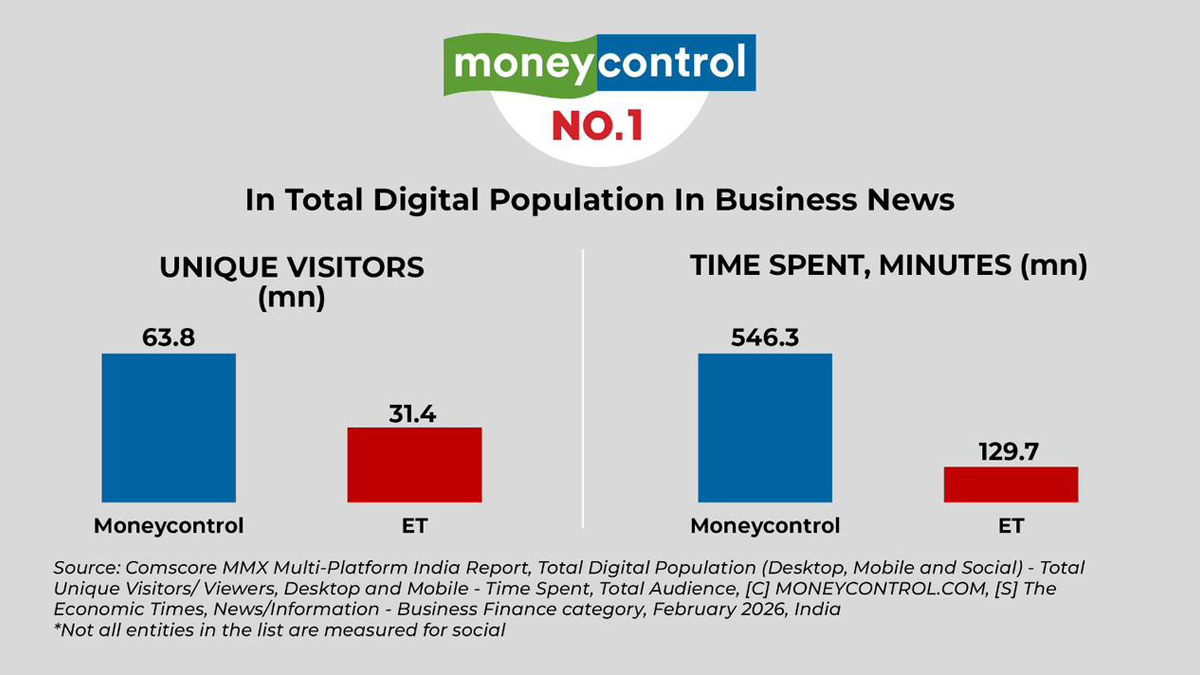
MUMBAI: Moneycontrol has tightened its grip on India’s business news landscape, pulling further ahead of The Economic Times across key digital metrics in February, according to data from global measurement firm Comscore.
The platform drew 63.8 million unique visitors during the month, more than double the 31.4 million recorded by its closest rival, underlining a growing gap in audience reach.
The story does not end with traffic. Moneycontrol also surged ahead on engagement, clocking 279.8 million page views, nearly three times The Economic Times’ 93.1 million. The numbers suggest that readers are not just dropping by, but staying longer and consuming more.
That trend becomes even clearer when looking at time spent. Users logged 546.3 million minutes on Moneycontrol in February, over four times the 129.7 million minutes spent on The Economic Times platform. In the battle for attention, Moneycontrol appears to be winning both the click and the clock.
Moneycontrol managing editor Nalin Mehta, said the surge comes at a time when audiences are grappling with global uncertainty. “As investors navigate war-related risks and geopolitical flux, the need for clarity has never been greater. Our focus remains on delivering timely and credible information to help readers make sense of the noise,” he said.
With markets on edge and headlines moving fast, Moneycontrol seems to have struck a chord, turning moments of uncertainty into an opportunity to deepen its connection with readers.








