Brands
Apple finally folds: iPhone Duo marks the company’s biggest design leap yet
The $1,999 foldable brings a tablet-sized screen, dual cameras and iOS 27


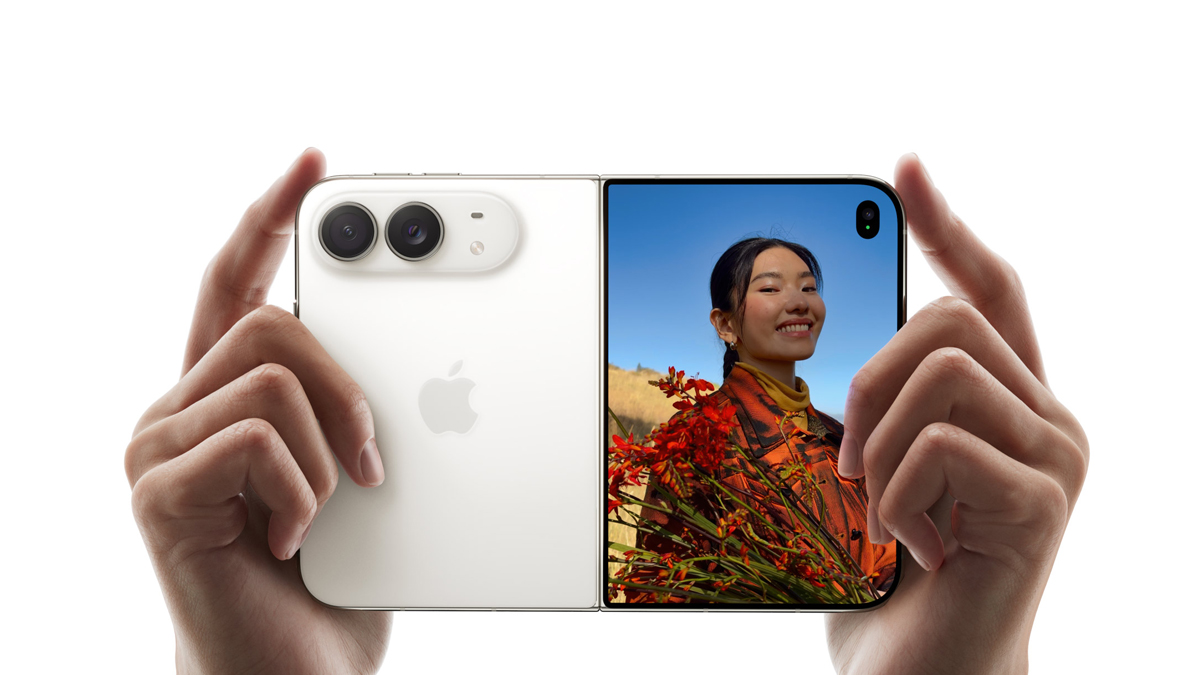
CUPERTINO: Apple has finally folded its way into a new smartphone category. The company has unveiled the iPhone Duo, its long-anticipated book-style foldable, marking the biggest design departure from the traditional iPhone format since the device first arrived.
Unveiled by John Ternus at Apple’s “Surprise and Shine” autumn launch event, the iPhone Duo is designed to bridge the gap between a conventional smartphone and a small tablet. It folds down to a passport-sized form factor while opening into a larger 7.6-inch display.
The device uses a Grade 5 titanium construction, paired with a 3D-printed hinge cover and Ceramic Shield 2 on both the front and back. Apple has also focused heavily on the hinge, using a custom multi-layer adhesive system aimed at reducing the visible crease where the two halves meet.
The outer display measures 5.4 inches and uses a Super Retina XDR panel with ProMotion, offering refresh rates of up to 120Hz. It also supports Always-On functionality and can reach up to 3,000 nits of peak brightness.
Open the device and users get a 7.6-inch folding Super Retina XDR display with an anti-glare nano-texture finish. An under-display FaceTime camera sits within the inner screen, helping Apple maintain the uninterrupted tablet-like canvas.
The two displays will also support the Apple Pencil with USB-C later this year, giving users the option to sketch, annotate documents and work directly on the larger screen.
Under the hood, the iPhone Duo is powered by Apple’s new 2nm A20 Pro chip, featuring a six-core CPU, seven-core GPU and dual 16-core Neural Engine. It comes with 12GB of LPDDR5X unified memory and storage options ranging from 256GB to 2TB.
Apple has paired the foldable with a dual-battery architecture and a custom vapor chamber to manage heat inside the slim, hinged body.
Connectivity includes Apple’s N1 chip for Wi-Fi 7 and Bluetooth 6, alongside the C2 5G modem. The iPhone Duo is also eSIM-only, doing away with a physical SIM tray.
For biometric security, Apple has moved away from Face ID on the foldable, integrating a capacitive Touch ID fingerprint sensor into the side power button.
The rear camera system combines a 48MP Fusion Main camera with 2x optical-quality Telephoto capability and a 48MP Fusion Ultra Wide camera. A 24MP front camera handles selfies and video calls, while the inner display gets its own under-display camera.
Apple has also built the foldable around the idea that both sides of the phone can work together. The outer display can act as a live preview when users shoot with the main rear cameras, allowing subjects to see themselves while a photo is being framed.
Smart Take is designed to automatically capture posed moments, while family photography gets a lighter touch through kid-friendly animations displayed on the outer screen.
The hardware is backed by foldable-focused features in iOS 27. Users can run two apps side by side, split windows from the same app or keep a video player pinned above a larger workspace.
Flex Mode adds another use for the hinge, allowing the lower half of the device to function as a virtual trackpad or keyboard when the phone is partially folded. StandBy mode has also been expanded to make better use of either panel when the device is placed on a desk or table.
The result is an iPhone that is not simply bigger when unfolded, but intended to behave differently depending on how it is positioned.
The iPhone Duo starts at $1,999 (roughly Rs 1,90,000) for the 256GB model, putting Apple’s foldable firmly into premium territory. Storage options extend to 512GB, 1TB and 2TB for users looking for more room.
The device will be available in stores from 23 October 2026.
With the iPhone Duo, Apple is betting that the next chapter of the smartphone story will not be about making a screen larger, but about making it fold. If the format catches on, the familiar iPhone silhouette may soon have a very different shape.