MAM
Amagi gets a Whitmore boost as cloud ambitions stream into EMEA

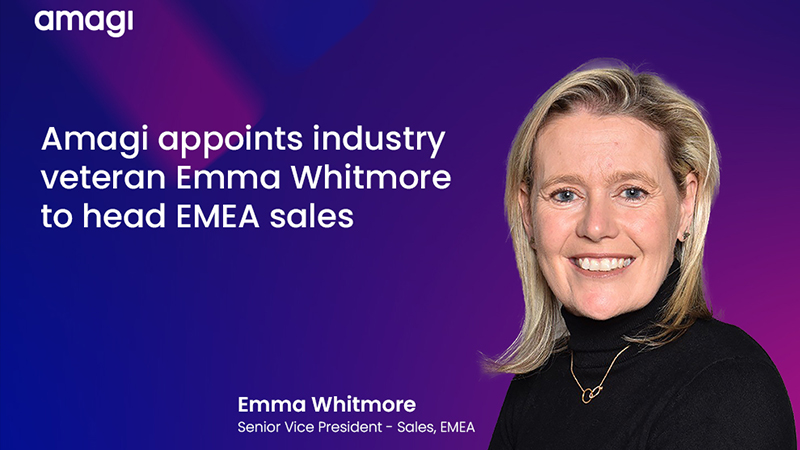
MUMBAI: Call it a cloud with a silver lining Amagi has just added some serious firepower to its global stream team. In a move that signals renewed focus on European and Middle Eastern markets, cloud-led broadcast tech company Amagi has appointed Emma Whitmore as its senior vice president of sales, EMEA. With over 20 years of industry expertise, Emma steps in to steer Amagi’s next phase of partner-led growth, regional expansion, and content innovation.
Known for her sharp eye on industry collaboration and customer-centric strategy, Emma’s appointment comes at a time when cloud-first broadcasting is more than just a buzzword, it’s a business imperative. She will report to Amagi EVP, global SaaS sales, Dan Marshall, and work closely with partners and platforms across the region to scale Amagi’s suite of broadcast and streaming solutions.
“I’m excited to join at a time of rapid growth and innovation across EMEA. This is a unique opportunity to work even more closely with our customers, expand our local presence, and ensure we’re delivering solutions that truly reflect the needs of today’s broadcasters and content owners,” said Amagi SVP of sales for EMEA Emma Whitmore.

“Emma brings a combination of deep industry expertise and focus on execution,” said Dan Marshall, EVP, Global SaaS Sales Amagi. “As we continue scaling across EMEA, her leadership will be pivotal in expanding our regional impact, strengthening partner relationships, and delivering even greater value to our customers.”
Her appointment follows Amagi’s acquisition of Tellyo and strategic investments in Europe, highlighting the company’s intent to become the go-to partner for live events, digital-first content, and scalable streaming tech across multiple markets.
Sri Hari Thirunavukkarasu, who led sales for Amagi in the EMEA region for over a decade, will be relocating to the company headquarters in India to drive strategic initiatives at the CEO’s office. “It has been a memorable stint building the Amagi footprint in Europe, and working very closely with customers to drive cloud adoption and business transformation,” said Sri Hari. “With the appointment of a seasoned industry professional like Emma, I am fully confident that our customers and partners in the region are in good hands and will benefit from her customer-first approach.”
Emma’s influence extends beyond the boardroom. She contributes to the UK Government’s Future of TV working group, sits on the Digital TV Group Council, and has been part of TM Forum’s innovation work on media sustainability. When not transforming media strategies, she’s mentoring women in tech or coaching youth hockey making her as impactful off the field as on it.
As Emma steps in, Sri Hari Thirunavukkarasu, who has led Amagi’s EMEA growth for over a decade, will relocate to India to join the CEO’s office and lead strategic initiatives.
Emma, alongside the Amagi leadership, will be present at MPTS 2025, ready to write the next chapter in Amagi’s global cloud journey, one that’s sure to be bold, seamless, and powered by serious streaming smarts.




MAM
T20 WC 2026 ad volumes rise 4 per cent despite fewer brands: TAM report
Fewer brands, bigger bets: India matches and top players drive ad surge
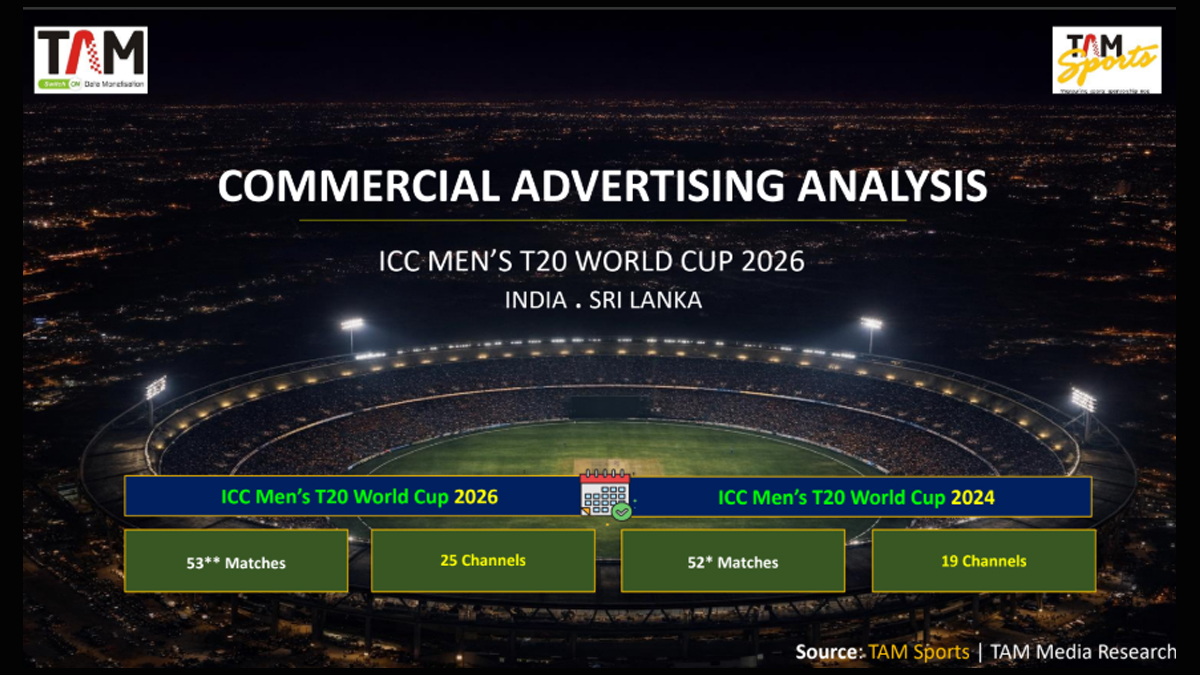
MUMBAI: Advertising during the ICC Men’s T20 World Cup 2026 may have become leaner in participation, but it certainly packed a stronger punch. A new analysis by TAM Media Research shows that ad volumes per match rose by 4 per cent compared to the 2024 edition, signalling sharper spending even as the advertiser base narrowed.
The numbers tell a tale of two trends. On one hand, the overall count of categories, advertisers and brands dropped steeply by 55 per cent, 63 per cent and nearly 68 per cent respectively versus the ICC Men’s T20 World Cup 2024. On the other, those who stayed in the game appeared to spend more aggressively, driving higher ad intensity across matches.
India’s pulling power remained unmistakable. Matches featuring the Indian team generated 66 per cent higher ad volumes than non-India games, underlining the country’s outsized influence on cricket’s commercial engine. The tournament final also saw an 18 per cent jump in advertising volumes compared to 2024, pointing to stronger monetisation at the business end of the competition.
The shift towards concentration was equally striking. The top five advertisers accounted for 39 per cent of total ad volumes, unchanged from the previous edition, but the names themselves saw a complete shake-up. OpenAI emerged as the leading advertiser with a 12 per cent share, followed by Coca-Cola India at 9 per cent and Mahindra & Mahindra at 8 per cent. Apollo Tyres and Reliance Consumer Products rounded off the top five.
A similar churn played out at the brand level, with no overlap in the top five brands between 2024 and 2026. At the same time, leading categories tightened their grip, with the top five accounting for 53 per cent of ad volumes, up from 42 per cent earlier. The cars category led the pack with a 15 per cent share, followed closely by e-commerce services at 14 per cent and aerated soft drinks at 11 per cent.
When it came to format, brevity ruled. Ads between 11 and 20 seconds dominated commercial breaks, making up over half of all spots, while shorter sub-10 second creatives followed as the next preferred choice.
The broader takeaway is clear. Even as fewer players entered the arena, those that did were willing to spend bigger and smarter. In a tournament where every over counts, advertisers seem to be playing a more focused, high-impact innings, betting on scale, timing and the enduring magnetism of cricket’s biggest stage.








