MAM
Allen jumps the gun as prep takes centre stage before JEE results
Multi-state newspaper blitz backs mindset over marks, ahead of peak results noise.
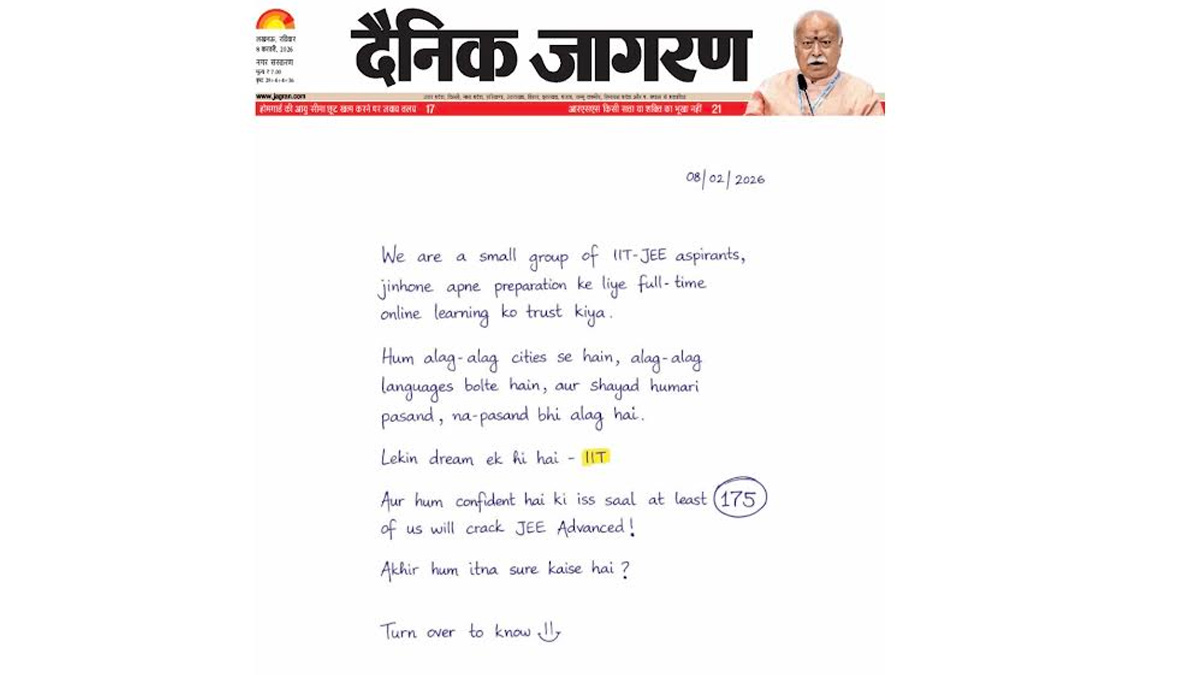
MUMBAI: While most test-prep brands wait for ranks to roll in before rolling out ads, Allen Online has decided to play a different game and play it early. Days before the JEE Advanced results are even declared, the edtech player has gone to print with a bold, multi-state newspaper campaign that flips the usual results-season script.
Running across Uttar Pradesh, West Bengal and Maharashtra, the campaign spans six leading publications and lands ahead of the most crowded advertising window in the education calendar. Instead of celebrating toppers after the fact, Allen Online places the spotlight squarely on preparation, student mindset and confidence while making a striking forward-looking claim of 175 plus IIT-qualified students even before the results are out.
Traditionally, the test-prep category comes alive only after competitive exam results are announced, with rank-led hoardings and congratulatory ads dominating newspapers and digital feeds. Allen Online’s move challenges that rhythm, signalling a shift from reactive storytelling to proactive narrative-building.
By entering the conversation early, the brand appears to be betting on recall before clutter. Results season is notoriously noisy, with multiple coaching institutes vying for the same slice of attention in a narrow time frame. A campaign timed before the announcement may help brands shape perception when audiences are not yet overwhelmed by celebratory claims and percentile wars.
“In highly competitive categories, timing can be as important as messaging. We saw an opportunity to engage audiences at a different moment in the results cycle and explore a narrative that advances outcome-led communication to a much earlier point in the results cycle,” an Allen Online spokesperson said.
The approach also subtly reframes success from a single-day outcome to a longer journey rooted in discipline and preparation. Whether this pre-results gamble pays off will be known soon enough, but for now, Allen Online has ensured it enters results season not with a whisper after the noise, but with a confident headline before it.

Brands
Amazon inks $30m carbon credit deal with Indian rice farmers
Methane-cutting farming push links climate goals with farmer income
NEW DELHI: Amazon has signed a $30 million agreement to purchase carbon credits generated by Indian rice farmers, marking one of the largest agriculture-linked carbon deals in the country to date and signalling a shift in how corporates approach climate action.
The agreement is being executed through the Good Rice Alliance, a collaboration between Bayer, GenZero, and Shell Nature-Based Solutions, backed by Singapore’s Temasek. Rather than dealing directly with individual farmers, Amazon is tapping into this alliance to scale the programme efficiently.
At the heart of the initiative is a relatively simple shift in farming practice known as Alternate Wetting and Drying. Traditionally, rice paddies remain flooded, creating oxygen-free conditions that produce methane, a greenhouse gas far more potent than carbon dioxide. Under the new method, fields are periodically allowed to dry, disrupting methane formation while maintaining crop yields.
The benefits go beyond emissions. The approach significantly reduces water usage, a crucial advantage in regions already facing water stress. For farmers, it also opens up a new income stream. By adopting climate-friendly techniques, they earn carbon credits that can be sold to companies like Amazon, effectively turning sustainability into a revenue opportunity.
The current phase of the project covers more than 13,000 smallholder farmers across roughly 35,000 hectares. Amazon expects the initiative to offset about 685,000 metric tonnes of carbon dioxide equivalent emissions, offering a measurable contribution to its broader climate commitments.
The deal is notable not just for its scale but for its direction. While many companies have historically focused on forestry or renewable energy offsets, this move highlights growing interest in agriculture-based solutions that tackle methane emissions directly. It also reflects the increasing sophistication of carbon markets, where even small, decentralised farms can be integrated into global climate strategies.
For India, the implications are significant. As the world’s largest rice producer and one of the biggest methane emitters, scaling such models could play a meaningful role in meeting climate targets while supporting rural livelihoods.
For Amazon, the message is clear. Climate action is no longer just about reducing emissions within operations. It is also about reshaping supply chains and ecosystems. And in this case, the path to net zero runs straight through the paddy fields.