Brands
Agencies must connect, not just communicate, say industry leaders at Goafest 2025

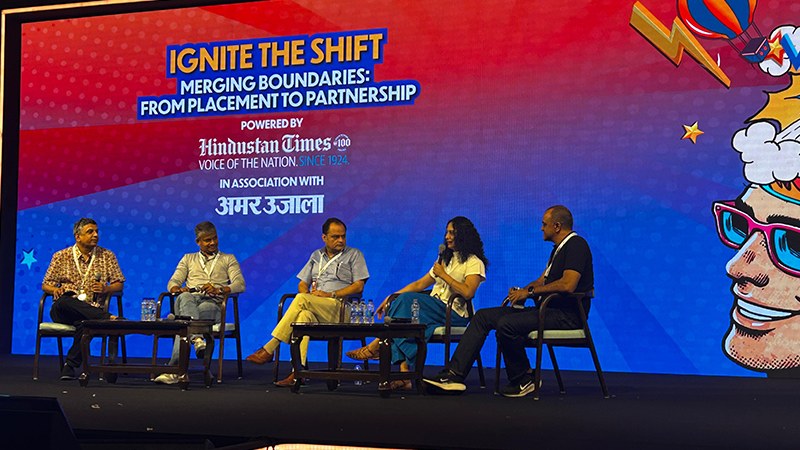
MUMBAI: Goafest 2025’s marquee session, ‘Ignite The Shift’, powered by Hindustan Times and Amar Ujala, staged a spirited conversation on marketing’s evolving ecosystem. The panel, titled “Merging Boundaries: From Placement to Partnership”, brought together five sharp minds—Google India director – marketing partners Satya Raghavan, Starcom India CEO Rathi Gangappa, JioStar head of revenue, entertainment & international Ajit Varghese, Tata Commercial Vehicles CMO Shubhranshu Singh, and moderator Omnicom Media Group India group CEO Kartik Sharma—for a high-voltage discussion on what defines partnership, performance, and brand-building in 2025.
Opening the session with nostalgic candour, Sharma remarked, “Media was once a business of placement; now it’s a business of partnership”. He added that today’s agencies juggle multiple hats—from storytellers and influencers to data miners and tech integrators.
Gangappa drove the point home: “It’s no longer innovate or die—it’s connect or die”. She called on agencies to shift from delivering solutions to forging seamless partnerships. “Partnerships today are about connecting the dots—storytelling, media, commerce, influence, even loyalty—and doing it all with intelligence and empathy”.
Varghese reinforced that clients today demand more, “Agencies now invest in first-party data and tech stacks, stitching solutions across OTT, mobile, and CTV”. From integration to insight, agencies, he said, must become navigators across a complex media map. “Clients expect segmentation, measurement, and execution to be interlinked. When they demand precision, we bend backwards”.
Raghavan added flair with an Avengers analogy. “The agency is literally the CMO’s superpower”, he joked. “In today’s marketing universe, consumers flit between universes—Youtube, search, Shorts, and shopping. Pinpointing them with the right message at the right moment is the challenge—and technology is the bridge”.
Singh brought it back to brand belief, “Separating performance from brand-building is a disservice”. He warned against the trap of short-termism. “If everything is dictated by last-click logic, brands lose soul. Media must also create scale and salience”.
The panel echoed a shared frustration with how measurement obsession has stifled creativity. Singh recalled, “We’ve become a business of attribution. But not everything valuable is measurable”. Raghavan nodded, saying that AI should empower creativity, not constrain it. “We’re now designing better razors, not just machines that shave you”.
As the session closed, Sharma fired a rapid question: “What are you doing today that would’ve sounded crazy five years ago?”
Raghavan shared that Google India had built an internal martech platform just for partner enablement. Varghese said he uses AI to ideate around obscure marketing days like “World Menstrual Hygiene Day”. Singh, meanwhile, said it’s time to rename the agency itself. “The term ‘media agency’ no longer fits. We’re something more”.






