
iWorld
Scindia opens 5G use case lab workshop to boost India’s telecom innovation
At IMC 2026, DoT highlights 100 5G labs, 1,400 hackathon teams and research collaboration for 6G development


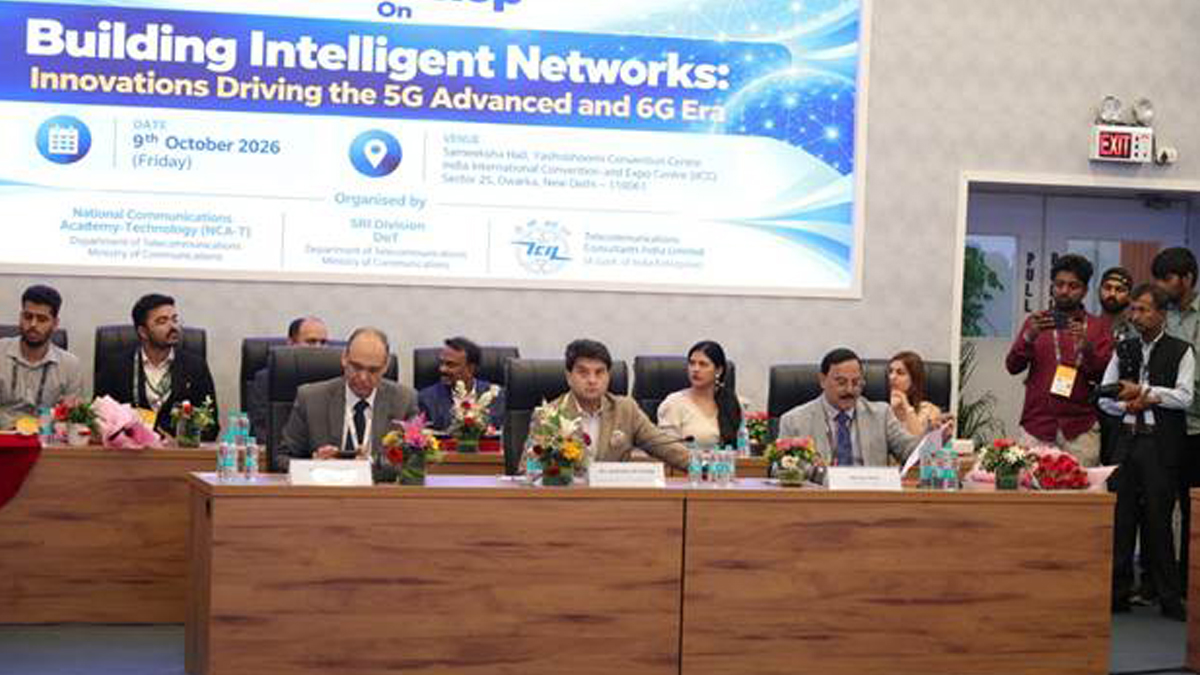
MUMBAI: India’s next telecom breakthrough may not begin with a tower or a network switch, but with a student testing an idea in a laboratory. Union minister for communications and development of the North Eastern Region Jyotiraditya M. Scindia inaugurated a one-day workshop on 5G Use Case Labs at the 10th edition of India Mobile Congress (IMC) 2026, placing student innovation and industry-academia collaboration at the centre of the country’s next-generation telecom ambitions.
Held under the theme “Building Intelligent Networks: Innovations Driving the 5G Advanced and 6G Era”, the workshop focused on turning academic research into practical technology solutions. The initiative aims to help students, researchers and academic institutions experiment with real-world 5G applications while developing capabilities for future communication technologies.
Scindia said the country’s 100 5G Use Case Labs were intended to do more than provide infrastructure, emphasising their role in nurturing innovators whose solutions could serve India and global markets.
“The networks of tomorrow will be imagined not only in exhibition halls but also in our universities, research laboratories and the minds of young innovators. The 100 5G Use Case Labs were established not merely to provide infrastructure, but to nurture innovators capable of developing solutions for India and the world,” he said.
The workshop highlighted the need to bridge the gap between academic research and industry requirements. By giving students and researchers opportunities to explore emerging technologies and test applications, the initiative seeks to encourage solutions with potential uses across sectors.
The focus also reflects a broader shift in India’s telecom ambitions: moving beyond adopting technologies developed elsewhere towards building indigenous capabilities. Collaboration among universities, research institutions, startups and industry is expected to play a role in developing applications for 5G Advanced and 6G networks.
Addressing the gathering, Department of Telecommunications (DoT) secretary Amit Agrawal stressed the importance of strengthening the academic and research ecosystem rather than limiting telecom development to conventional infrastructure expansion.
He congratulated the participating teams and underlined that innovation should continue beyond competitions and prototypes, extending into intellectual property creation, entrepreneurship, industry partnerships and commercial deployment.
Scindia also congratulated the winners of the second edition of the 5G Innovation Hackathon 2026 and the 50 finalists. He praised the potential demonstrated by young innovators and encouraged all 1,400 participating teams to continue developing ideas and technology solutions.
The emphasis on taking projects beyond the competition stage is significant for an ecosystem in which promising prototypes need industry support, investment and opportunities for deployment to become commercially viable products.
The workshop reiterated the government’s intention to connect academic research with industry requirements and national technology priorities, with the aim of accelerating the development of home-grown telecom solutions.
Alongside innovation, the workshop recognised efforts to strengthen the security of India’s digital infrastructure. Scindia commended DoT officers who completed a specialised Capacity Development Programme on Network and Mobile Security.
The programme included international certifications such as Certified Information Systems Security Professional (CISSP), Certified Ethical Hacker (CEH), PenTest and Cybersecurity Analyst (CySA). The minister distributed certificates and badges to officers who successfully completed the programme, recognising their role in developing network and mobile security expertise.
The focus on security reflects the importance of building networks that are not only faster and more intelligent but also resilient against emerging cyber threats. As telecom infrastructure becomes increasingly central to digital services, technical expertise in network protection will remain an important part of the industry’s development.
Emphasising the vision of a Viksit Bharat by 2047, Scindia called for collaborative efforts to develop intelligent networks designed and built in India and trusted globally. He formally declared the one-day workshop open.
The Department of Telecommunications reiterated its commitment to research, entrepreneurship and collaboration among academia, startups and industry to strengthen India’s capabilities in 5G Advanced, 6G and other next-generation telecommunications technologies.
The workshop’s broader challenge is to ensure that the ideas generated in laboratories translate into intellectual property, businesses and deployable solutions. With 100 5G Use Case Labs and 1,400 teams participating in the hackathon, the initiative places young innovators at the heart of that effort, as India seeks to strengthen its position in the global telecom technology landscape.