iWorld
Prime Video backs women led stories as Dahaad and Subhedar strike a chord
At CII Big Picture Summit 2026, Prime Video executives and actors discuss female agency, audience response and new storytelling opportunities


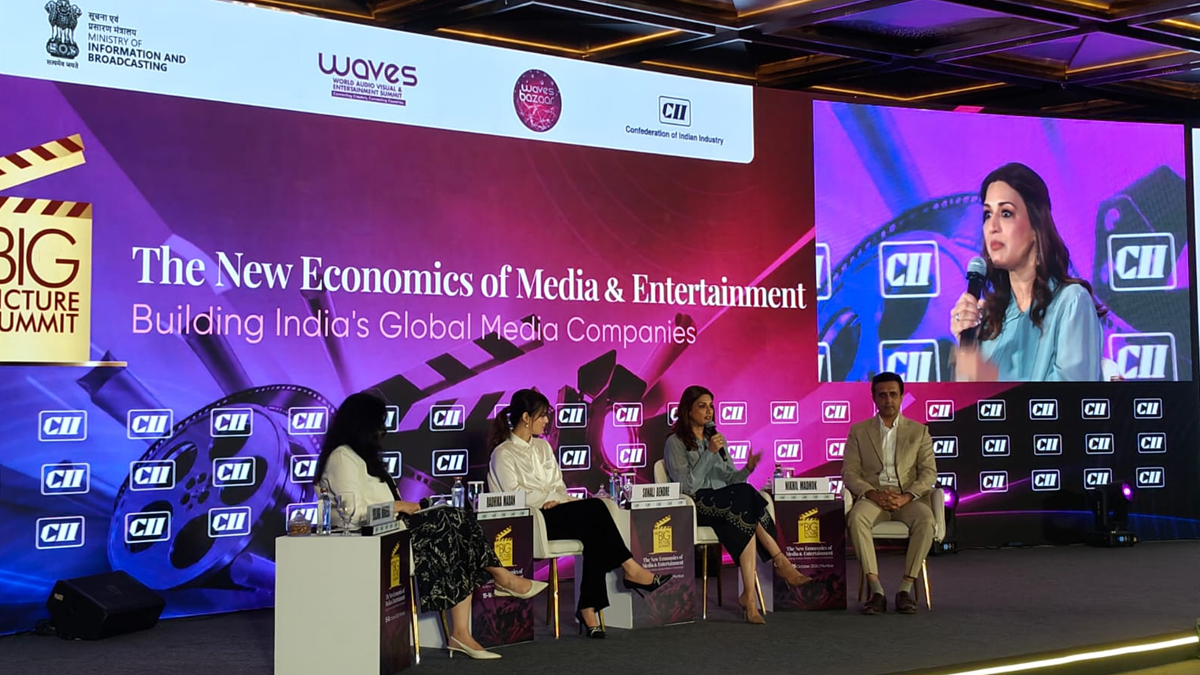
MUMBAI: Strong women are no longer just supporting characters in someone else’s story; increasingly, they are driving the plot, changing the stakes and holding audiences’ attention. At the CII Big Picture Summit 2026, Prime Video executives and actors discussed how stories led by women with agency are finding audiences, opening up more complex roles and reshaping the possibilities of Indian entertainment.
The marquee session, ‘The Power of Her Story’, brought together Prime Video India director and head of SVOD business Shilangi Mukherji, actress Sonali Kulkarni, actress Radhika Madan and Nikhil Madhok, director and head of originals (SVOD) at Prime Video and Amazon MGM Studios India. The conversation explored the creative decisions behind titles such as Dahaad and Subhedar, the commercial potential of female-led narratives and the opportunities offered by streaming’s longer storytelling formats.
Mukherji said Prime Video was drawn to stories featuring women with agency across genres, rather than limiting female characters to a particular type of narrative. She cited titles such as Paatal Lok, Subhedar, Call Me Bae and Dahaad as examples of the diversity of stories being developed, with characters who have their own ambitions, conflicts and defining journeys.
For the platform, she said, the common thread was not genre but the presence of women doing something remarkable within their stories. That approach, she added, had become an important consideration when deciding which projects to back.
The discussion highlighted how female characters in Dahaad and Subhedar were given arcs that carried weight alongside those of their male counterparts.
Madhok recalled how the team responded to the casting of Mrinal Kulkarni in Subhedar after director Suresh Kothare said he could imagine only her in the role. The character, he explained, has her own journey of confronting troublemakers and challenging the system, running alongside Subhedar’s fight against corruption.
In Dahaad, the decision to cast Sonali Kulkarni was driven by the need for an emotional centre to the story, particularly through the mother’s character. Madhok said a conversation with the actress quickly established a shared connection with the script.
For Sonali Kulkarni, the role was an opportunity to play a character whose response to the loss of a child did not follow a familiar dramatic template. She said the script’s nuanced treatment of grief and the mother’s distinctive reaction convinced her to take it on.
“I was looking for amazing characters, and that’s what Dahaad offered,” she said, explaining that the story’s treatment of loss was the decisive factor. The role was challenging, she added, because she had been avoiding emotionally difficult material during a period of healing and recovery. Nevertheless, she was determined not to let the opportunity pass, even if she needed to arrange therapy to help her through it.
Kulkarni described the experience as both difficult and rewarding, saying the character marked a culmination of her own healing and grieving period.
For Madan, Subhedar was a project she had initially planned to turn down. She recalled attending the meeting intending to persuade Kothare to consider her for another role. His dramatic narration, complete with music and his portrayal of multiple characters, changed her mind.
The father-daughter relationship was a major draw, she said, particularly the character’s struggle between the person she wanted to become and the traits she ultimately inherited from her father. The story also explored corruption, standing up for oneself and finding the courage to fight back.
Madan said the character’s journey connected with her because of its emphasis on survival and self-assertion, making the role different from her earlier work.
The speakers argued that the expansion of streaming has created space for characters and storylines that can be difficult to develop within a conventional film runtime.
Kulkarni said the arrival of multiplexes had already broadened the range of stories finding audiences by changing viewing habits and allowing more varied voices to emerge. Streaming, particularly long-form storytelling, had taken that further by giving characters more time to develop.
She noted that a role such as the mother in Dahaad could have been considerably reduced in a film, even if its emotional nuances remained. A series, by contrast, allows the character’s arc to unfold more fully, offering actors greater scope to explore complex motivations and reactions.
Kulkarni said she valued the distinct strengths of films, television and streaming, but increasingly looked to long-form projects for challenging roles with depth and strength.
She also pointed to a significant change behind the camera. Earlier in her career, she recalled, women on sets were often limited to the female actor and perhaps one senior woman in a leadership position. Today, she said, seeing women working as directors, technicians and in other behind-the-scenes roles was particularly encouraging.
While she acknowledged that the industry had made considerable progress, she stressed that more roles and opportunities for women were still needed. Commercial success, she added, was important in demonstrating that such stories could work for audiences.
Madhok said the platform wanted to avoid treating strong female characters as a box-ticking exercise. Instead, he said, the process begins with a compelling idea from a creator who genuinely wants to tell the story.
The team looks for female characters written as complete human beings, with different shades and contradictions rather than being confined to a fixed idea of what a strong woman should be. Female writers in writers’ rooms can also bring important perspectives to character development, he said.
Madhok cited Anusha Nandakumar, one of Dahaad’s creators, for the work that went into developing the character played by Sonali Kulkarni, ensuring that her emotional responses felt authentic to the story.
He said the platform’s role was to back the right creators, bring the right talent into the project and give strong scripts the opportunity to reach audiences.
The discussion also addressed whether female-led stories can deliver commercial results. Madhok said Prime Video’s experience had reinforced its belief that audiences respond to well-told stories regardless of whether the lead character is male or female.
He described Subhedar as the biggest original movie hit in Prime Video’s history, while Dahaad was the first series globally to trend at number one on the platform worldwide, according to his remarks at the session.
The figures were presented as evidence that stories centred on women can achieve both critical engagement and substantial audience interest, challenging assumptions that female-led narratives have limited commercial appeal.
Mukherji also highlighted the international reach available to streaming titles. She said Prime Video takes its stories to more than 240 territories and that 25 per cent of its streamers come from outside India. She added that the Indian diaspora had responded strongly to titles such as Dahaad and Subhedar, extending their reach beyond the domestic market.
For the speakers, this wider distribution offers Indian creators an opportunity to tell more distinctive stories without being confined to assumptions about what audiences in a single market will watch.
The conversation moved beyond viewing figures to the social discussions sparked by the shows.
Kulkarni said the response to Dahaad exceeded her expectations. She credited the creators and director team, including Anusha Nandakumar and Sandeep, for building the story around an incident that changed how society viewed safety and trust.
She said the series prompted conversations about how parents began warning children against strangers and how fear gradually changed everyday behaviour. Rather than simply presenting a story of loss, Dahaad explored what such events can do to society’s collective sense of innocence and trust.
Kulkarni said this underlying idea had not fully struck her when she first encountered the story, but became clearer through the creators’ interpretation. She praised the team for recognising the wider social implications and bringing them into the narrative.
Madhok also recalled the challenges surrounding Kulkarni’s participation in the series. Around a week or 10 days before filming was due to begin, the actress broke her wrist and required surgery. Rather than withdraw, she agreed to work around the injury, with scenes involving more extensive hand movements to be scheduled later.
According to Madhok, Kulkarni returned to set just three or four days after surgery for some sequences. Her commitment, he said, helped the production continue while the team adjusted the shooting plan.
The discussion also examined a particularly intense action sequence in Subhedar, in which Madan’s character confronts an attacker. Madan said the scene stood out during the narration and required careful preparation to feel believable.
Although she had trained in martial arts for a year and a half, Kothare told her that the action needed to feel real and reflect the character’s background as a kabaddi player. The choreography incorporated elements of the sport, including a move used to grab and pin down an opponent.
Madan connected the sequence to her own experience of growing up in Delhi, where she recalled being eve-teased at the age of 11 or 12. She said the incident had left her frightened and confused, and reflected on how such experiences can make women more guarded from an early age.
For her, performing the scene became an opportunity to channel those emotions into a character who could fight back. She said the experience was empowering, allowing her to express feelings that she had been unable to act on in real life.
Mukherji noted that the sequence’s impact came not only from its physical action but also from the emotional intensity Madan brought to it. She said the actress needed a 20-minute break around the filming of the scene to recover from the emotional demands of the performance.
As the session turned to performances that had inspired the actors, Kulkarni spoke about the variety of roles played by Anne Hathaway, saying that an actor’s dream was to move between different kinds of powerful characters rather than remain associated with a single type.
She said she hoped to have the opportunity to explore that range in her own career, adding that Hathaway’s ability to balance professional work and family life was also inspiring.
Madan, meanwhile, made a direct pitch for an Indian female superhero, drawing applause from the audience. She said she wanted to see a superhero created for the country rather than relying on the characters that dominate international franchises.
Madhok responded by recalling a similar discussion at an industry forum around a year and a half earlier, when he had been asked why Indian children were primarily watching superheroes from the West, including Marvel and the Avengers.
He said the question had stayed with him and had led the team to explore an Indian alternative. At Prime Video’s recent Presents event, the platform announced a partnership with TVF to create Vansh, described at the session as India’s first live-action superhero series. The project, which is going into production, is rooted in Indian history and mythology.
Madhok said Madan’s suggestion would prompt further thought, highlighting how conversations about representation can also shape the kinds of projects platforms consider developing.
The session closed with Mukherji reflecting that the performances discussed had not been calculated attempts to meet a representation target. Instead, she said, they had emerged from conviction among creators, actors and the platform backing the stories.
The broader message was that women-led storytelling is not simply about placing a female character at the centre. It is about giving her a fully realised journey, allowing her to make consequential choices and trusting audiences to engage with the complexity that follows. As streaming expands the canvas for Indian entertainment, the challenge for the industry is to turn that creative progress into a sustained pipeline of varied stories, more opportunities for women behind and in front of the camera, and commercial success that keeps those stories coming.