iWorld
Offshore Betting Sites: Why New Domains Keep Appearing After Blocks
Offshore betting sites can reappear after domain blocks. Learn why operator identity, licensing and domain verification matter more than the URL alone.


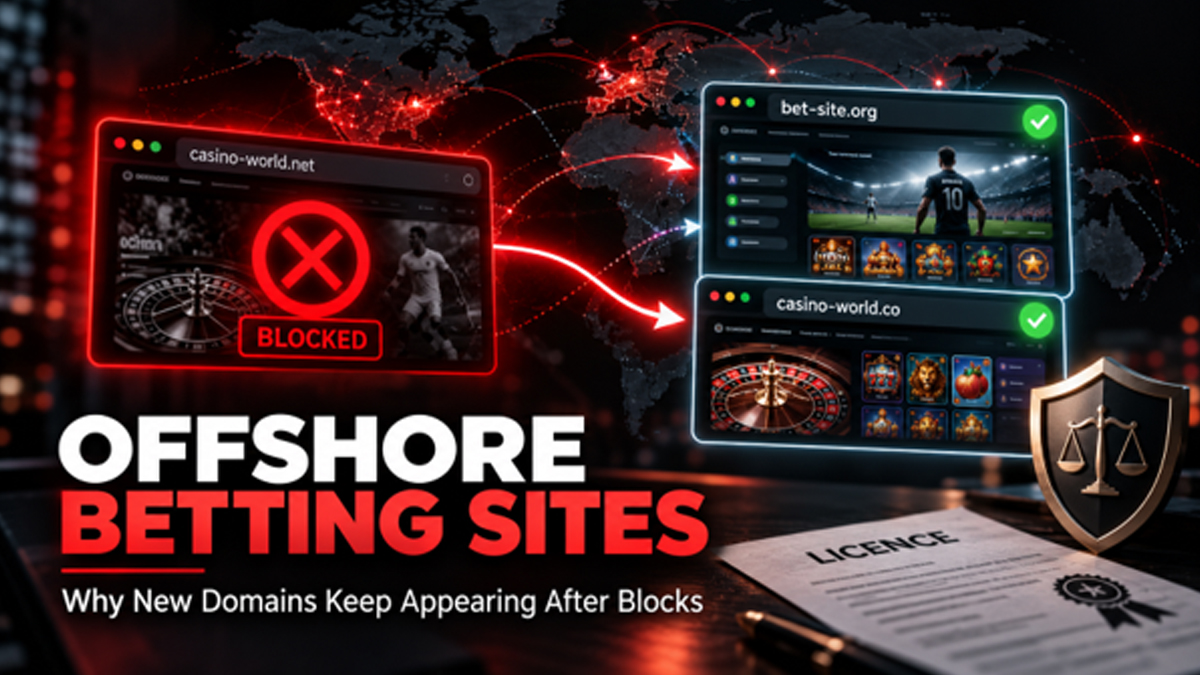
Blocking an offshore betting website sounds straightforward: identify the domain, restrict access and remove one more unlicensed gambling service from the market.
In practice, it rarely works that way.
India shows why. By January 2026 the government said it had blocked more than 7,800 illegal betting and gambling websites, yet traffic data reported at the time suggested that several blocked or restricted brands still drew hundreds of thousands of visits from India each month. India’s advertising self-regulator describes the same pattern from the advertising side: ASCI’s annual complaints report found betting brands operating across more than 60 domains, with individual takedowns having limited impact, and operators quickly reappearing through new accounts, IPs and minor brand variations.
The problem is therefore not simply finding a website. It is identifying the business behind it.
A domain is an address, not the gambling business
For most consumers, a gambling service is a brand name and a website. Legally and operationally, the structure is more complicated:
| Layer | What it identifies | Why it matters |
| Brand | The name marketed to players | Can survive a domain change |
| Domain | The current web address | Can be replaced or redirected |
| Legal operator | Company responsible for the service | Central to accountability |
| Licence holder | Entity authorised by a regulator | Determines regulatory responsibility |
| Platform provider | Technology behind the site | May serve multiple brands |
| Payment infrastructure | Systems involved in transactions | Adds another operational layer |
Sometimes one company controls most of these layers. In other cases, responsibilities are divided. Neither structure is automatically problematic. What matters is whether it is possible to identify who is legally responsible for the player relationship and under what authority the service operates.
Blocking a domain removes an address. It does not dissolve the company, disable its technology or prevent another address from being used.
Why blocking one domain may not remove the operation
Domain blocking still has value. It interrupts access and raises the cost of reaching users. But the domain is only one component of the operation.
Advertising is another, and the ASCI report puts numbers on it. ASCI identified and escalated 7,927 offshore betting advertisements during 2025, and offshore betting made up roughly 72% of all advertisements found in violation in FY26. This happened despite the Promotion and Regulation of Online Gaming Act (PROGA), which prohibits all advertising of online money games, including informational or disclaimer-based ads. In the eight months before the law, violative offshore betting ads averaged 594 a month. In the four months after it, they averaged 795. ASCI also reported 854 influencers promoting offshore betting content between April and December 2025, including accounts dedicated entirely to it.
The report’s description of the ecosystem is telling: fast content churn, distribution through influencers, affiliate networks, social media groups and messaging platforms, pages whose ownership is hard to trace, and brands spread across dozens of domains. The visible website is one layer of a network. If the other layers stay intact, replacing the address is easier than replacing the business.
IndianTelevision has already reported on this wider challenge in its coverage of offshore betting advertising in India.
Follow the operator, not just the brand
A stronger way to understand a gambling network is to move beneath the public brand and identify the legal entity responsible for it.
Two casino websites can have different names, designs and promotions while being connected to the same operator. The reverse is also possible: two sites may look alike because they use the same game providers or software while being run by unrelated businesses. Visual similarity is weak evidence of common ownership. Legal documentation is stronger.
Research can begin with a site’s terms and conditions, privacy policy and regulatory footer. These pages may identify the contracting company, registered address or claimed licence, which can then be compared with regulator records. Matching legal entities, licence details and registered addresses provides stronger evidence of a connection between brands than visual similarity alone.

This operator-level view reveals relationships that disappear when every domain is treated as an independent business. It also prevents the opposite mistake: sharing a platform or cashier system does not by itself mean common ownership.
White-label infrastructure adds another layer
A consumer-facing gambling brand may rely on technology supplied by another company, from the casino platform and payments to compliance tooling and back-office systems. White-label arrangements are an ordinary operating model, not a red flag.
But they show why the logo on a homepage is not the only organisation involved. The important question is not whether several companies are involved, but whether responsibility remains identifiable. A complicated structure can be transparent. A simple-looking website can be opaque.
Crypto payments do not answer the accountability question
A casino that accepts Bitcoin or USDT may settle transactions quickly. That says little about who controls the account.
A blockchain transaction can be publicly traceable while the company approving the withdrawal remains hard to identify. The FATF’s 2026 report on gaming and gambling lists cash, e-wallets, mobile money and virtual assets among the payment methods vulnerable to money-laundering risks. Payment speed and payment variety are not trust signals. What sits around the payment rail matters more: operator identity, licensing, withdrawal conditions and the history of the company behind the platform.
The same distinction matters when comparing crypto gambling platforms. A large coin selection or fast blockchain settlement does not show whether an operator handles withdrawals consistently or applies clear verification rules. CasinoIndex’s crypto casino comparison therefore looks at operator transparency, withdrawal behaviour, KYC requirements and other trust factors alongside cryptocurrency support.
A licence should be verified, not displayed
A regulator’s logo in a footer proves very little. A meaningful check asks:
- Which company holds the licence?
- Is the authorisation still active?
- What activities and markets does it cover?
- Does the regulatory record match the operator and, where the regulator publishes domain information, the website?
That last question matters most where sites move between addresses. A genuine licence held by a genuine company does not make every website claiming a link to that company authorised. Verification works in both directions: website → operator → licence, and licence record → authorised entity or domain → website. The strongest check is an independent match between the operator named on the site and the information published by the relevant regulator.
One point is easy to miss. A licence is jurisdiction-specific. A foreign licence is not permission to serve a market where the activity is prohibited. In India, where online real-money games are banned under PROGA, a licence claim from elsewhere does not make a site lawful for Indian users.
India’s framework reaches beyond the final website
The Ministry of Electronics and Information Technology (MeitY) publishes the Gazette notification of the PROGA framework, India’s current approach to online gaming regulation.
For enforcement, the key point is that online gambling does not run through a website alone. It depends on advertising distribution, affiliates, financial infrastructure, hosting, software and other services. Regulating only the final website leaves much of that ecosystem untouched. The more useful question is which organisations allow the operation to reach users, move money and remain accessible.
Financial-crime authorities are looking below the interface
The same shift is visible internationally. The FATF’s report Risks of Gaming and Gambling, published on 9 September 2026, examines online platforms, payment channels and illegal operators. It describes illegal and unlicensed gambling as one of the sector’s most significant risks and flags complex ownership structures, such as nominees, trusts or fragmented shareholdings, as a way to obscure beneficial ownership.
A regulated market reaches a similar conclusion. The UK Gambling Commission’s 2026 risk assessment, published on 30 July 2026, keeps remote casinos at high risk for money laundering, citing high transaction volumes and customers not being present for verification.
That is not a claim that every remote casino or offshore operator is linked to financial crime. It means the structure of remote gambling creates risks that require stronger controls. Where accounts open without a physical visit and money moves across jurisdictions, knowing which company controls the account matters more, not less.
Advertising platforms face the same identity problem
Publishers, social platforms and ad networks have the same issue. A gambling advertiser may present a familiar brand and a working website. That still leaves open:
- Who legally operates the service?
- Does the advertiser actually represent that operator?
- Is the promoted domain connected to any licence being claimed?
- Has the same operator appeared under other brands or domains?
The useful question for a publisher is not only “Which website wants to advertise?” but “Which legal entity operates the service behind it, and can its authority be independently verified?” The first identifies a URL. The second establishes accountability.
What readers and publishers can check
Nobody needs a full corporate investigation before every click. A few basic checks reveal whether a gambling business leaves a reasonably clear legal trail:
- Who do the legal terms name as the operator, and is a registered company given?
- If a licence is claimed, can it be verified independently, and does it match the operator or site?
- Are other brands tied to the same legal company?
- Is there a visible complaint route?
That last point is a useful test of whether accountability is real. A licence or operator name is more meaningful when users can also identify a clear complaint route and understand which company is responsible when a dispute arises. In regulated markets, this may include the operator’s own complaints process, independent dispute resolution and escalation to the licensing authority.
Corporate complexity is not itself evidence of risk. A group can run many brands while clearly disclosing the company behind each one. A single-brand site can be harder to assess if its operator cannot be identified. Transparency matters more than simplicity.
A new domain does not mean a new business
A recently created website has little public history under that exact domain. Its operator may have considerably more: other brands, earlier complaint patterns, past regulatory actions. A search limited to the new brand misses that context.
The reverse also happens. An established brand can change operator, licence structure or legal entity, and old reviews then describe a business that no longer exists. That is why operator and licence information should be checked against current records rather than assumed from reputation.
A blocked domain and a blocked operator are not the same thing
Different forms of intervention target different layers. Domain blocking targets access. Advertising restrictions target promotion. Payment controls target the movement of funds. Licensing rules define legal authority. Operator identification connects them.
The most visible part of a digital gambling operation is also one of the easiest to replace. A domain can change. An advertising account can disappear. A new brand can be created. Legal responsibility should be harder to move.
A domain tells a user where a gambling service can be found today.
The operator tells them who should still be accountable tomorrow.
Site Disclaimer:This article has been published without the journalistic or editorial involvement of indiantelevision.com, IndianTelevision.com Group, or any of its affiliated websites. IndianTelevision.com Group does not endorse, subscribe to, or take responsibility for the content, opinions, or views expressed herein.
Readers are further advised that Online Casino, Betting, Cryptocurrency products, Financial Investments/Engagements, NFTs, and products or calls-to-action related to Health, Booking, Wellness, and Food are largely unregulated and carry significant risk. There may be no regulatory protections or avenues for recourse in the event of financial losses or health-related risks arising from engagement with such products or services.
IndianTelevision.com Group expressly disclaims any responsibility or liability for the information, views, announcements, declarations, or affirmations presented in this article. By choosing to proceed, the reader acknowledges and agrees that they do so at their own discretion and risk, and expressly absolve indiantelevision.com (IndianTelevision.com Group) from any potential legal claims, liabilities, or actions.
The content provided is solely for informational and awareness purposes






