
iWorld
India Mobile Congress 2026 puts home-grown technology and next-gen networks in spotlight
IMC marks a decade of telecom growth, with focus shifting to 6G, AI and indigenous technology


NEW DELHI: India’s telecom journey is moving from connecting people to creating technology for the world. Prime Minister Narendra Modi inaugurated the 10th edition of India Mobile Congress (IMC) 2026 at Yashobhoomi in New Delhi on Thursday, with the government highlighting the country’s nationwide 5G expansion and setting a target of connecting one billion 5G users by 2030.
Organised jointly by the Department of Telecommunications (DoT), under the Ministry of Communications, and the Cellular Operators Association of India (COAI), the four-day event is being held under the theme ‘Scale Without Boundaries’. It brings together policymakers, telecom operators, technology companies, startups, investors and researchers to discuss the future of connectivity and emerging technologies.
Addressing the gathering, Modi said India had transformed from being a consumer of technology into a creator, with ambitions to develop products, intellectual property and solutions domestically.
The prime minister also highlighted the expansion of 5G services across the country, noting that India had deployed around 5.5 lakh 5G base stations and that mobile internet speeds had increased tenfold since 2022.
Union minister for communications and development of the north eastern region Jyotiraditya M. Scindia outlined the scale of India’s telecom expansion over the past decade.
India now has more than 1.35 billion telecom subscribers and over 1.09 billion broadband connections, Scindia said. Average monthly data consumption per user has risen from 0.26GB in 2014 to more than 36GB, while data costs have fallen by 97 per cent.
He added that the country’s 5G rollout had reached 550 million users across 99.9 per cent of its districts. The next target is to connect one billion 5G users by 2030 and strengthen India’s role in global digital innovation.
Scindia also highlighted the fall in data prices, saying one GB of data that cost Rs 268 in 2014 was now available for around Rs 8.
The expansion of connectivity has also supported the delivery of public services. Modi said hundreds of government services were now accessible through mobile phones, while direct benefit transfers had channelled nearly Rs 50 lakh crore into beneficiaries’ bank accounts, helping prevent around Rs 5 lakh crore from reaching unintended recipients.
IMC 2026 is placing greater emphasis on technologies that extend beyond conventional telecom infrastructure, including satellite connectivity, AI-native pre-6G networks, sovereign cloud, terahertz communications and integrated sensing and communication.
The exhibition also features applications across smart mobility, stadium experiences, industrial robotics and transport technology, reflecting the growing convergence of telecommunications, computing and artificial intelligence.
The event’s four pillars are Srishti, focused on building the future through innovation and next-generation infrastructure; Samvardhan, aimed at investment, entrepreneurship and manufacturing; Sashakt, centred on expanding opportunities through digital technology; and Suraksha, focused on secure and trusted networks.
According to the organisers’ pre-event projections, IMC 2026 is expected to attract more than 1.5 lakh attendees from over 100 countries, alongside more than 500 exhibitors and partners, 600 startups, 900 thought leaders and around 700 investor meetings.
The Department of Telecommunications is using the event to showcase home-grown technology and citizen-focused digital initiatives.
Its pavilion, built around the theme ‘Samridh Gram’, highlights how connectivity can support rural development and inclusive growth. Demonstrations include Sanchar Saathi, the Financial Fraud Risk Indicator and initiatives from the Telecommunication Engineering Centre and the Wireless Monitoring Organisation.
The event is also showcasing new telecom products and technology solutions developed by Indian companies, reflecting the government’s push to expand domestic research, manufacturing and intellectual property.
Modi said India was moving towards a stage where product design and the technology behind products would increasingly be developed within the country. He also pointed to ongoing reforms and incentives intended to strengthen indigenous capabilities.
Alongside the inauguration, Scindia chaired the IMC 2026 Ministerial Programme, which brought together international policymakers and telecommunications leaders to discuss investment, inclusive connectivity and resilient digital infrastructure.
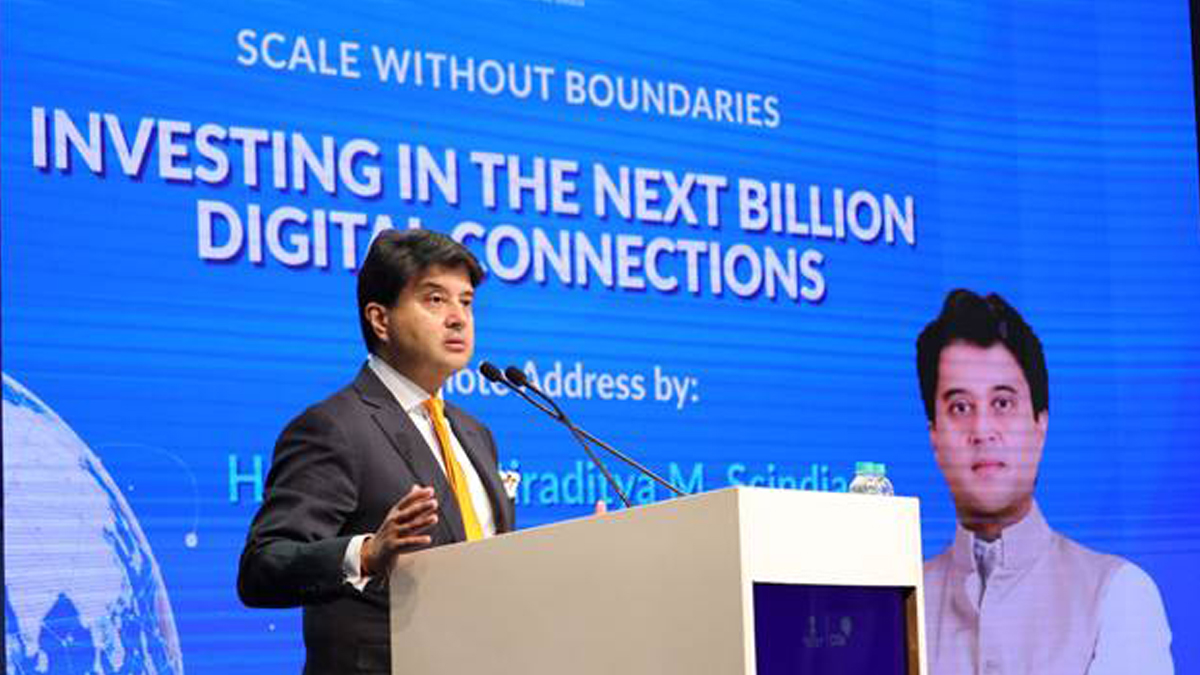
Held under the theme ‘Scale Without Boundaries: Investing in the Next Billion Digital Connections’, the programme featured representatives from Estonia and Japan, as well as the International Telecommunication Union and the GSMA Foundation.
Scindia said the next billion people to be connected would be among the hardest to reach, but could also bring new learners, entrepreneurs and innovators into the global digital economy.
He called for greater international cooperation and investment to ensure that geography, income or circumstance did not become barriers to digital opportunity. Discussions also covered 5G-Advanced, 6G, satellite networks and artificial intelligence.
Scindia also chaired a CEO round table titled ‘The Sovereign Inflection & The Future of Telecom’, bringing together senior representatives from telecom operators, network equipment manufacturers, technology companies, digital infrastructure firms and advisory organisations.
The discussion focused on the convergence of AI, cloud and computing, advanced connectivity and intelligent networks, alongside the need to strengthen domestic capabilities and create an environment that supports long-term investment.
Scindia said India had made significant progress in coverage, affordability, inclusion and innovation over the past decade. He highlighted the country’s position as the world’s second-largest telecom market and mobile phone producer, while pointing to the semiconductor manufacturing ecosystem taking shape in India.
The next stage, he said, would depend on India’s ability to shape technology standards, manufacture equipment and develop innovation across the telecom value chain.
The government also reiterated its commitment to working with industry, startups and research institutions to build a resilient and globally competitive digital ecosystem.
As India Mobile Congress enters its second decade, the focus is shifting from the scale of connectivity to the ability to develop, manufacture and export the technologies that will power the next generation of digital networks.






