iWorld
GUEST COLUMN | Three seconds to hook, eight episodes to pay: the new grammar of the microdrama
Three seconds. That is all a microdrama gets before the thumb moves on.


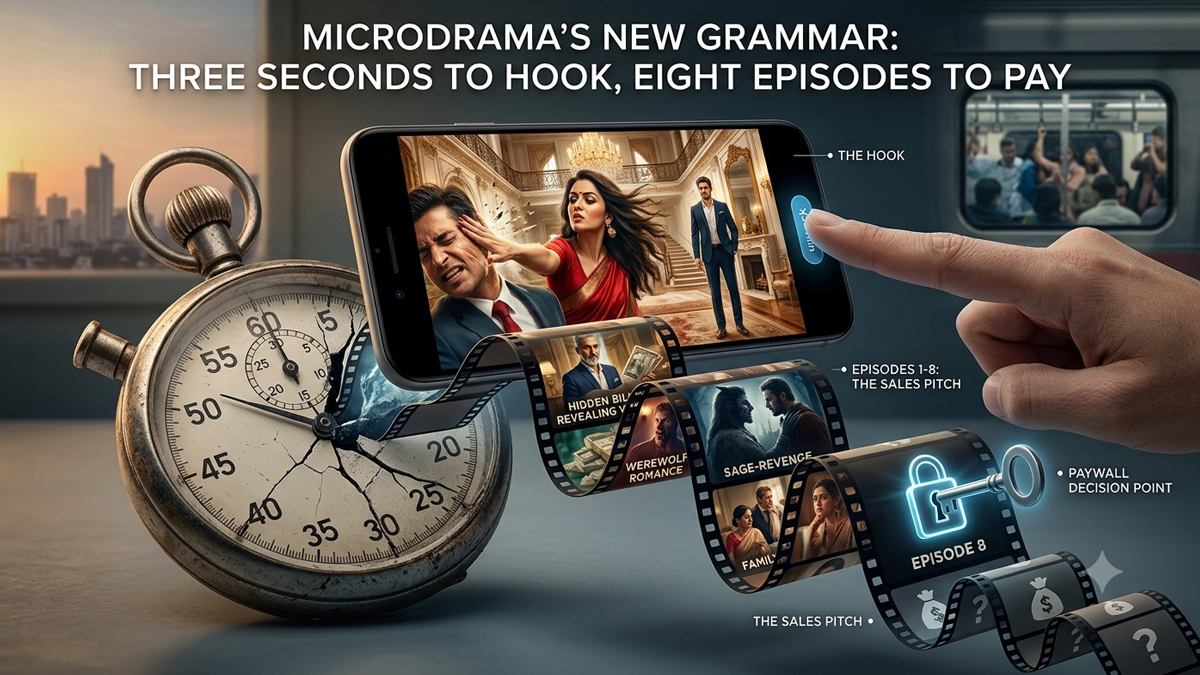
MUMBAI: The microdrama boom is rewriting the rules of storytelling, audience engagement and content monetisation, with every second engineered to capture attention and drive the next click. In this guest column, Indiantelevision.com founder, chairman and editor-in-chief Anil NM Wanvari examines how three-second hooks, calculated cliffhangers, evolving genre preferences and AI-led production are shaping the business of vertical storytelling, and why keeping viewers engaged beyond the eighth episode could determine who wins in this fast-growing entertainment category.
No title card. No slow pan across Mumbai at dawn. A slap across a face, or a waiter in a cheap shirt revealed as the heir to a fortune. Ninety seconds later comes a gasp, a freeze and the next episode is already loading.
This year the format stopped fiddling with its stopwatch. Episodes have settled at 60 to 120 seconds in India and the big overseas markets, with 90 to 100 seconds as the sweet spot. Some go tighter. JioHotstar says Tadka’s episodes run 30 to 60 seconds. A series still runs 50 to 100-plus episodes. Lay them end to end and you have a feature film, cut into pieces small enough to swallow between two WhatsApp pings.
Forget the two-hour marathon. Indians do not watch microdramas that way. A Meta-Ormax study found viewers spend a median of about 30 minutes a day on them, across seven or eight short sessions.
That is not streaming. It is the daily soap, taken eight times a day instead of once at 9 pm. A few minutes over breakfast, a few in the metro, a few at lunch and a long stretch in bed. The episode is the unit. The drip is the habit.
It is working. Tadka says daily watch time per viewer has grown fivefold since launch, and over 42 per cent of its users are under 24.
Everything hangs on the opening three seconds. The reason is commercial, not artistic.
Viewers do not walk into a microdrama. They trip over it. According to Meta-Ormax, 89 per cent of Indian viewers find microdramas through social feeds. The opening is not up against another show. It is up against a cricket clip and a cousin’s wedding reel, one flick away. If nothing happens in three seconds, the viewer never learns there was a story.
So the first shot does the job of a first act. A woman thrown out of a mansion in the rain. A husband caught with a stranger. Conflict first, context later, if ever.
Those seconds double as the advertisement. The apps buy their audiences on Facebook, Instagram and YouTube, and the hook is the creative. My Drama alone runs about 30,000 unique ad creatives a month across Facebook, Snapchat and TikTok. Each is a different opening, tested to see which stops the scroll. Losers vanish within days. Winners become the first scene. In this business the marketing team gets a vote on the opening shot before the director does.
Inside the app the rule repeats. Autoplay queues the next episode, so every instalment is a cold start. Ormax calls each one a decision point. A 70-episode series is not one hook. It is 70.
Indian television never had to sweat like this. A daily soap could open with a two-minute recap because the viewer had already picked the channel and the remote was across the room. On a phone, the remote is the thumb, and it never leaves the glass.
If the first three seconds sell the show, the next eight episodes sell the subscription.
On paywalled apps the big decision comes early. One analysis puts the unlock moment between episodes eight and nine. The first eight are a sales pitch. The eighth must end on the biggest shock of all.
Writers know it. Scripts are built backwards from that moment. Exposition is dead. Ptoducers says the hook must land almost at once, the stakes must keep climbing, and every episode must give a reason to watch the next..
The engineering has a price. When every 90 seconds demands a twist, characters turn stupid on cue. The wife who never spots her husband’s second phone. The heir who hides his wealth for 70 episodes for no reason at all. Audiences notice. Ormax found many viewers drift back to free social feeds rather than stay on paid apps, and flagged trust and consistent storytelling as the keys to growth. A cliffhanger that cheats earns one click, not a subscription.
The smarter producers now want tighter logic and payoffs that feel earned. Retention across the whole series is the number that pays the bills.
Romance still rules. Beneath it, five tropes return like clockwork.
The hidden billionaire, the ordinary man who turns out to be loaded. Pure revenge, the wronged woman or man back to settle scores. The secret identity, a double life or a buried past. Family betrayal, the relative who wrecks everything. The underdog, nobody to somebody in under ninety seconds.
They win on efficiency. Each plants an injustice in episode one and promises its reversal later. The viewer pays to see that promise kept.
What is new is how finely the tropes are now sliced by gender. In one recent weekly chart, a werewolf romance drew an audience that was 97.6 per cent female, while a sage-revenge title pulled in 91.49 per cent men. Women are sold rescue. Men are sold the comeback. Same fantasy wrapper, opposite emotional products.
And the men are pouring in. On My Drama, male users rose from 1.1 per cent to 30.3 per cent of monthly actives in seven quarters as the format spread into drama, comedy, science fiction and fantasy. The same study names horror and thriller as underserved. Follow the men and you see where the catalogue is heading.
India’s shelves already show it. A producer, whose credits include Crime Patrol and Savdhaan India, has made more than 30 microdramas, trying revenge, romance, family drama, crime, horror, hidden identity and youth stories with different hooks, lengths and pacing. Tadka’s slate covers romance, drama, thrillers, comedy, sports and youth stories in Hindi, Tamil, Telugu and more. It has also left Mumbai behind, with stories set in places like Indore and Lucknow.
That regional turn matters more than any single genre. For two decades the Hindi GEC sold one joint-family drama to the entire country. Microdrama can make a show for Lucknow and another for Hyderabad, because each costs a fraction of a TV episode and the data delivers a verdict within days.
Franchises have arrived as well. Story TV’s operator says Hacker King crossed 170 million views and spawned a sequel and a prequel, an Indian first. Once a plot becomes IP, a genre bet becomes a business.
Here is the bit few are talking about. How a show is made now decides what kind of show it is.
Fantasy and period drama used to cost a bomb in live action. Sets and effects ate the budget. AI has crushed that cost. In China, 95 per cent of the roughly 128,000 short dramas published in the first quarter were AI-generated. Hence the flood of werewolves and immortal sages. Producers says AI suits effects-heavy genres, while live action still wins on emotion.
Expect the catalogue to split down that line. Machines will churn out the spectacle. Humans will keep the slap across the dining table and the mother-in-law’s glare. India, where family drama still sells best, may hold on to live action longer than China. Not for ever, though.
The length is fixed and the hook is mandatory. Pure romance has lost its monopoly. The microdrama is now a category with a grammar of its own.
The phone owns the next ninety seconds. Producers who waste the first three will never see episode nine.