iWorld
Facebook announces call for applications from non-profit organisations for its CSR grant

MUMBAI: Facebook India today announced a call for applications for its CSR initiative, Facebook Pragati – powered by N/Core (The/Nudge Centre for Social Innovation). The initiative will incubate and accelerate, early stage women led non-profits that are working in the areas of women entrepreneurship and to drive awareness and adoption of technology among women in India. This is a part of the Corporate Social responsibility mandate by the Government, where Facebook will work in collaboration with N/Core. Facebook Pragati will award four grants of up to 50 lakhs for each non-profit to scale their work.
Ajit Mohan, Vice President and Managing Director, Facebook India said, “Facebook is an ally for accelerating India’s growth and promoting inclusion is one of our key priorities. An important enabler for that is financial independence. The relative number of businesses in India run by women entrepreneurs is still very low. We are committed to helping women entrepreneurs succeed through greater access to digital platforms, funds and mentorship. Our CSR focus with Facebook Pragati will be to empower women to set-up and grow their businesses, and contribute to making the country economically and socially stronger. ”
“N/Core believes in the massive potential of women entrepreneurs to drive innovation, create jobs, unlock the power of technology, and fuel India’s economic growth. We are excited to partner with Facebook in launching Pragati and taking a significant step towards bridging the deficit for providing essential support for women entrepreneurs.” added Akshay Soni, Managing Director, N/Core Accelerator

Each of the non-profits selected for Facebook Pragati initiative will get access to:
Direct Grant: as resources to build an organization and scale operations for a greater impact. Each non-profit selected will receive a grant of upto INR 50Lac.
Mentorship: by an N/Core Partner – Kamakshi Rao (Partner, Ankur Capital); K R Lakshminaraya (Chief Endowment Officer of Azim Premji Foundation) and S K Jain (Co-founder, WestBridge Capital) amongst others. The startups will also receive hands-on support in areas like technology, marketing and human resources from renowned experts and industry leaders including Facebook’s leadership team and employee volunteers
Fund-raising: Along with improving the fundraising strategy of the nonprofits through techniques including targeting and storytelling, the program will also ensure face to face meetings with funders to enable the nonprofits to utilise and internalise the learnings, leading to greater sustainability.
Organisational capacity building: the program will work on building second tier capacity within the nonprofits, with a series of functional mentors across marketing, HR and technology. Apart from creating sustainability, this will also let the founder of organisation to spend time on strategic growth, resulting in scaling up faster.
Who can apply?
Nonprofits that are less than 3 years old and have at least one woman founder
Should be able to demonstrate a viable business plan, working in the space of women entrepreneurship and promoting use of technology in India.







iWorld
Micro-Dramas Surge in India, Redefining Mobile Content Habits
Meta-Ormax study maps rapid rise of short-form storytelling among 18–44 audiences.
MUMBAI: Micro-dramas aren’t just short, they’re the snack that ate Indian entertainment, and now everyone’s bingeing between the sofa cushions. Meta, in partnership with Ormax Media, has released ‘Micro Dramas: The India Story’, a comprehensive study unveiled at the inaugural Meta Marketing Summit: Micro-Drama Edition. The report maps how the vertical, bite-sized format is reshaping content consumption for mobile-first audiences aged 18–44 across 14 states.
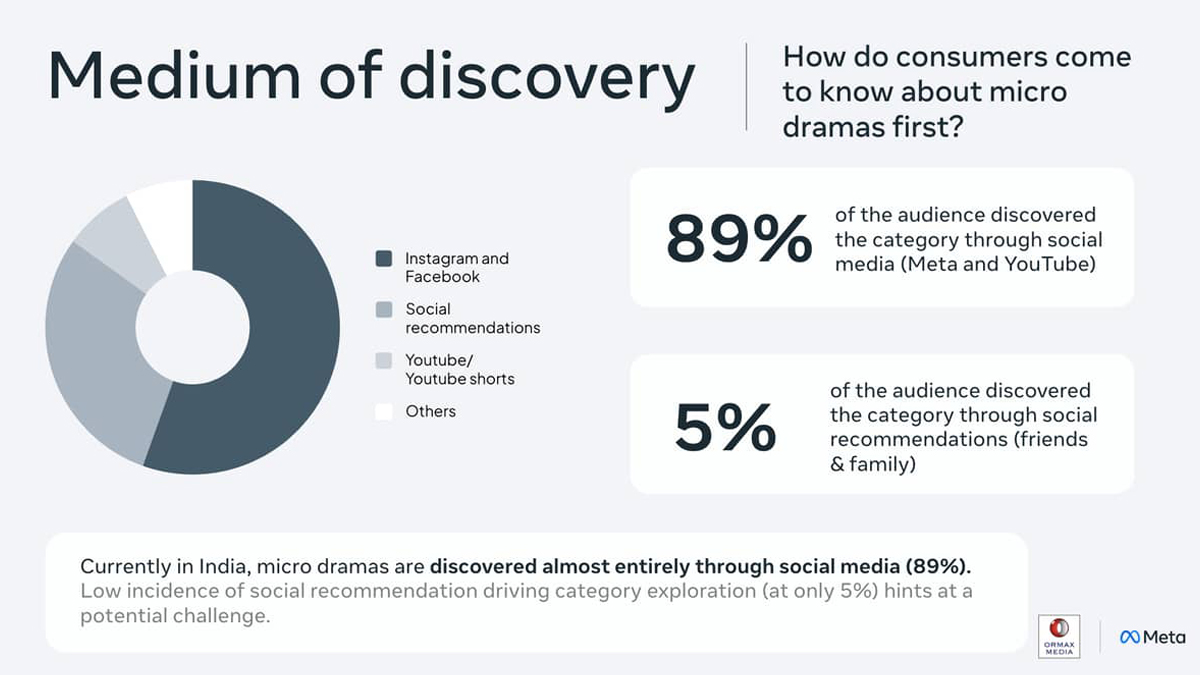
Conducted between November 2025 and January 2026 through 50 in-depth interviews and 2,000 personal surveys, the research reveals that 65 per cent of viewers discovered micro-dramas within the last year proof of explosive adoption. Nearly 89 per cent encounter the format through social feeds and recommendations, making algorithm-driven discovery the primary engine rather than active search.
Key viewing patterns show a median of 3.5 hours per week (about 30 minutes daily) spread across 7–8 short sessions. Consumption peaks between 8 pm and midnight, with additional spikes during commutes and work breaks classic “in-between moments” that the format fills perfectly. Around 57 per cent of viewing happens in ambient mode (while doing something else), and 90 per cent is solo, enabling more intimate, personal storytelling.
Romance, family drama and comedy lead genre preferences. Audiences show growing openness to AI-generated content, 47 per cent find it unique and creative, while only 6 per cent say they would avoid it entirely. Regional languages are surging after Hindi and English, Tamil, Telugu and Kannada dominate consumption.
Meta, director, media & entertainment (India) Shweta Bajpai said, “Micro-drama isn’t a passing trend, it’s rewriting the rules of Indian entertainment. In under a year, an entirely new category of platforms has emerged, built audience habits from scratch, and created a business vertical that is scaling fast.”
Ormax Media founder-CEO Shailesh Kapoor added, “Micro-dramas are beginning to show the early signs of becoming a distinct content category in India’s digital entertainment landscape. When a format aligns closely with how audiences naturally engage with their devices, it has the potential to scale very quickly.”
The study proposes ecosystem-wide responsibility, universal signposting of commercial intent, shared accountability among advertisers, platforms, creators, schools and parents, built-in safeguards, and formal media literacy in schools.
In a feed that never sleeps and a day that never stops, micro-dramas have slipped into the cracks of every spare minute turning 30-second stories into the new national pastime, one vertical swipe at a time.







