‘Blow The Whistle’ for road safety campaign
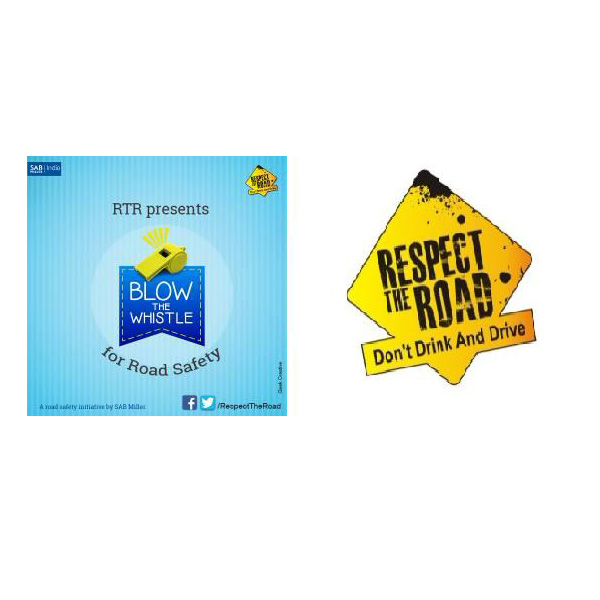
MUMBAI: SABMiller India’s ‘Respect the Road’- Don’t drink and drive campaign, launched ‘Blow The Whistle’ initiative on digital media to promote the message of responsible drinking and overall road safety.
As a part of this initiative, people would be given whistles to blow against all kinds of road and traffic offenders e.g. signal jumpers, rash drivers, people indulging in drinking and driving etc.
Respect the Road is India’s biggest Don’t drink and drive campaign on digital platform. Going beyond highlight the perils of drunk driving, the Facebook page of the campaign will now also highlight dangerous and risky road behavior leading to road accidents and fatalities.
SABMiller India VP sustainability and communications Meenakshi Sharma said: “Promoting responsible drinking is one of the core sustainable priorities for SABMiller worldwide. Through ‘Respect the Road’- Don’t drink and drive campaign, we promote responsible drinking encouraging people to use alternatives to drinking and driving such as calling a cab, hiring a chauffeur or designating a buddy to drive. Blow The Whistle initiative is an extension of our campaign and goes a step further to involve people giving them the responsibility to take action and spread the word about road safety. We are confident that people will step out of their comfort zones and blow the whistle against road offenders.”
The page will showcase whistle creatives and images of people blowing whistles at traffic offenders. The objective is to involve people and encourage them to participate in this campaign to address the issue of road safety. People can post pictures of road offenders, share their experiences and testimonials of blowing whistles at offenders and send in pictures and videos of what/who would they blow the whistle against. The campaign would also urge people to help the victims in a road mishap and respond when they hear a whistle on the street.
Geek Creative CEO Mayank Agarwal said: “Blow The Whistle was conceptualized as an initiative to involve people on ground and encourage them to take up the issue of road safety. Through social media, we will engage with people through pictorial representations, participation through quizzes, contests and encourage people to use a whistle against traffic and road offenders. Our strategy involves a 360 degree integration of the top digital platforms to connect with our audience and spread awareness about road safety.”
The campaign will be taken on ground during the festive season this year where people can come and share their thoughts on making the roads safer. Whistles will be distributed to people for them to blow it against the road offenders and rule breakers. Other engaging activities like quizzes, street plays will be organised to create awareness about the campaign and the issue of road safety.
The campaign has staged interactive street plays on responsible drinking, tied up with radio station urging listeners to pledge for responsible drinking and associated with cab services to spread the message of responsible drinking and road safety.
The Facebook page of the campaign (https://www.facebook.com/respecttheroad) is highly interactive with more than 30,000 followers. Recently a safety shayari contest was organised where twitteratis tweeted Road Safety slogans in form of Shayari along with the hashtag # Blow the Whistle. Within hours both Blow the Whistle and Safety Shayari hashtags # were trending all over India and the campaign reached to over one lakh people.
SABMiller India’s ‘Respect the Road’- Don’t drink and drive campaign has partnered with Home Safe, Delhi NCR’s first chauffeur service, popular radio taxi providers Mega Cabs and radio station Radio City 91.1 FM.

Brands
GUEST COLUMN: Beyond layoffs, India emerges as creative-tech hub
Shift in hiring and AI-led workflows is reshaping global media and marketing
MUMBAI:The global narrative around layoffs in media and technology may suggest contraction, but a deeper transformation is reshaping how creative and tech capabilities are built and deployed. For Sanjil Zaveri, general manager – India at Brandtech+, this shift is less about decline and more about redistribution, one that is positioning India at the centre of a new global operating model. In this piece, Zaveri explores how integrated workflows, AI-powered production, and evolving talent demands are redefining the creative-tech ecosystem, why India is emerging as a strategic hub for global content and innovation, and what this means for the future of media, marketing, and talent.
The global headlines around layoffs in technology and media continue to dominate industry conversations. From platform restructuring to reduced marketing spends, the narrative suggests a slowdown across the creative and digital ecosystem.
But beneath these headlines, a different shift is underway, one that is quietly redefining how creative and technology work is delivered globally.
Hiring is not disappearing; it is being redistributed. And India is increasingly at the centre of this transition.
A structural shift in the creative-tech ecosystem
The media and marketing landscape is undergoing a fundamental reset. Brands today are moving away from fragmented agency models and siloed teams toward more integrated, agile structures.
Creative, technology, and media are no longer operating in isolation. Campaigns are now built through connected workflows, where ideation, production, and optimisation happen simultaneously.
This shift is forcing organisations to rethink where and how teams are built. Increasingly, the focus is on capability, speed, and scalability, rather than geography alone.
India’s emergence as a creative-tech hub
India’s role in this evolving ecosystem has expanded significantly.
Traditionally positioned as a backend execution market, India is now playing a far more central role in global campaign delivery. Teams based here contribute not just to production, but also to strategy, content development, and performance optimisation.
This is particularly relevant in a market where content velocity has increased dramatically. With the rise of digital platforms, OTT, and always-on marketing, brands require high volumes of creative assets without compromising on quality.
Industry insights from Ernst & Young point to India’s growing strength as a global content hub, while NASSCOM continues to highlight the scale and depth of the country’s digital talent pool. Together, these factors create a compelling case for India as a foundation for more efficient, integrated content ecosystems serving global markets.
A global company’s perspective on India
At Brandtech+, this shift is already shaping how we operate.
As a global organisation working across creative, marketing, and technology, our talent strategy is increasingly driven by capability rather than location. India has therefore become a key market for both scale and strategic talent.
In the first quarter of this year, we have significantly accelerated hiring in India across creative, technology, and operations roles, moving well ahead of plan and continuing to build strong momentum. We are actively hiring across multiple functions, with India playing a central role in delivering integrated creativetech solutions for global brands.
These signals reflect a broader change in how global companies view India, not as a delivery centre, but as a hub for connected creative, data, and technology capabilities.
“While much of the global narrative is centred on contraction, what we are seeing in India is a different kind of growth,” says Sanjil Zaveri. “As a global company, we are investing in talent that can work across creative, data, and technology, because that is where the future of marketing is headed.”
AI and the new content economy
Artificial intelligence is playing a critical role in enabling this transformation.
In today’s media environment, the demand for content has scaled exponentially. Brands are expected to create, adapt, and optimise creative assets across multiple platforms in real time. The scale of this demand would be difficult to sustain through traditional production models alone.
AI is helping make this possible.
Rather than replacing roles, AI is streamlining workflows, automating repetitive tasks, accelerating production timelines, and enabling faster experimentation. This allows creative and strategy teams to focus on higher-value outputs.
“AI removes the mundane and elevates the meaningful,” says Zaveri. “It allows teams to focus on ideas and storytelling, while technology drives efficiency.”
For media platforms and advertisers, this is redefining how campaigns are built, moving from linear production cycles to continuous, data-driven content creation.
What this means for media talent
For professionals across media, advertising, and digital, this shift is redefining skill requirements.
The traditional boundaries between creative, media planning, and technology are blurring. Content creators are expected to understand performance metrics. Media professionals are working more closely with data, platforms, and automation. Collaboration across disciplines is becoming a core skill.
This is creating demand for hybrid talent, professionals who can operate across disciplines and adapt to rapidly changing workflows.
India’s talent ecosystem is particularly well suited to this environment. With strong capabilities across content, design, engineering, and analytics, the market offers a unique combination of scale and versatility.
Importantly, global exposure is no longer tied to relocation. Professionals in India are increasingly working on international brands and campaigns, collaborating with teams across markets in real time.
Looking ahead: India at the centre of the reset
What we are witnessing today is not a temporary phase; it is a structural reset in the global creative-tech ecosystem.
Layoffs may continue to shape short-term narratives, but they do not capture where long-term growth is being built. That growth lies in new operating models, integrated workflows, and markets that can deliver both scale and innovation.
India is firmly at the centre of this transformation.
As global media and marketing organisations continue to evolve, India’s role will only become more critical, not as a support market, but as a strategic hub for content, creativity, and technology-led innovation.
The future of creative-tech will be defined by collaboration, speed, and adaptability. And increasingly, it will be shaped from India.
Note: The views expressed in this article are solely the author’s and do not necessarily reflect our own.