Connect with us

MAM

ABP News rolls out Adarsh Voter campaign

Published

on

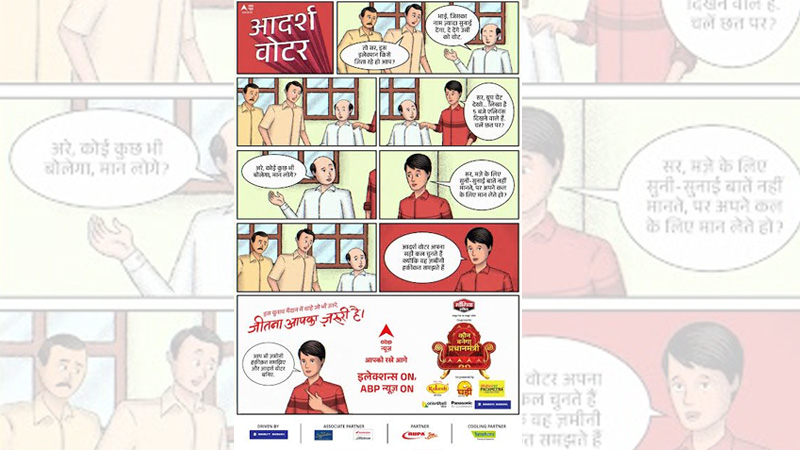
Mumbai: Continuing its efforts to strengthen India’s democratic process, ABP News has unveiled the ‘Adarsh Voter’ campaign, a series of educational comic strips designed to promote informed voting and active citizenship. This initiative follows the network’s successful ‘Jeetna Aapka Zaroori Hai’ campaign, which urged Indians to exercise their constitutional right and make their voices heard in the ongoing 18th Lok Sabha Elections.

The ‘Adarsh Voter’ comic strips aim to further empower citizens by highlighting the significance of voting, resisting misinformation, and seeking clarity amidst the chaos of electoral campaigns. Through engaging visuals and compelling narratives, these comics will guide viewers in navigating past sensationalism, promoting transparency, and grounding their voting decisions in factual realities.

An Adarsh Voter is someone who actively participates in the democratic process, seeks out reliable information, and casts their vote after carefully considering the issues that impact their lives. With this campaign, ABP News aims to nurture a generation of informed and discerning voters who can see through the noise and make choices that truly shape the nation’s future. The ‘Adarsh Voter comics will be released across ABP News’ digital channels and on print media, reaching millions of viewers nationwide.

Advertisement

ABP News’ commitment to empowering voters extends beyond the ‘Adarsh Voter’ campaign. The network’s comprehensive election coverage, including shows like ‘Kaun Banega Pradhanmantri 2024’ and ‘Lok Sabha Elections 2024’, provides in-depth analysis, expert insights, and ground reports to ensure that every Indian has access to the information needed to make an informed choice.

As India’s leading news network, ABP News remains dedicated to upholding the principles of democracy and fostering an engaged and informed electorate. The ‘Adarsh Voter’ campaign is a testament to this commitment, offering a unique and accessible platform for civic education and empowerment.

Join the movement and become an Adarsh Voter. Follow ABP News’ coverage and engage with the ‘Adarsh Voter’ comics to exercise your right to vote responsibly and shape India’s future.

Advertisement
Click to comment

Leave a Reply

Your email address will not be published. Required fields are marked *

MAM

Deepfakes target women in 93 per cent of cases, report finds

Pi-labs study shows 900 per cent rise in female-focused synthetic media; India sees 60 per cent jump in cybercrime complaints.

Published

on

MUMBAI: Deepfakes aren’t just fooling cameras, they’re hitting women hardest, turning pixels into a new kind of weapon. A new report from creator intelligence platform Pi-labs has revealed that nearly 93 per cent of deepfake victims are women, with deepfake content targeting females surging 900% in recent years. The findings paint synthetic media as a fast-escalating digital threat with a stark gendered impact.

In India, cybercrime complaints involving women rose from about 50,000 in 2024 to nearly 80,000 by 2026, an increase of roughly 60 per cent in just two years. Almost 98 per cent of deepfake pornography is aimed at women, often powered by face-swapping apps and bot networks that disproportionately target females, including school-age girls. Victims typically fall in the 18–30 age group, with Bengaluru reporting a growing share of cases.

Globally, 62 per cent of deepfake abuse cases involving women go unreported due to stigma, in India, over one-third of women facing online harassment take no action, and many reduce their digital presence after abuse. Close to 33 per cent of women remain unaware of protective laws.

Advertisement

City-level trends show Bengaluru leading with nearly 30 per cent of complaints, followed by Hyderabad (14 per cent), Mumbai (13 per cent), Chennai and Kolkata (5 per cent each), and Delhi (3 per cent).

Pi-labs, CEO and founder Anukush Tiwari said, “AI is one of the most powerful technologies of our time, but like every powerful tool, it reflects the intent of those who use it. We are witnessing a growing trust deficit in digital spaces, where identity can be manipulated within minutes and reputations can be damaged overnight.”

Image morphing and deepfake videos remain the most common forms of misuse. The report also notes a new trend: fully AI-generated female personas (not based on real individuals) gaining high engagement on social platforms, raising questions about digital credibility.

Advertisement

Detection remains challenging due to widespread generative tools and rogue creators. Industry estimates suggest over 5,000 face-swap tools and more than 1,000 voice-cloning applications are accessible online.

pi-labs offers pi-authentify, an AI-driven detection system that scans media for generative markers and provides authenticity scores, as well as Namokavach, a verification portal delivering confidential assessments within two working days. The Payal gaming case was resolved using pi-authentify’s forensic analysis.

The report urges minimising digital footprints and adopting detection tools to limit replication risks. It frames the gendered impact of synthetic media as an urgent digital safety issue requiring coordinated action from individuals, platforms and technology providers.

Advertisement

In a world where faces can be borrowed in seconds, the real crime isn’t just creation, it’s the silence that follows, and women are paying the heaviest price.

Continue Reading

Advertisement News18
Advertisement All three Media
Advertisement Whtasapp
Advertisement Year Enders

Copyright © 2026 Indian Television Dot Com PVT LTD

This will close in 20 seconds