Hindi
‘Movies.Masti.Magic’ at the Pandharpur Mela 2016
MUMBAI: Pandharpur Ashadhi Ekadashi Yatra is a yatra of faith in the Almighty that unites lakhs of warkaris from various places of Maharashtra. The yatra progresses into a colossal Mela at Pandharpur and witnesses the submission of countless warkaris to Lord Vithoba. This year, India’s leading Hindi movie channel -Zee Cinema – staying true to its core proposition of ‘Movies.Masti.Magic’ has made efforts to provide basic amenities during the yatra to the pilgrims so that they have a memorable pilgrimage.
With the fact that ‘The real India lives in villages’ and education being key to the development of India’s economy, Zee Cinema takes its first steps at the Pandharpur Mela this year. The channel is distributing books and pens to generate enthusiasm about learning amongst the youth. And, adhering to ZEEL’s ‘Zee is Green’ initiative, the stationary is being given along with eco-friendly cloth bags to more than fifty thousand pilgrims. Another concern in the region is the acute water shortage. Pilgrims wait endlessly in long queues for Lord Vithoba’s darshan in the scorching heat. The channel has made arrangements to distribute cold drinking water to the devotees to ensure a comfortable hassle-free darshan.
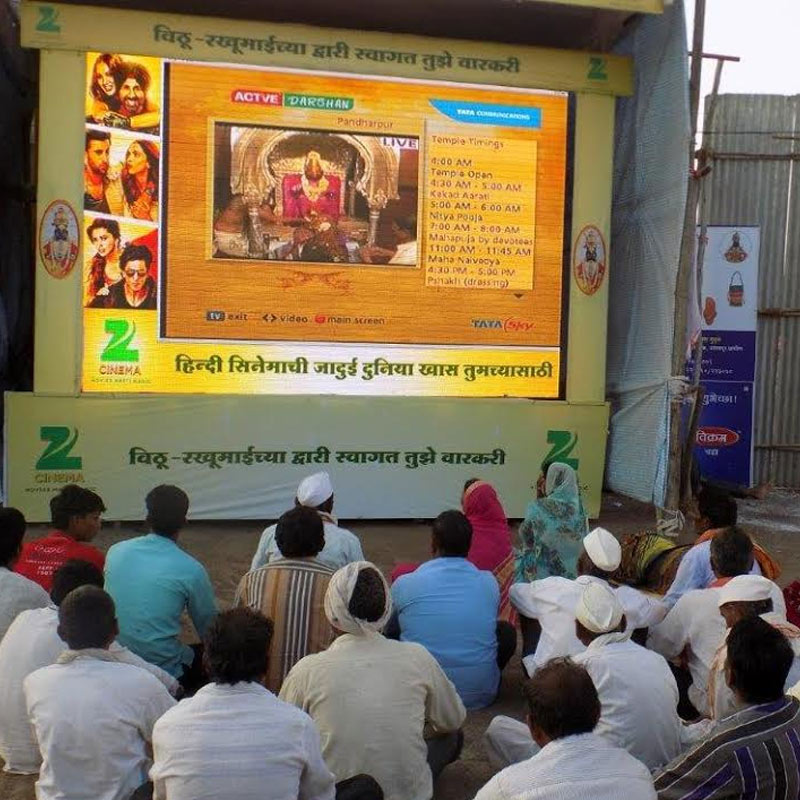
An LED screen will also provide live feeds from the inside of the temple to all the devotees in the surrounding areas. On the banks of Chandrabhaga river, the channel has organized an all-day open theatre that showcases films on Zee Cinema for people to sit and relax. There will also be an exclusive movie screening in the evenings, showcasing the latest blockbusters.

Hindi
Remembering Gyan Sahay, the lens behind film, television and advertising
From a puppet rabbit selling poppadums to Hindi cinema, he framed it all.
MUMBAI: There are careers, and then there are canvases. Gyan Sahay, the veteran cinematographer, director, and producer who passed away on 10 March 2026 in Mumbai, had one of the latter. Over several decades in the Indian film and television industry, he turned lenses, lights, and the occasional puppet rabbit into something approaching art.
A graduate of the Film and Television Institute of India (FTII) in Pune, Sahay built his reputation as a director of photography across a career that stretched from the early 1970s all the way to the digital age. He was the kind of craftsman who understood that a well-composed shot is not merely a technical achievement but a quiet act of storytelling.
For most Indians of a certain age, however, Sahay will forever be the man behind the rabbit. His direction of the iconic long-running television commercial for Lijjat Papad, featuring its now-legendary puppet bunny, gave the country one of its most cheerfully persistent advertising images. It was the sort of work that sneaks into the national subconscious and takes up permanent residence.
His big-screen credits as cinematographer include Anokhi Pehchan (1972), Pagli (1974), Pas de Deux (1981), and Hum Farishte Nahin (1988). In 1999, he stepped behind a different kind of camera altogether, making his directorial debut with Sar Ankhon Par, a drama that featured Vikas Bhalla and Shruti Ulfat, with a cameo by Shah Rukh Khan for good measure.
On television, Sahay was particularly prized for his command of multi-camera production setups, a skill that made him a go-to technician for large-scale shows and reality programmes. In an industry that has never been especially patient with complexity, he was the calm hand on the rig.
In later life, Sahay turned teacher. He participated regularly in masterclasses and Digi-Talks, often hosted by organisations such as Bharatiya Chitra Sadhna, sharing hard-won wisdom on cinematography, the comedy of timing in a shot, and the sweeping changes brought by the shift from celluloid to digital. He was also said to have been involved in a project concerning a biographical film on Infosys co-founder N.R. Narayana Murthy.
Tributes from the film industry poured in following the news of his passing, with colleagues remembering him as a senior cameraman who served as a rare bridge between two entirely different eras of Indian cinema. That is, perhaps, the finest thing one can say of any craftsman: he kept up, and he brought others along with him.