MAM
Hyundai Motor drives sustainable clean logistics in U.S. with vision for a hydrogen society

Mumbai: Hyundai Motor Company (Hyundai Motor) today shared its hydrogen vision and introduced its U.S. clean logistics business powered by the company’s Class 8 XCIENT Fuel Cell electric truck at the Advanced Clean Transportation (ACT) Expo 2024.
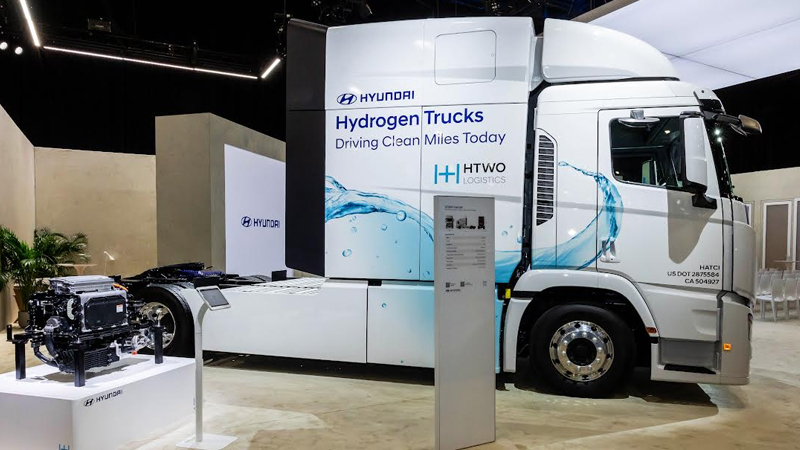
The company is exhibiting the XCIENT Fuel Cell truck and fuel cell system, along with digital exhibits, demonstrating the vehicle enhancement concept and its hydrogen value chain technologies, from 20–23 May at the Las Vegas Convention Center.
Building a hydrogen society roadmap
At Hyundai Motor’s press conference, Hyundai Motor executive vice president and head of the global commercial vehicle and hydrogen business Ken Ramirez, highlighted the company’s commitment to building a hydrogen society. He spoke about the true value of hydrogen and how Hyundai Motor Group (the Group) is leveraging its affiliates’ cross-industry capabilities spanning the entire hydrogen value chain — from hydrogen production and storage to logistics, transport and diverse applications — to realize the company’s vision for a hydrogen society.
Earlier this year, Hyundai Motor announced a vision for the HTWO brand’s expanding role in the hydrogen value chain, signalling that it will be the catalyst for a global energy transition. Hyundai Motor aims to realize its vision for a hydrogen society by leveraging the Group’s integrated capabilities across various industries.
“Our HTWO brand’s expanding role reflects Hyundai’s unique reach beyond mobility into an integrated hydrogen value chain to lead the global energy transition,” Ramirez said. “We are like no other energy company with roots deeply grounded in mobility – and we are like no other mobility company with branches so far reaching into energy. Our mission has always been clear: leverage our strengths in both mobility and energy sectors to realize our vision for a hydrogen society.”
Joining the presentation, Hyundai Motor North America senior vice president and head of commercial vehicle and hydrogen business development Jim Park detailed the company’s rollout of its Class 8 XCIENT Fuel Cell electric trucks in key U.S. hydrogen logistics projects, including the NorCAL ZERO Project and Clean Logistics Project as further proof of the company’s commitment.
Last year through the NorCAL ZERO Project, Hyundai Motor deployed 30 XCIENT Fuel Cell trucks at the Port of Oakland and Port of Richmond to haul freight containers and vehicles, marking the single largest commercial deployment of Class 8 heavy-duty hydrogen fuel cell electric trucks in North America. In Georgia, the company is working on the Clean Logistics Project at its Hyundai Motor Group Metaplant America (HMGMA), to decarbonize the company’s production facility.
“This landmark port decarbonization initiative in California serves as a prime example of how hydrogen trucks are paving the way towards sustainable future logistics,” Park said. “By replicating the success of NorCAL ZERO and tailoring it to specific customer needs, we at Hyundai aim to create a worldwide network of clean, hydrogen-powered operations.”
Hyundai Motor is actively working to decarbonize its captive logistics through the Clean Logistics Project. This year, the company will take a significant step by deploying XCIENT Fuel Cell trucks to its facility in Georgia. This deployment will begin Hyundai Motor’s efforts to reduce emissions from its internal logistics operations.
HTWO Logistics to bring clean solutions to HMGMA
GLOVIS America executive director Glenn Clift a leading logistics provider that shares Hyundai Motor’s hydrogen vision, joined the press conference as a guest speaker to introduce HTWO Logistics, a partnership for benchmarking in sustainable logistics solutions revolving around HMGMA.
“Our clean logistics operation in Georgia deals specifically with reducing the carbon emission of inbound and outbound transportation around our new manufacturing facility,” Clift said. “Through HTWO Logistics, we will partner with Hyundai Motor in establishing a value chain of clean hydrogen production, supply, refuelling and zero-emission vehicles to handle the logistics, creating a hydrogen mobility ecosystem in and around Georgia’s Metaplant.”
Through this partnership, the two companies will leverage a comprehensive suite of HTWO solutions to maximize carbon emissions reduction. By gaining valuable insights from this project, the companies aim to replicate this success model globally, further expanding Hyundai Motor’s HTWO business.
XCIENT Fuel Cell truck product enhancement concept
In line with Hyundai Motor’s continuous dedication to customer-driven innovation, the company digitally previewed the enhancement concept of its XCIENT Fuel Cell truck.
The enhancement concept videos on display show a 12.3-inch fully digital instrument cluster, offering drivers clear and concise information at a glance, and a 12.3-inch touchscreen infotainment system with physical buttons integrated into the centre console for driver convenience.
The display model also features a comprehensive suite of Hyundai Motor’s Advanced Driver-Assistance Systems (ADAS) designed to enhance vehicle safety and minimize driver fatigue. These enhancements include Forward Collision-Avoidance Assist (FCA), Lane Departure Warning (LDW), Side Collision Avoidance Warning (SOD) and Smart Cruise Control (SCC).
The company also introduced its collaboration with autonomous driving industry leader Plus to enhance road safety and freight efficiencies. The two companies are testing Level 4 autonomous driving technology on Hyundai Motor’s XCIENT Fuel Cell truck in the U.S., a first for a Class 8 fuel cell electric truck in the country.
Hyundai Motor’s XCIENT Fuel Cell truck, equipped with Plus SuperDrive Level 4 autonomous driving technology, is on display at Plus’s ACT Expo booth (#2044).
HTWO’s vision for hydrogen’s potential in the CV sector and beyond
Widely regarded as a safe, clean and sustainable energy carrier, hydrogen is considered a perfect solution for commercial vehicles and logistics transportation due to its diverse advantages, including production, storage, logistics and refuelling infrastructure. Hydrogen is a high-density energy carrier that allows fuel cell electric vehicles (FCEVs) to provide a sustained power output suitable for long-haul driving and carrying heavy loads.
Hyundai Motor’s XCIENT Fuel Cell truck, powered by its field-proven fuel cell system, is already a game changer and leads the FCEV market, with units in operation around the world, including in Europe, South Korea and North America. Hyundai Motor’s hydrogen fuel cell technology is already going beyond mobility into various applications, including stationary power, industrial equipment and, soon, electrolyzers.
As announced at CES 2024, HTWO has evolved from a fuel cell system to a complete hydrogen value chain brand, integrating the Group’s capabilities across various industries. By leveraging its strength in the mobility and energy sectors, the Group is now uniquely positioned to offer holistic solutions spanning every stage of the hydrogen value chain.
Moving upstream in the hydrogen value chain, the Group has developed pioneering methods for converting organic waste into hydrogen as part of its pilot project operating in Chungju, South Korea. By extracting biogas from food waste, hydrogen is created through an advanced process. This hydrogen is then supplied to an on-site hydrogen refuelling station to power hydrogen vehicles. The Group will have another facility in Korea by the end of this year in which sewage sludge is transformed into hydrogen.
The Group is also reviewing a hydrogen energy business model to integrate the whole value chain, from hydrogen production through plastic-to-hydrogen technology, to carbon capture, utilization, storage (CCUS), transportation, supply and applications.
XCIENT Fuel Cell truck on display at ACT Expo 2024
The XCIENT Fuel Cell truck with a 6×4 drive axle configuration is on display at Hyundai Motor’s booth (#530, open to the public May 20-23) along with a hydrogen fuel cell system. The truck will be shown together with digital exhibits demonstrating the company’s HTWO Grid solutions and the enhancement concept of the XCIENT Fuel Cell truck. The company is also operating an XCIENT Fuel Cell truck test drive program at the Expo (May 21-22).