Connect with us

Brands

Hyundai powers ‘Atmanirbhar Bharat’ with localisation and EV breakthrough

Published

on

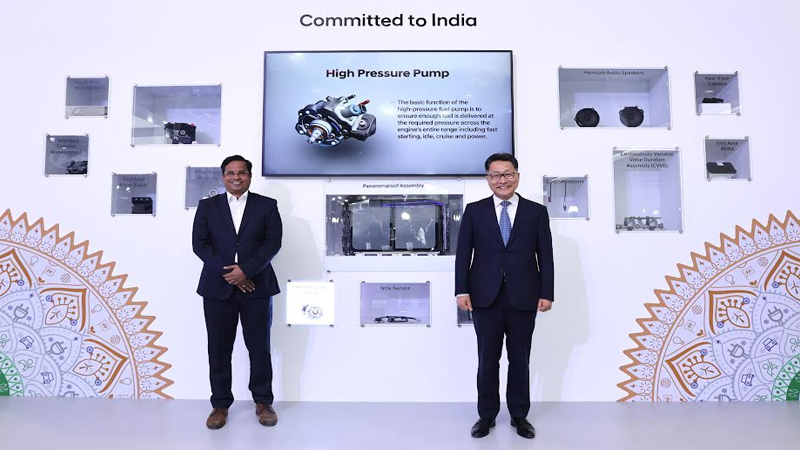
MUMBAI: Hyundai Motor India Limited (HMIL) isn’t just making cars; it’s making waves. With a roaring 92 per cent localisation in manufacturing and a game-changing battery-pack assembly plant in Chennai, Hyundai is taking its ‘Make-in-India’ commitment to full throttle. If this isn’t a rev-up moment for India’s automotive landscape, we don’t know what is.

Let’s talk numbers—1,238 indigenised parts, 194 vendors, and a whopping $672 million in forex savings (over Rs 5,678 crore) since 2019. Hyundai’s localisation journey is no leisurely Sunday drive; it’s a turbocharged race to leverage India’s resources and engineering talent.

Hyundai’s whole-time director & chief manufacturing officer, Gopalakrishnan Chathapuram Sivaramakrishnan, put it perfectly, “Our indigenisation aligns seamlessly with India’s ‘Atmanirbhar Bharat’ vision. The launch of the battery-pack assembly plant is not just a milestone; it’s a testament to our commitment to delivering world-class technology made in India.”

Advertisement

Oh, and did we mention that Hyundai’s Creta Electric now boasts locally assembled battery packs? Talk about an electrifying debut!

Why is everyone talking about Chennai? Because Hyundai and Mobis India have launched a state-of-the-art battery-pack assembly plant, complete with an annual capacity of 75,000 packs in phase one. Whether it’s NMC (Nickel-Manganese-Cobalt Oxide) or LFP (Lithium-Iron-Phosphate) batteries, this facility has it all.

Hyundai isn’t just building cars; it’s building them with 100 per cent locally sourced components like alternators, alloy wheels, catalytic converters, and shark fin antennas. Fancy tech like tyre pressure monitoring systems and panoramic sunroofs? Yep, localised too.

Advertisement

The company is also looking ahead with plans to replicate this success at its Talegaon manufacturing plant in Maharashtra. Can we hear a round of applause for the future?

In its localisation journey, Hyundai isn’t just saving forex; it’s creating jobs—1,400 direct employment opportunities, to be exact. The company’s engineering prowess and strategic partnerships are redefining what it means to be ‘Atmanirbhar’.

In a world racing toward electric and sustainable solutions, Hyundai’s efforts are more than just industry milestones—they’re a blueprint for automotive evolution. The localisation strategy isn’t just a business move; it’s a bold statement. And with the Creta Electric leading the charge, Hyundai is proving that Indian manufacturing isn’t just capable; it’s competitive.


Advertisement
Click to comment

Leave a Reply

Your email address will not be published. Required fields are marked *

Brands

Trump announces $300bn Texas oil refinery with Reliance, calls it the biggest in US history

First new US refinery in 50 years planned at Brownsville port with Reliance

Published

on

WASHINGTON: The United States may soon see the first brand-new oil refinery built on its soil in half a century.

Donald Trump announced a proposed $300 billion refinery project in Texas, calling it a landmark moment for American energy production and jobs.

Posting on Truth Social on 10 March, Trump said the facility would be built at the Port of Brownsville and developed by a company called America First Refining, with major investment from India’s Reliance Industries.

Advertisement

The announcement frames the project as a centrepiece of the administration’s push for “energy dominance”, with Trump claiming it would deliver thousands of jobs and billions of dollars in economic activity to South Texas.

If realised, the plant would mark the first all-new major refinery constructed in the United States since the 1970s. In recent decades, oil companies have largely chosen to expand existing facilities rather than build new ones, citing high costs, regulatory hurdles and environmental scrutiny.

Trump described the proposed investment as the “biggest in US history”, positioning it as proof that policy changes such as streamlined permits and lower taxes are drawing large-scale energy investments back into the country.

Advertisement

The refinery is planned for the Port of Brownsville, a strategic Gulf Coast location that provides easy access to shipping routes and export markets.

A key partner in the project is Reliance Industries, controlled by billionaire industrialist Mukesh Ambani. The company already runs the world’s largest refining complex in Jamnagar, India, making it one of the most experienced operators in large-scale petroleum processing.

The Texas venture would mark a significant step for the group into America’s domestic refining sector, potentially strengthening industrial ties between the US and India.

Advertisement

The proposed refinery is being promoted as a next-generation facility capable of processing American shale oil while maintaining high environmental standards. Trump said it would be “the cleanest refinery in the world”, although the specific technologies behind that claim have not yet been detailed.

Industry observers also note that the $300 billion figure is unusually large for a refinery project, and analysts are waiting for more clarity on whether the number reflects total construction costs, long-term infrastructure investment, or broader economic impact estimates.

As of 11 March, Reliance Industries had not publicly confirmed the investment size or the structure of its involvement.

Advertisement

For now, the announcement has sparked equal parts excitement and curiosity in energy markets. If the plan moves from promise to pouring concrete, the refinery could reshape the Gulf Coast energy landscape, and reopen a chapter in American refining that has been quiet for nearly fifty years.

Continue Reading

Advertisement News18
Advertisement All three Media
Advertisement Whtasapp
Advertisement Year Enders

Copyright © 2026 Indian Television Dot Com PVT LTD

This will close in 20 seconds