News Broadcasting
NDTV Infrashakti Awards: Honouring milestones in India’s infrastructure growth story

Mumbai: The NDTV Infrashakti Awards 2024 celebrated India’s remarkable infrastructure growth story by honouring extraordinary initiatives. Speaking at the event, union minister of road transport and highways, Nitin Gadkari, revealed that India would launch the first phase of a GPS and satellite-based toll system in the next three months, before implementing it nationwide.
During a fireside chat with NDTV’s CEO and editor-in-chief Sanjay Pugalia, Gadkari spoke at length about the importance of tackling pollution in India by promoting non-polluting sources for personal and public transportation. The NDTV Infrashakti Awards were created to inspire innovation and excellence across the country by recognising individual and institutional initiatives.
A significant component of the Infrashakti campaign, the awards focused on celebrating stories behind India’s infrastructural advancements. From engineering marvels to sustainable urban planning, the awards honoured exceptional contributions that defined the nation’s growth.

Gadkari spoke on the importance of tackling pollution in India by promoting non-polluting sources for personal and public transportation. The union minister highlighted the government’s initiatives, including the promotion of electric scooters, cars, and buses, as well as the need to expand the use of bio and alternative fuels.
Gadkari mentioned ongoing projects like electric trolley buses in Nagpur and the adoption of hybrid engines in construction equipment, which operate on diesel and CNG. He also stressed how the potential of tractors powered by ethanol, methanol, CNG, and electricity was set to revolutionise the agricultural sector, benefiting farmers significantly within the next year. “Green hydrogen is the future,” Gadkari stated, envisioning India as an exporter of energy rather than an importer.
Adani Enterprises MD (agro, oil and gas) and director Pranav Adani while delivering the keynote address spoke on the transformative power of infrastructure, mentioning “Human history, whether ancient or modern, shows us that infrastructure is the fundamental key to all the progress.”
The NDTV Infrashakti Awards 2024 comprised six jury-selected categories and one popular choice/viewers’ choice category. The categories include Rural Infra Pioneer, Renewable Energy Star, Water Saviour, Urban Infra Hero, Infra Visionary, and Transport Trailblazer. The public can also vote for the Inclusive Infrastructure category in the popular choice award, which allows everyone to make their voice heard.
The awards were judged by an esteemed panel of five jury members – prime minister’s economic advisory council chairman Dr. Bibek Debroy; GSK Pharmaceuticals chairperson and HDFC Bank Ltd’s former MD and current non-executive director Renu Sud Karnad; image guru specialising in litigation landscaping and policy analyst Dilip Cherian; actor, sustainability advocate, and social activist Gul Panag; and Professor Emeritus at Gujarat Maritime University Professor G Raghuram.
The stellar guest list also included union minister of petroleum and natural gas Hardeep Puri as the Guest of Honour. The minister, in conversation with NDTV’s Marya Shakil, laid emphasis on India’s growing focus and shift to green energy, while adding,
“No matter which way you look at it, if you look at green energy, the transition, biofuels… look at the 15 per cent transition we have done. We did 15 per cent biofuel blending. And we are solving the problem in agriculture,”
With this union minister Hardeep Singh Puri presented NDTV Infrashakti Lifetime Achievement Award for Connecting India to E Sreedharan, the “Metro Man” of India. Delhi Metro Rail Corporation’s executive director Anuj Dayal accepted the award on Sreedharan’s behalf. The Infrashakti Award for Rural Infra Pioneer went to DeHaat’s CEO Shashank Kumar, for his vision and commitment to leveraging technology for rural development, which has not only improved infrastructure but also revitalized rural economies, creating a ripple effect of socio-economic benefits. The NDTV Infrashakti Award for Inclusive Infrastructure was awarded to Swarga Foundation. Swarnalatha J, on receiving the award, remarked, “People call me by different names. I am here to tell the whole world that I am not just special because of my disability but because of my ability to turn every adversity into an opportunity.”
Arun Krishnamurthy, recipient of the NDTV Infrashakti Award for Water Saviour, has been a beacon of hope in water conservation and management. His dedication to environmental stewardship underscores the critical importance of water conservation in India’s development agenda. The NDTV Infrashakti Award for Renewable Energy Star went to Pankaj Kumar and Siddhant Agarwal of Quant Solar. Union minister Hardeep Singh Puri also presented NDTV Infrashakti Award for Infrastructure Financier to the State Bank of India. The Infrashakti Award for Transport Trailblazer was given to Afcons Infrastructure for innovative solutions, significant contributions to the transport infrastructure sector and for setting new benchmarks in project execution and management.
Sudhanshu Mani was honoured as Infrashakti Infravisionary, for his visionary initiatives that have not only addressed critical challenges but have also propelled India towards sustainable and inclusive growth. Sandeep Patel, Founder of Nepra, received the Urban Infra Hero Award for his instrumental leadership in pioneering projects that enhance liveability and resilience in urban centres, setting a new standard for integrated urban development.
Centre for Science and Environment (CSE) executive director of research and advocacy Anumita Roychowdhury, highlighted the urgency of addressing climate change. “If there’s a takeaway from the summer we just had, with its persistent heatwaves and unprecedented floods, it’s that climate change is real and constant. We can’t keep blaming climate change; we must ensure our infrastructure development is sustainable and mitigates the impact.”
The NDTV Infrashakti Awards 2024 showcased the pulse of a vibrant country by recognising and celebrating the efforts of those transforming India’s infrastructure landscape. By acknowledging infrastructure development, which has the power to change lives and connect communities, these awards serve as guiding beacon for a Viksit Bharat. The NDTV Infrashakti Awards aim to inspire further innovation and excellence in the sector, honouring the visionaries driving India’s growth story and contributing vastly to a sustainable future.





News Broadcasting
Induction cooktop demand spikes 30× amid LPG supply concerns
Supply worries linked to West Asia tensions push households and restaurants to turn to electric cooking alternatives
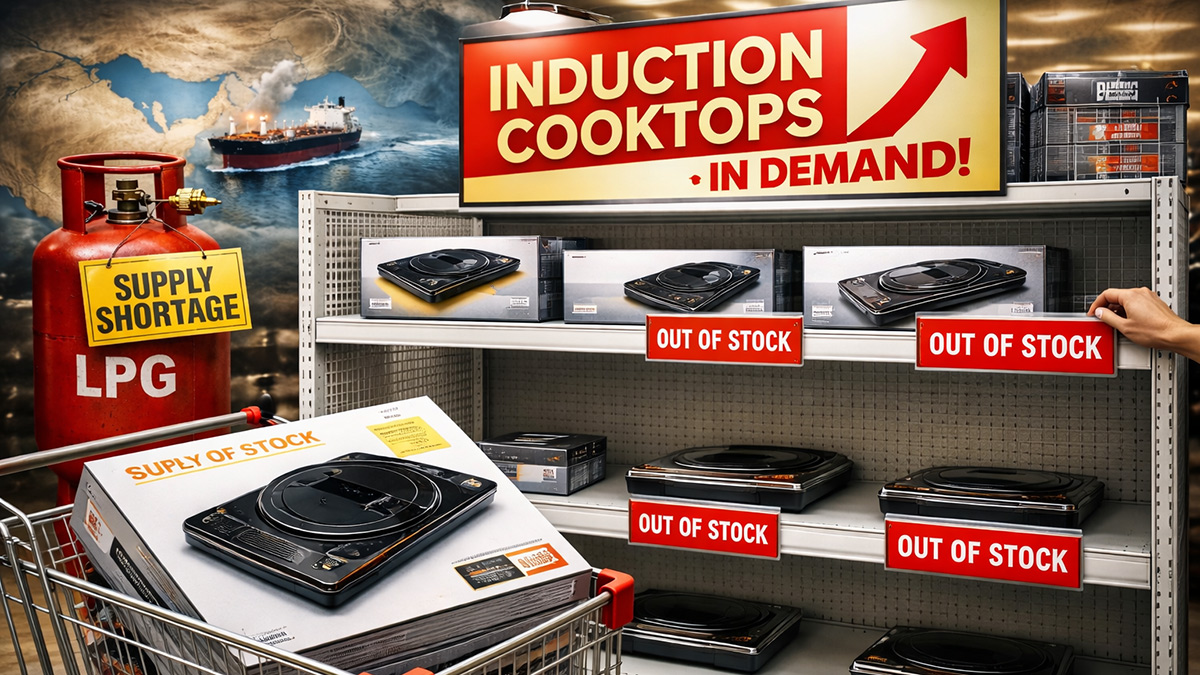
MUMBAI: As geopolitical tensions in West Asia ripple through global energy supply chains, the familiar blue flame in Indian kitchens is facing an unexpected challenger: electricity.
What began as concerns over the availability of liquefied petroleum gas (LPG) has quickly evolved into a technology-driven shift in cooking habits. Households across India are increasingly turning to induction cooktops and other electric appliances, initially as a backup but now, for many, a necessity.
A sudden surge in demand
Recent data from quick-commerce and grocery platform BigBasket highlights the scale of the shift. According to Seshu Kumar Tirumala, the company’s chief buying and merchandising officer, demand for induction cooktops has risen dramatically.
“Induction cooktops have seen a significant surge in demand, recording a fivefold jump on 10 March and a thirtyfold spike on 11 March,” Tirumala said.
The increase stands out sharply when compared with broader kitchen appliance trends. Most appliance categories are growing within 10 per cent of their typical demand levels, while induction cooktops have witnessed explosive growth as households rush to secure an alternative cooking option.
Major e-commerce platforms including Amazon and Flipkart have reported rising searches and orders for induction stoves. Quick-commerce apps such as Blinkit and Zepto have also witnessed stock shortages in major metropolitan areas including Delhi, Mumbai and Bengaluru.
What was once considered a convenient appliance for hostels, small kitchens or occasional use has suddenly become an essential addition in many homes.
A crisis thousands of miles away
The trigger for this shift lies far beyond India’s kitchens.
Escalating conflict in the Middle East has disrupted shipping routes through the Strait of Hormuz, one of the world’s most critical energy corridors. Nearly 85 to 90 per cent of India’s LPG imports pass through this narrow waterway, making the country particularly vulnerable to supply disruptions.
The ripple effects have been swift.
India currently meets roughly 60 per cent of its LPG demand through imports, and tightening global supply has already begun to affect domestic availability and prices.
Earlier this month, the price of domestic LPG cylinders increased by Rs 60, while commercial cylinders rose by more than Rs 114.
To discourage panic buying and hoarding, the government has also extended the mandatory waiting period between domestic refill bookings from 21 days to 25 days.
Restaurants feel the pressure
The strain is not limited to households. Restaurants, hotels and roadside eateries are also grappling with supply constraints as commercial LPG availability tightens under restrictions imposed through the Essential Commodities Act.
In cities such as Bengaluru and Chennai, restaurant associations report that commercial LPG availability has dropped by as much as 75 per cent, forcing many establishments to rethink their kitchen operations.
Some restaurants have reduced menu offerings, while others are rapidly installing high-efficiency induction systems, creating hybrid kitchens where electricity now shares the workload with gas.
For smaller eateries and roadside dhabas, the shift is less about sustainability and more about survival.
A potential structural shift
The government has maintained that there is no nationwide LPG crisis and has directed refineries to increase production to stabilise supply.
Nevertheless, the developments of March 2026 may already be triggering a longer-term behavioural shift.
For decades, LPG has been the backbone of cooking in Indian households. However, recent disruptions have highlighted the risks of relying on a single fuel source.
Increasingly, households appear to be hedging against uncertainty by adopting electric cooking options to guard against price volatility and delivery delays.
If the current trend continues, the induction cooktop, once viewed as a niche appliance, could emerge as a quiet symbol of India’s evolving kitchen economy.