MAM
Post-lockdown perceptions, aspirations and anticipations of Indian millennials


MUMBAI: The current lockdown is a dark phase, something that the world has not witnessed in decades. But there is always a silver lining in any adverse situation. Laqshya Media Group has found a bit of that silver lining by conducting a research study to help marketeers figure out the perceptions, aspirations and anticipations of the Indian Millennial via-a-vis the ‘New Normal’ that the world faces today.
An online study was conducted reaching 1104 respondents across the primary cities in India. The target group belonged to the age group between 18 and 39, across genders and representing both NCCS A andB. Summarising all the reports and survey results has helped Laqshya assess the perceptions, aspirations and anticipations of the Indian millennials. The good news is that not only are the IMF and the RBI confident of India bouncing back – so are the Indian Millennials. A few findings of the report are excerpted below.
The research talks about customer behavior as per two primary age groups 18-25 and 26-39. Analysis shows that each cohort responded differently to some of the questions posed to them, while they were statistically similar in response to others. For example, one of the questions was whether people will wait to visit malls, restaurants or any public places right after the lockdown is lifted. 75 per cent of the entire respondent base responded that they will be back within four to five weeks. The younger people, 18-25, shared that they will hit the malls in an average of 23 days while the 25-39 cohort’s average wait time was 29 days!

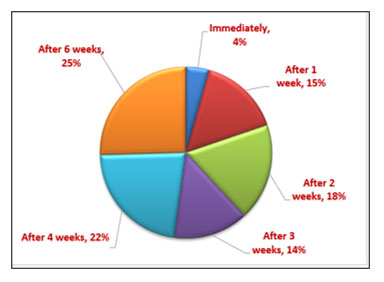
But 31 per cent of the targeted group is more likely to use personal travel more frequently as compared to earlier. A sneak peak of this data can be seen in the pie chart given below that shows the time people will wait to go out post the lockdown.
It is interesting to realise that people have different mindsets towards outings, investing and traveling. Similar to the aforementioned question, a series of questions were asked to the people from different ages, genders, backgrounds and professions. Majority of people responded that they want to meet friends and family after the lockdown. It was noted that younger people and women had a major inclination towards eating out.

The millennials are optimistically cautious especially in investing money or procuring assets. 53 per cent of the respondents want to invest in fixed deposits, but more than 40 per cent of them continue to have faith in mutual funds, and more than a quarter anticipate investing in the stock market. The millennials also want to invest more in education and development of their skills, which will surely give a boost to the education sector.
In the advertising world, print and outdoor media have taken a major hit as people during the lockdown had little option but to move to digital news portals and OTT platforms. Most of the population is binge watching on all the major OTT platforms. Video calling apps have also gained great popularity thanks to official meetings and social hangouts being restricted to our laptop/mobile screen. Will these trends stay after the lockdown ends? On that note, 36 per cent of the respondents said that their online shopping will increase, and whopping 86 per cent say that they will notice OOH advertising as much or more than they did before!
References from the reports by The Reserve Bank of India, The International Monetary Fund and McKinsey and Company were also taken into account while making the report.
Laqshya Media Group CEO Atul Shrivastava believes that people in India are committed to fight and win over the current situation. He said, “There is a huge consumption of every product in India and there will be eagerness amongst the brands to become the first choice for every consumer. This is likely to fuel the demand for the advertising sooner than most nay-sayers predict.”
Laqshya Media Group MD Alok Jalan is positive of the way ahead, “Although some industries have taken a major hit, others like the e-commerce businesses have a lot of scope ahead. This is also a good opportunity for the traditional businesses to evolve their digital presence. If we are able to contain the pandemic shortly then there is a scope for the market to bounce back and show growth.”
Follow Tellychakkar for the consumer facing news & entertainment







Digital
India leads global adoption of ChatGPT Images 2.0 in first week
From anime avatars to fantasy covers, users turn AI visuals into culture

NEW DELHI: India has emerged as the largest user base for ChatGPT Images 2.0, just a week after its launch by OpenAI, underlining the country’s growing influence on global internet trends.
While the tool was introduced as an advanced image-generation upgrade within ChatGPT, Indian users are quickly reshaping its purpose. Instead of sticking to productivity-led use cases, many are embracing it as a creative playground for self-expression, storytelling and online identity.
From anime-style portraits and cinematic headshots to tarot-inspired visuals and fictional newspaper front pages, the model is being used to create highly stylised, shareable content. Features such as accurate text rendering, multilingual prompts and the ability to generate detailed visuals with minimal input have helped drive rapid adoption.
What sets the latest model apart is its ability to “think” through prompts, generating multiple outputs and adapting to context, including real-time web inputs. But the bigger story lies in how users are engaging with it.
In India, trends are already taking shape. Popular formats include dramatic studio-style lighting edits, LinkedIn-ready headshots, manga-inspired avatars, soft pastel “spring” aesthetics, AI-led fashion moodboards, paparazzi-style visuals and fantasy newspaper covers. Users are also restoring old photographs, creating tarot-style imagery and experimenting with futuristic design concepts.
Local flavour is adding another layer. Prompts such as cinematic portrait collages and Y2K-inspired romantic edits are gaining traction, blending global aesthetics with distinctly Indian internet culture.
The surge reflects a broader shift in how AI tools are being used in the country, moving beyond utility to creativity. As younger users, creators and social media enthusiasts experiment with new visual formats, AI-generated imagery is increasingly becoming part of everyday digital expression.
If early trends hold, ChatGPT Images 2.0 may not just be a tech upgrade but a cultural moment, giving millions a new visual language to play with online.