MAM
Guest column: How brands can negotiate the ‘work-from-home’ & ‘virtual’ reality of PR

NEW DELHI: John Wooden, a renowned American ex-basketball player, coach and author, once famously said, “If we fail to adapt, we fail to move forward.” True to his saying, every change that mankind has faced has forced us to adapt and evolve, and the current Covid2019 pandemic is no different. Not only has it altered the way we take care of ourselves at a personal level to avoid contracting the ailment, but it has also impacted us financially, professionally and socially, among others.
One of the most common adaption at a professional level, unequivocally, has been implementing the practice of work from home (WFH) by organisations across geographies and scale. This is particularly true for the IT, FMCG, pharmaceutical, electronics, online retail platforms, digital lenders, start-ups, and BPO/ KPO sector. A recent report by a leading search engine company (Naukri.com) notes that the hiring of employees for a WFH job role has increased by a whopping 300 per cent since the lockdown. The enthusiasm for this ‘new normal’ has been equally reflected at employees’ end, with WFH being one of the top keywords searched.
Advantages of WFH

Aside from the safety factor, there are several other advantages of WFH. It has been observed that a significant amount of time is saved, that would otherwise be spent on travelling to work and meetings. Instead, it can, now, be used more productively and to incubate innovative solutions and ideas. WFH can also help organisations blur geographical boundaries by connecting all its stakeholders through common virtual communication and transactional platforms. Additionally, it is beneficial financially. In WFH, lower overheads, especially fixed, would be incurred and this would, eventually, prompt organisations to offer products and services at lower costs and make them more profitable and affable to its customers. Hence, post the pandemic, these factors are going to continue to encourage a multitude of organisations across sectors to reconsider a permanent WFH for some or all of its employees.
Changing dynamics of the PR landscape
Given that organisations are increasingly getting accustomed to WFH, public relations (PR), being a service-led industry, has also adopted the new norm of WFH to be on the same page as its stakeholders. The dynamic PR industry has redefined itself and has reinvented its objectives, strategies and tools to transcend to the world of ‘virtual reality’, seamlessly. Virtual models and methods are, at times, replacing and in other times, going hand in hand with traditional approaches to client servicing, media relations and other stakeholder engagements.
At a time, when client engagements can no longer happen via in-person meetings, it has to be conducted virtually. PR consultants need to maintain effective engagement with clients by sharing daily updates and various status reports in a timely manner, and schedule regular phone and video calls so that the client does not feel alienated. Key documents could be updated on shared drives to enable real-time reviewing and discussion on the way forward. It is, of course, imperative to use encrypted and trustworthy platforms to avoid leakage of confidential information or data. Time management is of key essence in WFH. It is ideal to synchronise work timings with those of the clients, to the maximum extent possible, so as to be available when the client requires your assistance and ensure that neither is eating into each other’s personal time. Virtual working has also led to merging geographical boundaries. Consultancies can now cater to existing clients, as well as onboard new ones in any location and engage virtually.
The media catches on too
It has been noted that in times of Covid, consumers are heavily relying on online and social media forums for information. This is true not just for consumers but also for the media where press conferences are now being replaced by video calls. Product launches and key announcements are taking place through social media handles of organisations. There is an even greater need for brands to post various ‘updates’ so as to maintain the brand recall in this age of information overload. It could be easy for consumers to lose interest in virtual engagement. Hence, the content to be driven on such platforms needs to be brief, relatable and highly engaging. Crisis resolution also has been redefined, since every social media participant could be a potential influencer for the brand. In the wake of this, there is a pressing need to reshape the crisis manual, timely engagement with the client, its customer or media, and address concerns promptly. All in all, a PR professional has to be well versed with digital engagement as well as the measurement metrics for gauging interest and evaluating strategies.
In the media domain, engagement has also become virtual since media rounds and meetings, one of the key relationship-building approaches are no longer feasible. There is a need to constantly engage with the media to share updates about clients, but avoid calling journalists at odd hours or expect them to check emails instantly, since WFH is a new setup for them, as well. The bottom line is to maintain a fair balance of engagement without overwhelming them.
So, how to turn this into a success story?
Last, but far from the least, WFH requires PR consultants to work in a more collaborative manner with all stakeholders, including their teams. It is vital for leaders to stay connected with teams and keep them engaged, motivated, and maintain a personal connect, beyond work. Using positive reinforcement, rather than negative, will help keep up the morale. Small gestures like celebrating achievements, occasions or simply connecting at regular frequencies, will go a long way in retaining team bonding whilst working remotely.
In a nutshell, since the end of the pandemic is indefinite, many organisations and sectors have declared, or atleast considered, WFH for its employees for at least a year. It has been observed through the passage of time that every working environment requires its own strategy to succeed. Leveraging this ‘virtual reality’ to maintain healthy relationships with all stakeholders, will enable PR consultants to assist clients to respond to new age challenges more effectively and lead the overall PR and communication industry to its growth and evolution.
(The author is founder of Value360 Communications. Indiantelevision.com may not subscribe to his views.)



MAM
VML India lands two finalist spots at Cairns Hatchlings 2026
The Mumbai agency is back in Australia with two teams, a UN brief and 24 hours to impress

MUMBAI: VML India is heading to Australia again. The Mumbai-based creative agency has secured two finalist spots at the Cairns Hatchlings 2026 competition, one in the Audio category and one in Design, making it the only Indian agency to have reached the finals in both editions of the contest since its launch in 2025.
Four people will make the trip. Senior copywriter Shilpi Dey and senior art director Raj Thakkar will compete in Audio. Art directors Shabbir and Shruti Negi will go head-to-head with the world’s best in Design. The finals take place at the Cairns Convention Centre from 13th May, culminating in an awards ceremony on 15th May.
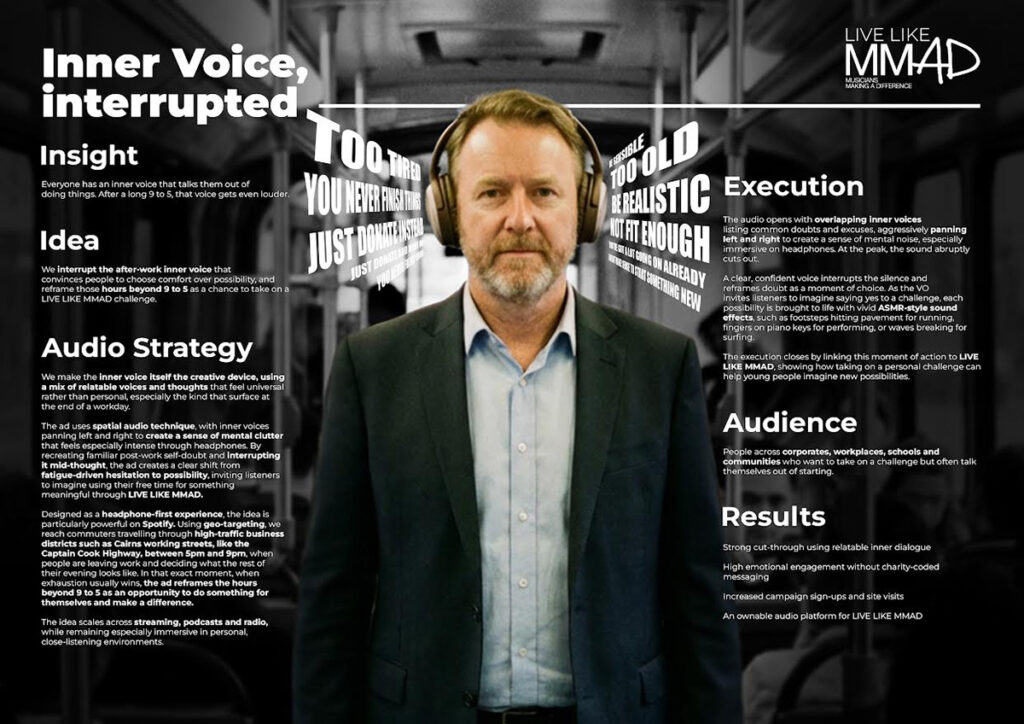
The work that got them there is worth examining. For the Audio category, Dey and Thakkar tackled a brief for LIVE LIKE MMAD with a campaign called Inner Voice, Interrupted. Using spatial audio techniques, the campaign recreates the overwhelming self-doubt that descends after a long workday, physically panning negative thoughts left and right before cutting the noise entirely to reveal a confident inner voice. Strategically targeted at commuters via Spotify during evening rush hours, the campaign reframes the hours after work as an opportunity for personal growth and charitable action.
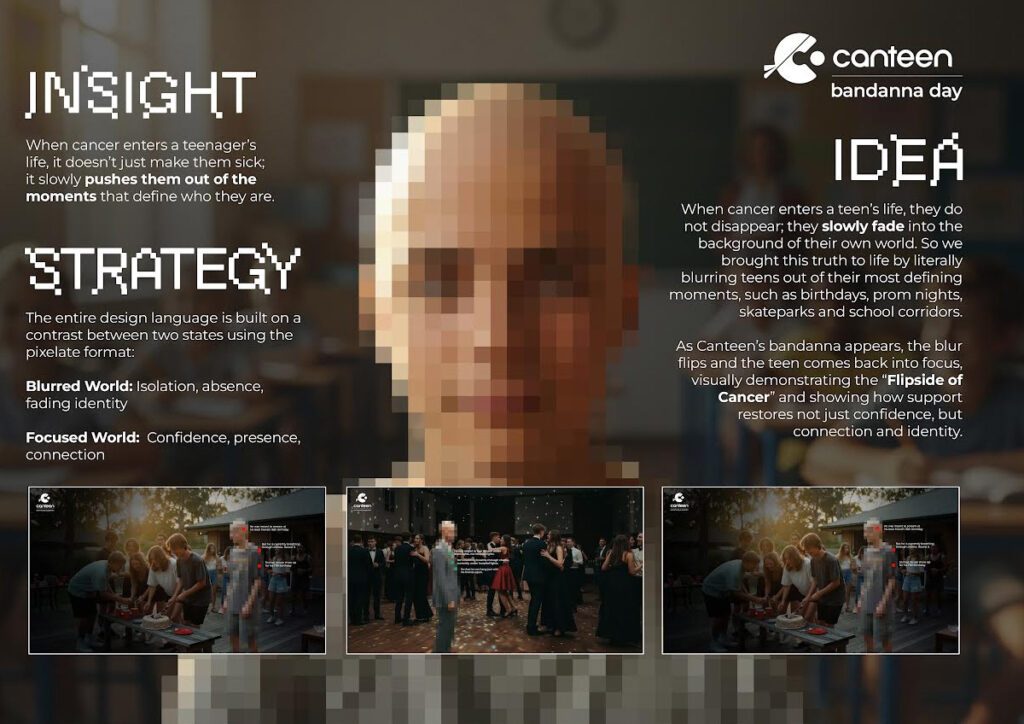
For the Design category, Shabbir and Negi worked on a brief for Canteen’s Bandanna Day, a campaign highlighting how cancer pushes teenagers out of their own defining moments. Using a pixelated design language to create stark contrast between a blurred world of isolation and a focused world of connection, the campaign, titled The Flipside of Cancer, shows teenagers fading into the background of birthdays, skateparks and school proms. As a Canteen bandanna appears, the blur flips and the teenager snaps back into sharp focus.
Kalpesh Patankar, group chief creative officer of VML India, made no attempt to disguise his satisfaction. “We are immensely proud to see our teams consistently excel on the Cairns Hatchlings platform since its inception,” he said. “They have masterfully tackled challenging briefs across diverse categories, demonstrating both layered storytelling and a unique creative approach. This exceptional teamwork is truly inspiring.”
Dey and Thakkar, returning to the finals after last year’s run, were candid about the demands of the audio medium. “It’s one of the most demanding mediums, where we only have a few seconds to capture a listener’s world with sound alone, so absolute clarity is essential,” they said. “The true measure of creative work is its ability to create positive change, and our audio submission was made to help those who need it most while encouraging people to silence the inner voices that hold them back.”
Shabbir and Negi, competing in Design for the first time, described the experience as “a completely different beast.” “We see it as an opportunity to showcase our expertise, raise the bar, and challenge ourselves in new ways, while also learning from creative minds from across the globe,” they said.
In Australia, the four finalists will face a live 24-hour brief from the United Nations before presenting in a live pitch session. Twenty-four hours, one brief, one shot. VML India has been here before. It knows exactly what is at stake.