MAM
Divine confluence: inside Megha Tata’s spiritual odyssey at the Maha Kumbh

MUMBAI: It’s been around a year since media industry veteran Megha Tata – who has led channels such as Turner International, HBO, Bloomberg TV, Discovery – has held a steady job. It’s been by choice. After slogging it out from 1992 when she was an executive with Sunday Mail, and then for more than a decade with Star India, she believes she deserves the rest. She has been happy lending her services to corporate India as a financial adviser and an independent director.
Her husband Ariez is in total agreement with her choices. An entrepreneur, he too has decided to slow down on the blistering work front and, along with Megha, they have been exploring themselves individually, each other and the world.
Normally seen in suits and sarees, these days Megha appears to be more comfortable in jeans, boots, salwar kameez’ and a backpack as she lives out every senior executive’s dream – to have a complete balanced life, rather than being caught on the treadmill of corporate achievement alone.
 Megha and Ariez have been gathering mileage – both on flights and on Indian roads. It’s been motorcycle rides to nearby towns of Mumbai as she unwinds the years of tension of corporate meetings and targets from her sinews. Meditation, discourses from Sadhguru of the Isha foundation is what have been keeping both of them occupied apart from their freelance assignments.
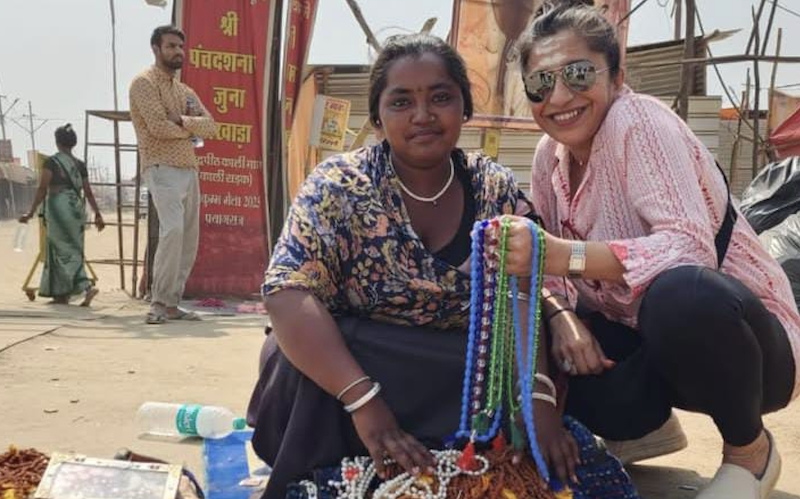
So when Megha and Ariez decided to get to Maha Kumbh, like many of her other exploratory journeys, she had no idea what she was getting into, though the duo had planned out everything. What she discovered was that it was far more than a religious gathering – it was a masterclass in spiritual immersion, logistical precision, and the harmonious blend of ancient traditions with modern conveniences.
The secret to Tata’s seamless experience lay in strategic choices that might seem counterintuitive to luxury travelers. Eschewing traditional comforts, she and her husband opted for motorcycle taxis over cars, transforming potential logistical nightmares into smooth spiritual passages.
“There was a method in the madness,” Tata reflects, describing how these agile two-wheeled vessels became their chariots through the sea of humanity.
The decision to travel light – carrying only backpacks – proved equally crucial. Where others might have struggled with unwieldy suitcases, Tata and her husband found freedom in minimalism. This mobility allowed them to weave through the crowds with ease, their motorcycle taxis navigating paths where cars would have stood helplessly gridlocked.
Their accommodation at Royal Kumbh, managed by The Secret Camp, offered a striking contrast to their minimalist transit strategy. “It was a beautifully organised setup,” Tata shares, describing their tent positioned along the Ganga’s sacred banks. This thoughtfully curated space provided not just luxury, but a serene sanctuary for reflection between spiritual immersions.
The location proved strategic, offering easy access to the heart of the Kumbh while maintaining a peaceful distance from the most crowded areas. The blend of comfort and spirituality allowed them to fully absorb the profound energies of the gathering without being overwhelmed by its scale.

What makes Tata’s journey particularly compelling is its transcendence of religious boundaries. Her husband’s Parsi heritage adds a fascinating dimension to their shared spiritual quest.
“For us, this journey was not about religion but about experiencing the energy and being part of a once-in-a-lifetime event,” she explains, highlighting how the Kumbh’s spiritual magnetism crosses all denominational lines.
Their experiences ranged from witnessing the dramatic presence of Naga Babas to finding kinship among fellow Isha Meditators.
“It was incredible to witness people from all walks of life, rich or poor, from every background united in devotion,” Tata recalls.
The sacred dip in the Ganga became a powerful symbol of unity, where the waters “seemed to embrace everyone, symbolising inclusivity and faith at its purest.”
In an interesting contemporary twist, Tata acknowledges social media’s role in amplifying the Kumbh’s reach. Rather than viewing this digital dimension as a distraction, she sees it as a bridge making this ancient gathering accessible to a global audience. “While some may see it as a double-edged sword,” she notes, “it has undeniably helped bring attention to the event.”
With an estimated 40-50 crore visitors, the event’s smooth operation stands as a testament to administrative efficiency. The Uttar Pradesh government and police force orchestrated what Tata describes as “organised chaos,” creating an environment where spiritual seeking could flourish unimpeded by logistical concerns.
For Tata, who has been on a spiritual path for over a decade, the Kumbh experience served to deepen her existing practice.

“The experience strengthened my faith in spirituality and reaffirmed my connection to this path,” she reflects. Even as her daughters remained distant – one in Bangalore, another in the United States – the journey became an intensely personal chapter in her spiritual evolution.
As the Maha Kumbh approaches its conclusion on 26 February, Tata’s experience stands as both inspiration and practical guide for future pilgrims. Her journey illuminates how this ancient gathering has evolved to meet contemporary needs while preserving its spiritual essence. In navigating the delicate balance between comfort and authenticity, tradition and modernity, Tata’s story offers valuable insights for anyone drawn to this extraordinary confluence of faith, humanity, and divine energy.
Her parting advice to potential visitors encapsulates the wisdom gained and can be applied to our daily lives as well. As she says, plan thoughtfully, travel light, embrace the unexpected, and remain open to the transformative power of the journey (to the Maha Kumbh or) of your life. In doing so, you too might discover, as she did, that both the Maha Kumbh and your daily experiences offer a far lot more –they provide a gateway to profound spiritual awakening.