Connect with us

MAM

Anymind adds horsepower with five senior hires to supercharge AI-native BPaaS transformation

Published

on

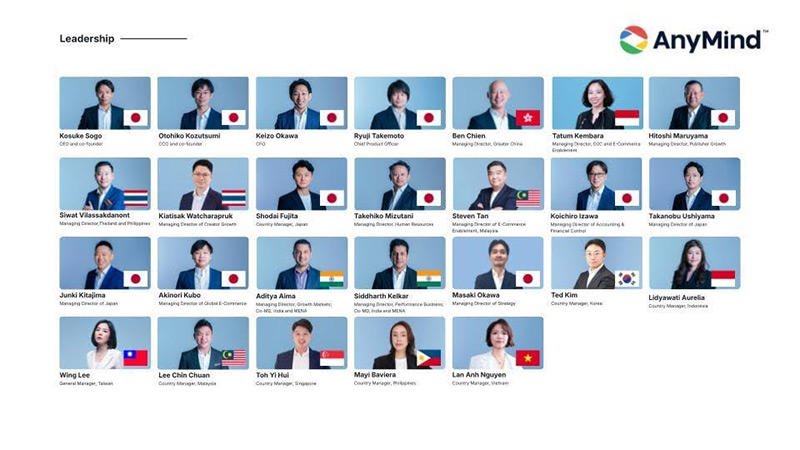
MUMBAI: Anymind Group just hit the gas pedal on its AI-native ambitions and they didn’t stop for speed limits. In one of its biggest leadership reshuffles yet, the Singapore- and India-headquartered BPaaS (Business process as a service) player has appointed five heavy-hitters to steer its next-gen business engine into high gear. With talent sourced from Google, P&G, and its own rising stars, Anymind’s management garage is now fully tuned for the next leg of digital transformation.

Announced on 16 April 2025, the appointments reflect the company’s aggressive pivot toward an AI-native BPaaS model essentially, AI meets ops meets scalability. With a focus on marketing, e-commerce, creator economy, and fulfillment, the company is throwing every tool in the tech shed at building a future-ready, hyper-scalable engine for growth.

CEO & co-founder Kosuke Sogo put it plainly, “These appointments mark a significant step forward as we scale our solutions across Asia and beyond. With deep expertise in technology, digital commerce, and fulfillment, we’re strengthening the leadership we need to navigate the next phase of our growth and shape the future of how business is done.”

Advertisement

Ryuji Takemoto takes charge as chief product officer, The company’s first-ever CPO, Takemoto has been with Anymind since day one, literally he was their first engineer in 2016. Now, he will embed AI across the company’s operations, lead the AI App Studio, and integrate next-gen product development across five engineering hubs in Tokyo, Bangkok, Ho Chi Minh City, Bangalore, and Hangzhou.

“As Anymind advances our transformation to become an AI-native company, I am committed to accelerating this journey by deepening the implementation of AI technologies into our platforms and enhance feature sets,” said Takemoto.

Shodai Fujita becomes country manager, Japan, Fujita started as a fresh grad with Anymind, cut his teeth in Thailand and Vietnam, then launched influencer marketing in Japan. After co-leading the Japanese market, he now takes full control of the company’s business in one of Asia’s biggest consumer markets.

Advertisement

“Having started my career at Anymind and grown alongside the company, I’m deeply honoured to now lead our Japan business,” said Fujita, ready to ride the AI wave with local precision.

Kiatisak Watcharapruk joins as MD of creator growth, Fresh out of Google’s Asia-Pacific HQ, where he spearheaded the launch of Gemini and other AI products, Kiatisak steps in to replace Moindy founder Punsak Limvatanayingyong. He now leads the creator growth division, which supports over 2,900 content creators globally.

“I’m thrilled to join Anymind Group at such a pivotal time for the creator economy,” he said. “I’m particularly excited to harness the power of AI to optimise content creation, distribution, and monetisation.”

Advertisement

Masaki Okawa joins as MD of strategy, Ex-P&G exec and Logipeace strategist, Okawa will be driving business across e-commerce, emerging markets, and revenue-scale initiatives. With 16 years of global FMCG experience, he’s got just the toolkit to make spreadsheets and storytelling work together. “I aspire to be a catalyst to take Anymind to the next level,” he said, adding that AI + BPaaS + business dev = his new formula for success.

Steven Tan becomes MD of fulfillment, keeps CEO hat at Arche Digital, Having joined via the acquisition of Malaysia-based Arche Digital, Tan now expands his remit across warehousing, shipping, and Anylogi Anymind’s international logistics platform.

“We’re taking a strategic step to drive further operational excellence and sustainable scalability,” said Tan, looking to connect the dots between offline grit and online smarts. This management power-up follows closely on the heels of Lan Anh Nguyen’s appointment as country manager for Vietnam earlier this year. With a roster this stacked, Anymind seems more than ready to drive their BPaaS machine into uncharted and AI-automated territory.

 

Advertisement
Click to comment

Leave a Reply

Your email address will not be published. Required fields are marked *

MAM

ASCI study uncovers how Gen Alpha navigates ads in endless digital feeds

‘What the Sigma?’ ethnographic report maps blurred boundaries between content and commerce for 7–15-year-olds.

Published

on

MUMBAI: Gen Alpha isn’t scrolling through the internet, they’re living rent-free inside its never-ending dopamine drip, and the ads have already moved in next door. The Advertising Standards Council of India (ASCI) Academy, partnering with Futurebrands Consulting, has published ‘What the Sigma?’, an immersive ethnographic study that maps how Indian children aged 7–15 (Generation Alpha) consume, interpret and live alongside media and commercial messaging in a hyper-digital environment.

The research draws on in-home interviews, sibling and peer conversations, and discussions with parents, teachers, counsellors, psychologists, marketers and kidfluencers across six cities. It examines not only what children watch but how algorithms, content creators, peers and parents shape their relationship with the constant stream of shorts, vlogs, gameplay, memes, sponsored posts and ‘kid-ified’ adult material.

Five core themes emerged:

Advertisement
  1. Discontinuous Generation, Gen Alpha is not growing up alongside the internet, they are growing up inside it. Cultural references, humour, aesthetics and language sync globally in real time, often leaving adults functionally illiterate in their children’s world. A reference that lands instantly for a 10-year-old in Mumbai or Visakhapatnam feels opaque or disjointed to most parents.
  2. Authority Vacuum, Parents and teachers frequently lose cultural fluency in digital spaces. The algorithm responsive, inexhaustible and perfectly attuned to preferences becomes the most attentive presence in many children’s daily lives. Rules around screen time feel increasingly difficult to enforce when adults cannot fully see or understand the content landscape.
  3. Digital as Society, Online and offline no longer exist as separate realms, they form one continuous reality. The phone is not a tool children pick up; it is the primary social environment they inhabit.
  4. Great Media Mukbang, Content flows as an ambient, boundary-less, multi-sensorial stream. Entertainment, advertising, commerce, gameplay, memes and vlogs merge into one undifferentiated feed. The line between active choice and passive absorption has largely collapsed.
  5. Blurred Ad Recognition, Children aged 7–12 typically recognise only the most overt advertising formats. Influencer promotions, gaming integrations and vlog sponsorships often register as organic entertainment. Children aged 13–15 show greater ad literacy but remain highly susceptible to narrative-integrated, passion-driven and emotionally resonant brand messaging. Discernment remains low across the board in a non-stop stream.

ASCI CEO and secretary general Manisha Kapoor said, “ASCI Academy’s study is an investigation into the content life of Generation Alpha not to judge them but to understand them. Their cultural reference points seem disjointed from those of earlier generations. Insights on how they perceive advertising is the first step towards building more responsible engagement frameworks, given that they are the youngest media consumers in our country right now.”

Futurebrands Consulting founder and director Santosh Desai added, “While earlier generations have been exposed to digital media, for this generation it is the world they inhabit. This report explores not only what they watch but how they are being shaped by algorithms, content and advertising.”

The study proposes four adaptive, principles-led pathways:

  • Universal signposting of commercial intent using design principles that make advertising recognisable even to young audiences.
  • Ecosystem-wide responsibility shared among advertisers, platforms, creators, schools and parents.
  • Future-ready safeguards built directly into children’s content experiences rather than as optional background settings.
  • Formal media and advertising literacy embedded in school curricula to teach age-appropriate understanding of persuasion and commercial intent.

In a feed that never pauses, Gen Alpha isn’t merely watching content, they’re swimming in an ocean where entertainment, commerce and identity swirl together. The real question isn’t whether they can spot an ad; it’s whether the adults building the ocean can agree on where the lifeguards should stand.

Advertisement
Continue Reading

Advertisement News18
Advertisement All three Media
Advertisement Whtasapp
Advertisement Year Enders

Copyright © 2026 Indian Television Dot Com PVT LTD

This will close in 10 seconds