AD Agencies
GoaFest 2025: Future Tense Rishad Tobaccowla urges leaders to rewrite the rules before AI does
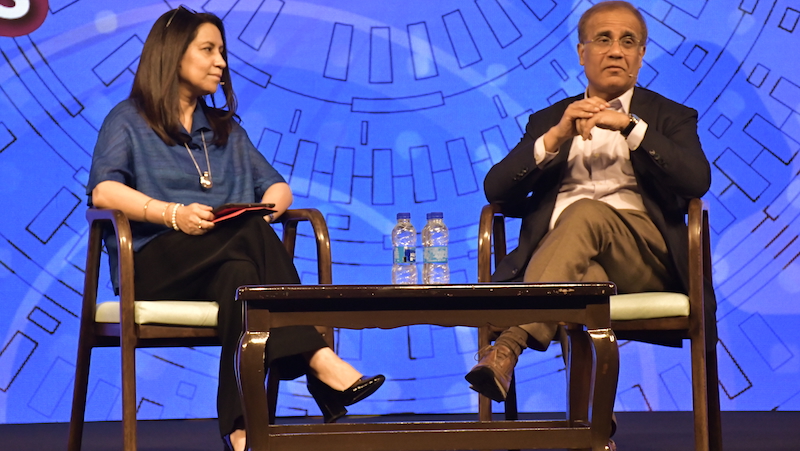
GOA: Change sucks, but irrelevance sucks harder. With that disarming one-liner, author and Publicis Groupe senior advisor Rishad Tobaccowala had the GoaFest 2025 crowd hooked. In a sharp and soul-searching fireside chat with Publicis Groupe CEO of South Asia Anupriya Acharya Tobaccowala offered a crash course in survival and soul in an era increasingly dominated by algorithms, automation and AI anxieties.
Tobaccowala’s core thesis was clear: AI won’t replace you, someone using AI better will. But the real danger isn’t the technology, it’s complacency. “Too many companies are trying to use AI to make their broken models slightly more efficient,” he warned. “You don’t just want faster printing presses you want a new way to communicate entirely.”
To prove the point, he spotlighted the New York Times, a legacy media brand that reinvented itself from a print-first paper to a digital-first platform with 12 online subscribers for every print one. Today, 35 per cent of its revenue comes not from news, but from games, recipes, and other lifestyle content. “They don’t call themselves a newspaper anymore, they’re an entertainment brand with a news vertical,” he quipped.
Referencing Andy Grove’s classic Only the Paranoid Survive, Tobaccowala argued that the age of paranoia has passed. In its place? Dual thinking. “Successful companies must run two business models at once, one for today, and one for tomorrow,” he said.
His advice: Spend five to 10 per cent of your money and 20–25 per cent of your best talent building the future. “Don’t assign tomorrow’s strategy to the person you don’t know what to do with,” he warned. “That’s like watering your grandfather’s grave instead of feeding your kids.”
“I worked 37 years in one company, lived 45 years in the same city, and met my wife 53 years ago,” he said. “So when I say I hate change, I mean it. But irrelevance? That’s worse.”
He dismantled the sugar-coated corporate approach to transformation. “Telling people change is good is a lie. It’s painful. It makes you look stupid. It scrapes your knees like learning to ride a bike.” What works instead? A three-part formula: incentives, training, and personal relevance. “Tell employees what’s in it for them, not just what’s in it for the company,” he urged.
Tobaccowala didn’t mince words about leadership either. “We’ve entered the age of de-bossi-fication. Nobody wants a boss. They want a leader.”
Monitoring, allocating, and measuring won’t cut it anymore. Today’s leaders must inspire, create, and mentor. If you’re not spending at least 50 per cent of your time leading instead of managing, he warned, “you’ll be retired by machines or Gen Z sooner than you think.”
Tobaccowala also had sharp advice for younger professionals: “You’re in a 50-year career. Stop thinking in 6-month cycles.” He urged them to chase growth over glam, pick the right boss, and resist jumping ship just because the grass looks greener. “The grass is greener because it’s fertilised with… well, you know what,” he joked.
Despite all the AI hype, Tobaccowala believes the machines may help us rediscover what makes us human. In 2023, the most popular AI tools weren’t just about productivity, they were about relationships, purpose, and self-growth.
“AI will amplify your creativity, but it can’t replace your conviction,” he said. “It’s not about resisting AI. It’s about partnering with it without outsourcing your soul.”
As he signed off, Tobaccowala reminded the audience of something many forget. “India is not the future. It is the present. Publicis gets 65 per cent of its workforce and a growing chunk of its global revenue from India, China, and the US,” he noted. “You’re not a footnote. You’re a headline.”
He ended with a final, cheeky mic-drop about his book’s global release: “My publisher didn’t want to launch in India first. Said it wouldn’t sell. Now India is the only place it’s sold out twice.”

AD Agencies
AdTrust Summit 2026 to examine trust, AI and Gen Alpha in advertising
Two-day summit in Mumbai to explore ethics, regulation and the future of advertising trust
MUMBAI: At a time when advertising is navigating a delicate trust deficit, the Advertising Standards Council of India is preparing to bring the industry to the table. On 17 and 18 March, the body will host the inaugural AdTrust Summit 2026 in Mumbai, a two-day gathering designed to spark conversation around responsibility, regulation and credibility in modern advertising.
The summit, to be held at the Jio World Convention Centre in Bandra Kurla Complex, will bring together leaders from advertising, media, technology and policy to examine how brands can build trust in a marketplace increasingly shaped by algorithms, influencers and artificial intelligence.
In an age of deepfakes, dark patterns and blurred lines between content and commerce, the question is no longer just how brands capture attention, but whether audiences believe what they see. The AdTrust Summit aims to unpack that challenge.
Day one will turn its attention to the youngest digital natives. Titled Decoding Gen Alpha, the session will unveil ‘What the Sigma?’, a study by ASCI and Futurebrands Consulting that explores how children growing up in a hyper-digital environment encounter advertising and commercial messaging.
The report presentation will be delivered by Santosh Desai, founder and director at Think9 Consumer Technologies and a social commentator known for his insights into consumer behaviour. The discussion that follows will attempt to decode how Gen Alpha consumes media, interacts with brands and navigates the growing overlap between entertainment and marketing.
In a move that mirrors the subject itself, two Gen Alpha students will also join the conversation, offering a rare perspective from the generation advertisers are trying to understand.
The second panel of the day will shift the focus from observation to implication, asking what the report’s findings mean for brands, agencies and society. Speakers include Karthik Srinivasan, communications strategy consultant; Preeti Vyas, president at Mythik; and Abigail Dias, associate president planning at Ogilvy. The session will be moderated by Sonali Krishna, editor at ET Brand Equity.
Day two moves from insight to regulation. Under the theme From Compliance to Trust, ASCI will release its Ad Law Compendium, a comprehensive guide to India’s advertising regulations.
The day will open with a keynote by Sudhanshu Vats, chairman at ASCI and managing director at Pidilite Industries, followed by a chief guest address by Sanjay Jaju, secretary at the Ministry of Information and Broadcasting.
Legal experts from Khaitan & Co., including Haigreve Khaitan, senior partner, and Tanu Banerjee, partner, will present an overview of the current advertising law landscape in India and examine whether existing frameworks are equipped to deal with emerging technologies and formats.
Subsequent panels will explore issues increasingly shaping the industry’s ethical compass. Conversations will range from the limits of persuasive design and the rise of dark patterns, to the growing scrutiny brands face from digital creators and consumer watchdogs.
One session will also feature Revant Himatsingka, widely known online as the Food Pharmer, whose critiques of packaged food brands have sparked debate around transparency and corporate accountability.
Later discussions will turn toward media literacy among Gen Alpha, asking how children can be equipped to navigate a digital world where gaming, content and commerce are becoming indistinguishable.
The summit will conclude with a final panel on the future of advertising, bringing together voices from agencies, legal circles and technology platforms to discuss how innovation, intelligence and integrity can coexist.
For an industry built on persuasion, trust has always been its quiet currency. But as audiences grow more sceptical and digital ecosystems more complex, that currency is under pressure.
Events like the AdTrust Summit suggest the advertising world knows it cannot afford to take credibility for granted. The real challenge now is turning conversation into commitment.