eNews
Moneycontrol Mutual Fund Summit spotlights SIP’s influence in Bharat’s financial journey
Mumbai: Moneycontrol Mutual Fund Summit 2024 in Mumbai brought together a distinguished assembly of finance experts, industry leaders, and regulators. This year’s theme, ‘How SIPs Are Empowering Bharat,’ emphasised the growing role of SIPs in driving financial inclusion across the nation. The summit featured insightful discussions, innovative ideas, and strategies to enhance investor experiences and promote financial empowerment.
In his welcome note, Nalin Mehta, Managing Editor, Moneycontrol managing editor Nalin Mehta set the tone for the summit. He said, “At Moneycontrol, we strongly believe in empowering India’s growth story, the remarkable expansion of Indian markets, and the rise of a new breed of retail investors fuelling this transformation. The mutual fund industry plays a pivotal role in this shift. With SIP inflows tripling over the past three years, we must address how to manage this shift responsibly and sustainably, especially as more first-time investors emerge from smaller towns. This marks our third Mutual Fund Summit, and we’re proud to host top industry leaders—CEOs, fund managers, and key stakeholders—to engage in meaningful discussions and debates on the pressing questions of our time. We’re also excited to honour and award the industry’s biggest change-makers.”
In his keynote address, Amarjeet Singh, Whole Time Member, SEBI, pointed out that fresh capital raising is a better reflection of the markets and reduces concerns related to asset price inflation. He added, “While we are witnessing a lot of money coming to the mutual fund space, we need more listings, more asset class, more fund raising by existing listed companies in the market so that the money which is coming in can be appropriately invested.
“… fresh paper issuance is clearly a better reflection of fresh capital formation and raises less doubts about asset price inflation,” he added.
Singh also elaborated on the importance of corporate governance within the mutual fund industry. “In order to sustain the current growth story, it is essential for mutual funds to uphold strong governance practices and maintain reputation for integrity and reliability. Good governance assumes greater significance given significant retail participation in mutual funds. They account for 28 percent of the industry AUM,” he said. Also, many of these retail participants are first-time investors. “Maintaining their trust in the markets is vital, as once lost, it is challenging to regain these investors’ confidence.”
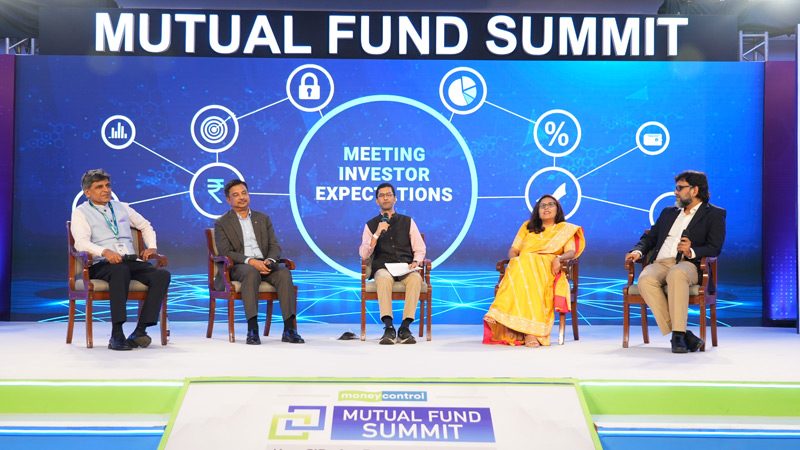
A panel discussion on meeting investor expectations featured industry stalwarts such as Radhika Gupta, MD and CEO, Edelweiss Asset Management; Kalpen Parekh, MD & CEO, DSP Mutual Fund; Ajit Dayal, Founder and Advisor, Quantum Advisors; and Swarup Mohanty, VC & CEO, Mirae Asset Investment Managers, India.
Speaking on the challenges and opportunities that come with Micro SIPs, Radhika Gupta said that the reason AMCs do not promote micro-SIPs is due to the number of costs involved with a micro SIP. However, Gupta also pointed out that if investors are willing to spend Rs 100 a month on OTT, she is “excited” that they could just as easily allocate that money towards a micro SIP.
A special highlight of the evening was an engaging chat with India’s first Chess Grandmaster, Viswanathan Anand. He remarked, “In chess, as in finance, success requires careful calculation and strategic risk-taking. Many players have successfully transitioned into the world of finance, applying the same analytical skills they honed on the board to manage their personal investments. The parallels between these fields are clear—both demand a deep understanding of the landscape, meticulous planning, and the courage to make decisive moves when the time is right.”
Other speakers and panellists at the summit included Kailash Kulkarni, CEO, HSBC India Asset Management; Suresh Sadagopan, SEBI RIA, MD & Principal Officer, Ladder7 Wealth Planners; Misbah Baxamusa, CEO, NJ Wealth; Rajeev Thakkar, Chief Investment Officer, Director, PPFAS Mutual Fund; Roshi Jain, Senior Fund Manager, HDFC Asset Management; Dinesh Balachandran, Head of Equity, SBI Mutual Fund; Ashish Gupta, CIO, AXIS Mutual Fund; Sanjay Chawla, CIO – Equity, Baroda BNP Paribas Mutual Fund; Akhil Chaturvedi, Chief Business Officer, Motilal Oswal AMC and G Senthil, CFA, CAIA, Chief Business Development Officer, KFintech.
The evening concluded with the Mutual Fund Distributor Awards ceremony, celebrating the sector’s achievements and recognizing outstanding contributions towards financial empowerment and inclusion across India.
Winners of the Mutual Fund Distributor Awards 2024:
| Sr No | Category | Broker Name |
| 1 | SIP Champion – North | MALOO INVESTWISE PRIVATE LIMITED |
| 2 | SIP Champion – South | Future First Financials Pvt Ltd |
| 3 | SIP Champion – East | Finomatic Fintech Services Pvt Ltd |
| 4 | SIP Champion – West | Ambition Finserve Pvt Ltd |
| 5 | Youth Investment Champion | Prabeta Vision LLP |
| 6 | Distributor of the Year Award | Sapient Finserv Private Limited |
| 7 | FinTech Impact Award | AssetPlus |
| 8 | National Distributor Award | Prudent Corporate Advisory Services Ltd |
| 9 | B30 Champion | Sukanta Bhattacharjee |
| 10 | Digital Champion | IntyGritty MoneyTree Private Limited |
| 11 | Lifetime Achievement Award | Goldstar Financial Services Private Limited |
| 12 | Naari Shakti Award |
Manju Mastakar, Armstrong Capital & Financial Services Pvt. Ltd
|
| 13 |
Bank Accelerator Award |
HDFC BANK LTD |

eNews
How short, addictive story videos quietly colonised the Indian smartphone
A landmark Meta-Ormax study of 2,000 viewers reveals a format that is growing fast, paying slowly and consumed almost entirely in secret
MUMBAI: India has a new entertainment habit, and it arrived without anyone really noticing. Micro dramas, those short, cliffhanger-driven episodic stories built for the smartphone screen, have quietly embedded themselves into the daily routines of millions of Indians, discovered not by design but by algorithmic accident, watched not in living rooms but in bedrooms, on commutes and in the five minutes before sleep.
That, in essence, is the finding of a sweeping new audience study released by Meta and media insights firm Ormax Media at Meta’s inaugural Marketing Summit: Micro-Drama Edition. Titled “Micro Dramas: The India Story” and based on 2,000 personal interviews and 50 depth interviews conducted between November 2025 and January 2026 across 14 states, it is the most comprehensive study of the category in India to date, and its findings are striking.
Sixty-five per cent of viewers discovered micro dramas within the last year. Of those, 89 per cent stumbled upon the format through social media feeds, primarily Instagram and Facebook, without ever searching for it. The algorithm did the heavy lifting. Discovery, as the report puts it bluntly, is algorithm-led, not intent-led.
The typical viewer journey begins with accidental exposure while scrolling, moves through a cliffhanger-driven incompletion hook that makes stopping feel unfinished, and is reinforced by algorithmic repetition until habitual consumption sets in. Only then, when a platform asks for an app download or a payment, does the viewer pause. Trust, not content quality, determines what happens next, and many simply return to the free feed rather than pay. It is a funnel with a wide mouth and a narrow neck.
The numbers on consumption tell their own story. Viewers spend a median of 3.5 hours per week watching micro dramas, spread across seven to eight sessions of roughly 30 minutes each, peaking sharply between 8pm and midnight. Daytime viewing is snackable and low-commitment, squeezed into morning commutes, work breaks and coffee pauses. Night-time is where the format truly lives: private, uninterrupted and, for many viewers, socially invisible. Ninety per cent watch alone, compared to just 43 per cent for long-form OTT content. Half the audience watches during their commute, well above the 37 per cent figure for streaming platforms, a direct reflection of the format’s low time investment advantage.
The audience itself breaks into three segments. Incidental viewers, comprising 39 per cent of the total, are passive consumers who stumble in and rarely seek content actively. Intent-building viewers, the largest group at 43 per cent, are beginning to form habits and seek out episodes but remain cautious. High-intent viewers, just 18 per cent, are the ones who download apps, tolerate ads and occasionally pay: skewing male, younger and urban.
What audiences want from the content is revealing. The top three genres are romance at 72 per cent, family drama at 64 per cent and comedy at 63 per cent, precisely the same top three as Hindi general entertainment television. The format rewards emotional familiarity over complexity. Romance in particular thrives because it demands low cognitive investment, needs no elaborate world-building and plays naturally into the private, pre-sleep viewing window where inhibitions lower and emotional intimacy feels safe.
The most-recalled shows, led by Kuku TV titles such as The Lady Boss Returns, The Billionaire Husband and Kiss My Luck, share a common narrative DNA: rich-poor conflict, hidden identities, power imbalances, melodrama and cliffhangers that make stopping feel physically uncomfortable. Predictability, the research warns, is fatal. Each episode must re-earn attention from scratch.
The terminology question is telling. Despite the industry’s embrace of the phrase “micro drama,” viewers have not adopted it. They call the content “short story videos,” “short dramas,” “reels with stories” or simply “serials.” One respondent from Chennai said bluntly that “micro sounds like a scientific word.” The category is at the stage that OTT occupied in 2019 and podcasts in the same year: widely consumed, poorly named and not yet crystallised in the public imagination.
Platform awareness remains alarmingly thin. Only three platforms, Kuku TV at 78 per cent, Story TV at 46 per cent and Quick TV at 28 per cent, have crossed the 20 per cent awareness threshold. The rest languish in single digits. This creates a trust deficit that directly throttles monetisation: viewers who cannot remember which app they used are hardly primed to enter their payment details.
Yet the appetite is clearly there. Sixty-five per cent of viewers watch only Indian content, drawn by the TV-serial familiarity of the storytelling, the comfort of Hindi as a shared language and the sight of actors they half-recognise from decades of television. South languages are rising fast: Tamil, Telugu and Kannada together account for 24 per cent of first-choice viewing. And AI-generated content, still a novelty, has landed better than expected: 47 per cent of viewers call it creative and unique, with only 6 per cent actively rejecting it.
Shweta Bajpai, director, media and entertainment (India) at Meta, called micro drama “a category that is rewriting the rules of Indian entertainment,” adding that the discovery engine being social distinguishes this wave from previous content formats. Shailesh Kapoor, founder and chief executive of Ormax Media, was characteristically measured: the format, he said, is showing “the early signs of becoming a distinct content category” and, given how closely it aligns with natural mobile behaviour, “has the potential to scale very quickly.”
The format’s fundamental mechanics are working. It enters lives quietly, through boredom and a scrolling thumb, and burrows in through incompletion and habit. The challenge now is monetisation: converting a category of highly engaged but deeply anonymous viewers into paying customers who trust the platform enough to hand over their UPI credentials. The story, as any micro-drama writer knows, is only as good as the next cliffhanger. India’s platforms had better have one ready.