Brands
Philips trims the taboo with Oneblade Intimate

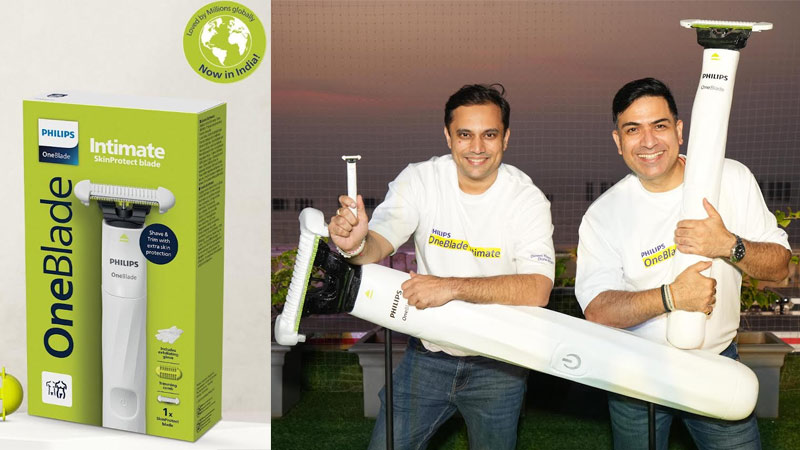
MUMBAI: Looks like Philips isn’t beating around the bush, literally! The brand has launched the Philips Oneblade Intimate, a sleek, skin-safe grooming device designed to make “down there” care feel as normal as skincare or shaving.
With India’s Gen Z leading a self-care revolution, Philips’ latest innovation answers a growing need for safe, irritation-free Intimate grooming. A recent Philips survey of over 6,000 young Indians found that a whopping 90 per cent already practise Intimate hair removal, but many still battle nicks, cuts and discomfort from products not built for sensitive zones.
Enter Oneblade Intimate: a unisex, waterproof device made to trim and shave with precision, protection and peace of mind. Its triple-protection skin protect blade system and fast-moving cutter (100 times per second) promise a smooth, nick-free experience, while a 3mm comb and rechargeable battery make it travel-friendly too.

To launch the product, Philips rolled out its cheeky Dontbeataroundthebush campaign with the tagline “Down there, done right.” From bush-shaped installations across Mumbai, Delhi and Bengaluru to influencer buzz and a vibrant event at Taj Lands End, Mumbai, the campaign turned Intimate grooming into a confident conversation about comfort and choice.
“Today’s younger generations are rewriting the rules of self-care,” said Philips personal health India subcontinent head Smit Shukla. “Their openness inspired us to create an honest conversation and a product that delivers safety, comfort, and freedom of choice.”
Priced at Rs 2,399, Philips Oneblade Intimate is available on Amazon, Blinkit, Instamart and Nykaa (which also offers an exclusive women’s edition with an exfoliating glove). Replacement blades range from Rs 899 to Rs 1,549.
With its bold messaging and light-hearted honesty, Philips has managed to make grooming talk, well, a cut above the rest.







Brands
Estée Lauder to shed 10,000 jobs as new boss bets on digital shift
The cosmetics giant raises its profit outlook but stays silent on a possible merger with Spain’s Puig, as job cuts deepen and a three-year sales slump weighs on the turnaround
NEW YORK: Stéphane de La Faverie is not done cutting. Estée Lauder announced on Friday that it plans to eliminate as many as 3,000 additional jobs, taking its total redundancy programme to as many as 10,000 roles, up from a previous target of 7,000 announced a year ago. The company, which owns La Mer, The Ordinary, Tom Ford, and Aveda, employs roughly 57,000 people worldwide. The mathematics of what is now being contemplated is stark.
The fresh round of cuts is expected to generate a further $200 million in savings, bringing the total annual savings from the programme to as much as $1.2 billion before taxes. That money, De La Faverie has made clear, will be ploughed back into the turnaround.
A CEO in a hurry
De La Faverie, who took the helm in January 2025, inherited a company that had endured three consecutive years of annual sales declines. His response has been to move fast and cut deep. A significant portion of the latest redundancies reflects his push to reduce headcount at US department stores, long a cornerstone of Estée Lauder’s distribution model but now a channel in structural decline. In their place, he is accelerating the shift toward faster-growing online platforms, including Amazon.com and TikTok Shop, a pivot that is reshaping not just where Estée Lauder sells but how it thinks about its customers.
The numbers are moving in the right direction
Despite the pain, there are signs the medicine is working. Estée Lauder raised its profit outlook for the remainder of the fiscal year, guiding for adjusted earnings per share in the range of $2.35 to $2.45, above analyst estimates and a notable step up from the $2.05 to $2.25 range it had guided for in February. Organic net sales growth is expected to come in at 3 per cent, the company said, at the high end of the range it set out in February.
The share price tells a mixed story. After De La Faverie took charge, the stock surged nearly 60 per cent, buoyed by investor optimism that a longtime company insider could finally arrest the decline. But 2026 has been rougher: the shares have fallen 27 per cent this year, weighed down by disappointing February results and the overhang of unresolved merger talks with Spanish beauty giant Puig Brands SA. The company gave no additional details about those discussions on Friday, leaving the market to guess.
Silence on Puig
The proposed tie-up with Puig remains the most consequential unknown hanging over Estée Lauder. A deal with the Barcelona-based group, which owns brands including Carolina Herrera and Rabanne, would reshape the global luxury beauty landscape. But with nothing new to say and a turnaround still very much in progress, De La Faverie is asking investors to trust the process.
Three years of sales declines, 10,000 job cuts, and a merger that may or may not happen. At Estée Lauder, the overhaul has barely started.