Connect with us

Hindi

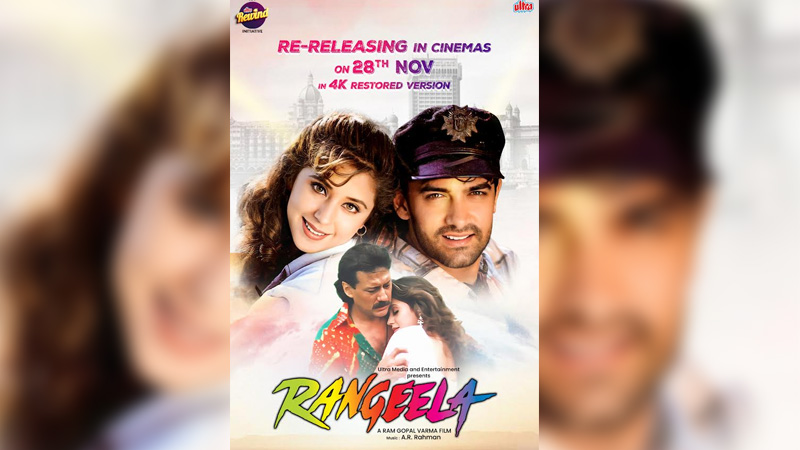
Rangeela rolls again in 4K 90s magic gets a new frame of mind

Published

on

MUMBAI: It’s time to put on those dancing shoes again Rangeela is ready to paint theatres in technicolour nostalgia. Three decades after Aamir Khan, Urmila Matondkar, and Jackie Shroff set the screen ablaze, Ram Gopal Varma’s cult classic is making a grand comeback. The 1995 musical will hit cinemas once again on 28 November 2025, exactly 30 years after it first redefined Bollywood cool.

The re-release isn’t just a replay; it’s a revival. Presented in a 4K HD restored version with immersive sound, the film promises razor-sharp visuals, richer colours, and a sonic polish worthy of A.R. Rahman’s iconic soundtrack. The restoration comes courtesy of Ultra Media, under its Ultra Rewind initiative, a project devoted to bringing India’s cinematic gems back to the big screen, one frame-perfect classic at a time.

When it first released, Rangeela was nothing short of revolutionary, a vibrant cocktail of melody, ambition, and Mumbai masti that marked a turning point for Hindi cinema in the 90s. From Rahman’s foot-tapping “Tanha Tanha” to the breezy “Yaaron Sun Lo Zara,” the soundtrack redefined Bollywood music, while Urmila’s star-making turn and RGV’s kinetic storytelling gave Hindi cinema a fresh, stylish edge.

Advertisement

Reflecting on the film’s enduring legacy, Ram Gopal Varma said, “Rangeela embodied the spirit of aspiration, showing that ordinary people can also dare to dream big. Its success demonstrated that rule-breaking cinema is often the most unforgettable.”

Ultra Media CEO Sushilkumar Agrawal added, “For many, Rangeela is a nostalgic trip back to the golden era of Bollywood. With Ultra Rewind, we’re bringing this beloved classic to modern audiences in a stunning 4K format, ensuring that its timeless charm continues to mesmerise audiences for years to come.”

Rangeela is the second project under Ultra Rewind, following the Guru Dutt Centenary Retrospective earlier this year on 8 July. That initiative saw the re-release of gems like Pyaasa, Sahib Biwi aur Ghulam, Kagaz Ke Phool, and Chaudhvin Ka Chand in 4K glory. The studio now plans to restore and re-release many other classics across languages, keeping India’s cinematic heritage alive and looking sharper than ever.

Advertisement

So, come November, the big screen will once again shimmer with Rahman’s rhythms, RGV’s storytelling swagger, and Urmila’s electric charm. Because some films don’t just age, they replay beautifully.


Click to comment

Leave a Reply

Your email address will not be published. Required fields are marked *

Hindi

Remembering Gyan Sahay, the lens behind film, television and advertising

From a puppet rabbit selling poppadums to Hindi cinema, he framed it all.

Published

on

MUMBAI: There are careers, and then there are canvases. Gyan Sahay, the veteran cinematographer, director, and producer who passed away on 10 March 2026 in Mumbai, had one of the latter. Over several decades in the Indian film and television industry, he turned lenses, lights, and the occasional puppet rabbit into something approaching art.

A graduate of the Film and Television Institute of India (FTII) in Pune, Sahay built his reputation as a director of photography across a career that stretched from the early 1970s all the way to the digital age. He was the kind of craftsman who understood that a well-composed shot is not merely a technical achievement but a quiet act of storytelling.

For most Indians of a certain age, however, Sahay will forever be the man behind the rabbit. His direction of the iconic long-running television commercial for Lijjat Papad, featuring its now-legendary puppet bunny, gave the country one of its most cheerfully persistent advertising images. It was the sort of work that sneaks into the national subconscious and takes up permanent residence.

Advertisement

His big-screen credits as cinematographer include Anokhi Pehchan (1972), Pagli (1974), Pas de Deux (1981), and Hum Farishte Nahin (1988). In 1999, he stepped behind a different kind of camera altogether, making his directorial debut with Sar Ankhon Par, a drama that featured Vikas Bhalla and Shruti Ulfat, with a cameo by Shah Rukh Khan for good measure.

On television, Sahay was particularly prized for his command of multi-camera production setups, a skill that made him a go-to technician for large-scale shows and reality programmes. In an industry that has never been especially patient with complexity, he was the calm hand on the rig.

In later life, Sahay turned teacher. He participated regularly in masterclasses and Digi-Talks, often hosted by organisations such as Bharatiya Chitra Sadhna, sharing hard-won wisdom on cinematography, the comedy of timing in a shot, and the sweeping changes brought by the shift from celluloid to digital. He was also said to have been involved in a project concerning a biographical film on Infosys co-founder N.R. Narayana Murthy.

Advertisement

Tributes from the film industry poured in following the news of his passing, with colleagues remembering him as a senior cameraman who served as a rare bridge between two entirely different eras of Indian cinema. That is, perhaps, the finest thing one can say of any craftsman: he kept up, and he brought others along with him.

Continue Reading

Advertisement News18
Advertisement All three Media
Advertisement Whtasapp
Advertisement Year Enders

Copyright © 2026 Indian Television Dot Com PVT LTD

This will close in 10 seconds

×