MAM
Throwback Thursdays: A look back at game-changer ad campaigns over the years

Mumbai: IndianTelevision.com kicks off its Throwback Thursdays series where we go into flashback mode to revisit brilliant ad campaigns created over the years – one campaign at a time. Be it in Print, Television, or Digital (in the recent past)- the medium is irrelevant so long as the messaging was crystal clear and the execution fantastic.
And what better campaign to kickstart with, than one considered by many ad gurus as one of the greatest ad campaigns of all times – and one that broke new ground and changed the rules of the game.
It’s the 1960s ‘Think Small‘ ad campaign for the Volkswagen Beetle.
Product: Volkswagen Beetle car
Agency: Doyle Dane Bernbach (DDB)
Country: United States
Year: 1959
Think Small was one of the most famous ads in the advertising campaign for the Volkswagen Beetle, art-directed by Helmut Krone, the copy written by Julian Koenig.
However, there was nothing small about the campaign’s aspirations!
Consider this. The first Beetles arrived in the United States in the 1950s. Volkswagen had hired the Doyle Dane Bernbach (DDB) ad agency to create a campaign that would introduce the German car to the US market.
A lot was working against the Beetle. It was small and plain in comparison to the big, flashy cars that Americans were obsessed with, at the time. Also, it was awkwardly shaped (which later led to it being dubbed the “Beetle”). And to make matters worse for its sellers, this was at a time when following World War II the anti-German sentiment was at a high. The initial reception to the car was expectedly lukewarm.
Here’s how an ad agency changed the car’s fate.
In 1960, DDB launched a game-changing campaign called “Think Small”, that promoted the car’s diminutive size as a distinct advantage to consumers.
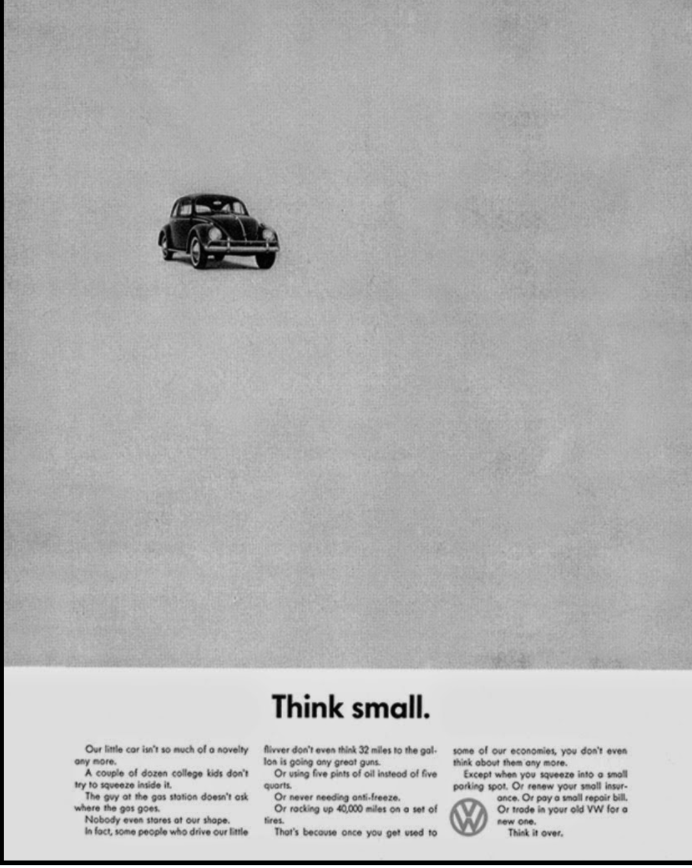 The black & white campaign encouraged drivers to “Think Small.” DDB revolved the print campaigns around the car’s ‘small’ form and focussed on minimalism. It contradicted the traditional association of automobiles with luxury and big size, keeping simplicity at its core.
This is why most of the print ads from this campaign and others that followed had a lot of empty white space with a small, stark picture of a Beetle, followed by a copy that matter-of-factly listed the compact car’s advantages in an irreverent, even self-deprecating manner.
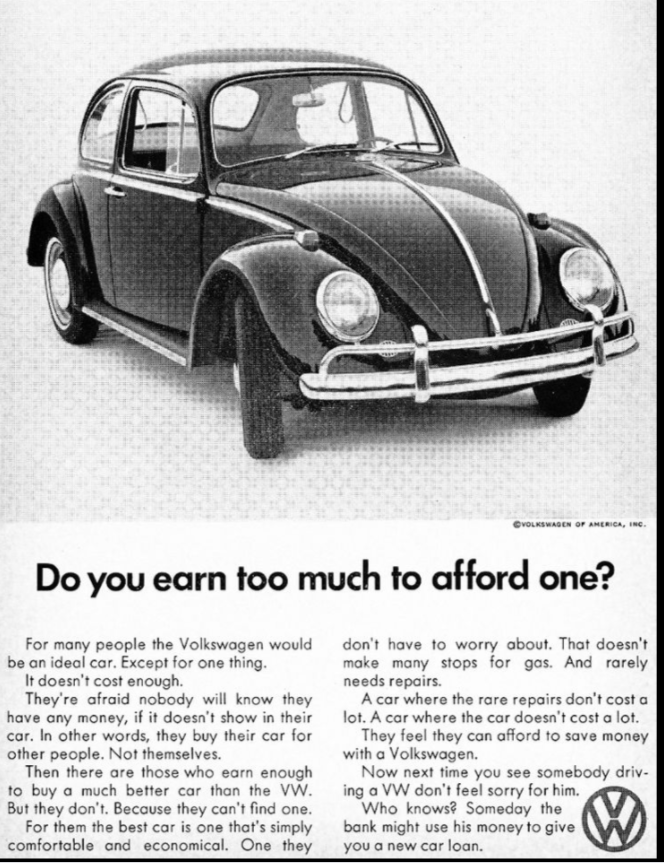 Each ad that followed in the series stood on its own, highlighting the car’s strengths while not trying to hide its possible weakness. And they were so cleverly done that they left the readers keen to watch out for the next one.
Even more notably, the ads were modestly unpretentious and emphasised as much on the intelligence, frugality, and essence of the Beetle’s buyer as they did on the car itself. The smart copy asking ‘Do you earn too much to afford one’, is a case in point- implying that don’t let your money (or its excess thereof) come in the way of buying a good car!
This tone of dry humour became a hallmark of Volkswagen Beetle ads, even later in its Television commercials. The ads effectively made the case for why owning a small, oddly-shaped car (in other words: thinking small) actually made sense, managing to show the consumer the bigger picture.
And the rest, as they say, is history or rather the stuff that advertising lore is made up of.
 The Volkswagen Beetle Print Ads shook the automobile industry and the marketing landscape of the 1960s and over the next several years, VW became the top-selling auto-import in the US.
Doyle Dane Bernbach’s Volkswagen Beetle campaign was ranked as the best advertising campaign of the twentieth century by Ad Age, in a survey of North American advertisements.
The distinctive but simple print campaign and the equally brilliant ones that followed it, brought widespread attention to the car, imbibing the Beetle in pop culture for years to come.
It did much more than boost sales and build a lifetime of brand loyalty. The ad, and the work of the creative minds behind it, changed the very nature of advertising, becoming known as one of the most legendary campaigns of all time.