I&B Ministry
I&B ministry may adopt TV rating committee’s recommendations : Anurag Thakur
New Delhi: The ministry of information and broadcasting (I&B) has analysed and evaluated the recommendations made by the committee led by Prasar Bharti chief executive officer Shashi Shekhar Vempati to review the current guidelines on TV rating agencies in India.
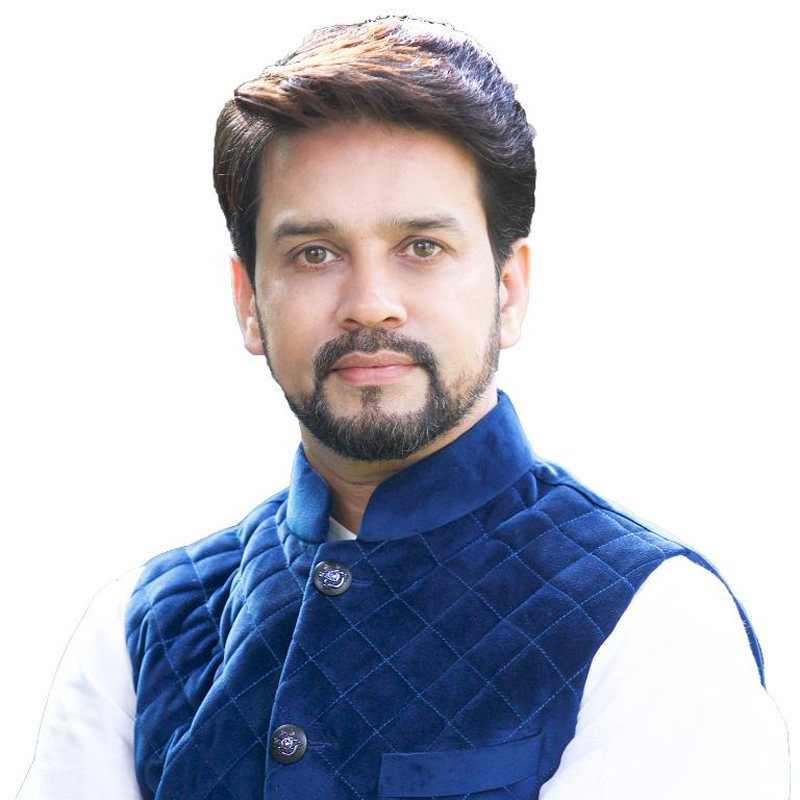
The newly inducted I&B minister Anurag Thakur told the Lok Sabha on Friday, that the recommendations will be incorporated into the existing TV rating guidelines wherever required. “The recommendations have been analysed and evaluated vis-à-vis their being translated, if required, into the existing guidelines where-ever required,” said Thakur while responding to a question on the action-taken report of the said committee.
The union minister said the existing guidelines have provisions like methodology for audience measurement, panel selection, viewing platform secrecy and privacy, data analysis, transparency etc. which are essential for a transparent and accountable rating system in India.
The guidelines, inter-alia, prescribe that the panel homes shall be drawn from the pool of households selected through an establishment survey. The procedure adopted for selection and rotation of the panel homes shall be made transparent. Further, the panel size shall be increased in a graded manner and has to remain representative of all TV households in the country.
The guidelines also prescribe that the rating agency shall publish the detailed methodology on its website. These parameters have been included in the existing guidelines to ensure transparency and representative collection of panel homes.
“Based on the recommendations of the Committee headed by CEO, Prasar Bharati along with recommendations of TRAI, the present guidelines have been analysed / evaluated vis-à-vis strengthening of transparency / panel homes and other parameters,” the minister told the Parliament.
The TV rating system in India came under scanner when in October 2020, the Mumbai police claimed in a press briefing that they had unearthed a case of manipulation of TRPs and found some incriminating evidence. The police said the accused were allegedly bribing households with BARC bar-o-meters installed to keep a particular channel running, leading to several arrests. In light of the controversy, BARC had temporarily suspended publishing of weekly data for news channels.

I&B Ministry
AIDCF moves TDSAT over Waves plan to stream linear TV channels
Industry body flags regulatory gap as OTT push sparks broadcast turf war
NEW DELHI: The battle between traditional television distributors and digital platforms has found its way to the courts, with the All India Digital Cable Federation (AIDCF) moving the Telecom Disputes Settlement and Appellate Tribunal (TDSAT) against Prasar Bharati’s latest OTT play.
At the heart of the dispute is Waves, Prasar Bharati’s OTT platform, which has invited applications to onboard linear satellite TV channels. Aidcf, which represents multi-system operators (msos), argues that this move sidesteps existing broadcasting rules and risks tilting the playing field in favour of digital platforms.
The federation’s petition hinges on a key provision in the Uplinking and Downlinking Guidelines, 2022. Clause 11(3)(f) allows broadcasters to downlink channels only if they provide signal decoders to recognised distribution platforms such as MSOS, DTH operators, hits operators and iptv platforms. OTT platforms, aidcf points out, do not feature on that list.
In simple terms, AIDCF’s argument is this: if OTT platforms are not officially recognised distributors, they should not be receiving broadcast signals in the first place. By inviting channels onto Waves, the federation claims, Prasar Bharati is opening a backdoor that lets broadcasters bypass long-standing rules.
The concern goes beyond legal interpretation. Aidcf says OTT platforms currently operate without a clear regulatory framework, allowing them to expand into traditional broadcasting territory without the compliance burden that cable and satellite operators must carry. That, it argues, creates an uneven contest.
There is also a warning for broadcasters. If they provide signal decoders to an OTT platform like Waves, they could risk breaching the very conditions under which their downlinking permissions were granted.
For its part, Prasar Bharati’s Waves initiative is positioned as a step towards wider access and digital reach, bringing linear television into the streaming era. But critics say the move blurs the line between regulated broadcasting and largely unregulated streaming.
The matter is expected to come up before tdsat next week. The outcome could do more than settle a single dispute. It may help define how India regulates the fast-merging worlds of television and OTT, where the lines are getting fuzzier by the day and the stakes, sharper than ever.