MAM
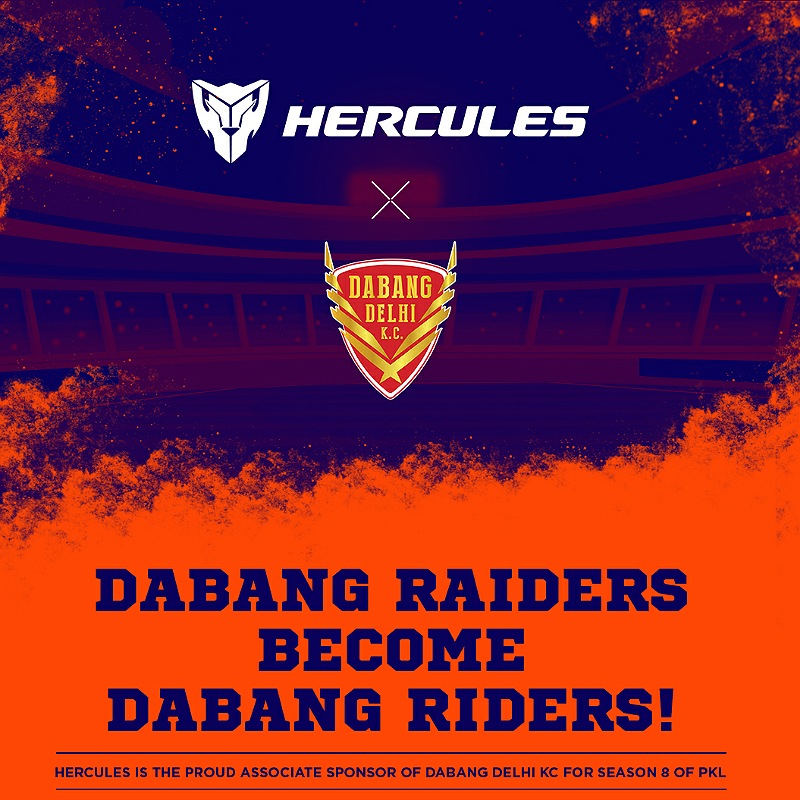
Hercules Cycles rides with ‘Dabang Delhi Kabaddi Club’ in PKL Season 8
Mumbai: Hercules, the bicycle brand from the stable of TI Cycles of India has announced its partnership up with Dabang Delhi Kabaddi Club for the Pro Kabaddi League Season 8 as an associate sponsor. The domestic league returned to the field on 22 December after two years.
“As a sport, Kabaddi involves working as a team, coming together, challenging together, fighting together and winning together, all of which fits into the brand vision of Hercules, that of helping India’s youth explore the power of togetherness,” said the brand in a statement.
Through this association, Hercules Cycles aim to reach out to the fans of The Eagles, as the members of the club are fondly addressed, as well as the larger game to encourage the tireless pursuit of dreams.
TI Cycles of India president KK Paul said, “Hercules has always been the bicycle of choice for young boys who wish to discover their spirit of adventure and exploring together with their friends through cycling. In a similar manner, the sport of Kabaddi emphasises team spirit, agility, and focuses on making one’s physique healthier and stronger. With this association, we are on a journey to support that inspiration to pursue their dreams with determination, passion, and swag, relentlessly.”
According to the head of operations and team manager Omkar Prabhu, Dabang Delhi embodies strength, agility, teamwork, and determination, and in a similar manner, TI Cycles are targeted towards adventurous youngsters who choose to explore and embrace the spirit of adventure. With this association, we seek to embark on a journey that inspires the young generation to pursue their dreams and achieve goals with relentless enthusiasm, he added.

MAM
ASCI study uncovers how Gen Alpha navigates ads in endless digital feeds
‘What the Sigma?’ ethnographic report maps blurred boundaries between content and commerce for 7–15-year-olds.
MUMBAI: Gen Alpha isn’t scrolling through the internet, they’re living rent-free inside its never-ending dopamine drip, and the ads have already moved in next door. The Advertising Standards Council of India (ASCI) Academy, partnering with Futurebrands Consulting, has published ‘What the Sigma?’, an immersive ethnographic study that maps how Indian children aged 7–15 (Generation Alpha) consume, interpret and live alongside media and commercial messaging in a hyper-digital environment.
The research draws on in-home interviews, sibling and peer conversations, and discussions with parents, teachers, counsellors, psychologists, marketers and kidfluencers across six cities. It examines not only what children watch but how algorithms, content creators, peers and parents shape their relationship with the constant stream of shorts, vlogs, gameplay, memes, sponsored posts and ‘kid-ified’ adult material.
Five core themes emerged:
- Discontinuous Generation, Gen Alpha is not growing up alongside the internet, they are growing up inside it. Cultural references, humour, aesthetics and language sync globally in real time, often leaving adults functionally illiterate in their children’s world. A reference that lands instantly for a 10-year-old in Mumbai or Visakhapatnam feels opaque or disjointed to most parents.
- Authority Vacuum, Parents and teachers frequently lose cultural fluency in digital spaces. The algorithm responsive, inexhaustible and perfectly attuned to preferences becomes the most attentive presence in many children’s daily lives. Rules around screen time feel increasingly difficult to enforce when adults cannot fully see or understand the content landscape.
- Digital as Society, Online and offline no longer exist as separate realms, they form one continuous reality. The phone is not a tool children pick up; it is the primary social environment they inhabit.
- Great Media Mukbang, Content flows as an ambient, boundary-less, multi-sensorial stream. Entertainment, advertising, commerce, gameplay, memes and vlogs merge into one undifferentiated feed. The line between active choice and passive absorption has largely collapsed.
- Blurred Ad Recognition, Children aged 7–12 typically recognise only the most overt advertising formats. Influencer promotions, gaming integrations and vlog sponsorships often register as organic entertainment. Children aged 13–15 show greater ad literacy but remain highly susceptible to narrative-integrated, passion-driven and emotionally resonant brand messaging. Discernment remains low across the board in a non-stop stream.
ASCI CEO and secretary general Manisha Kapoor said, “ASCI Academy’s study is an investigation into the content life of Generation Alpha not to judge them but to understand them. Their cultural reference points seem disjointed from those of earlier generations. Insights on how they perceive advertising is the first step towards building more responsible engagement frameworks, given that they are the youngest media consumers in our country right now.”
Futurebrands Consulting founder and director Santosh Desai added, “While earlier generations have been exposed to digital media, for this generation it is the world they inhabit. This report explores not only what they watch but how they are being shaped by algorithms, content and advertising.”
The study proposes four adaptive, principles-led pathways:
- Universal signposting of commercial intent using design principles that make advertising recognisable even to young audiences.
- Ecosystem-wide responsibility shared among advertisers, platforms, creators, schools and parents.
- Future-ready safeguards built directly into children’s content experiences rather than as optional background settings.
- Formal media and advertising literacy embedded in school curricula to teach age-appropriate understanding of persuasion and commercial intent.
In a feed that never pauses, Gen Alpha isn’t merely watching content, they’re swimming in an ocean where entertainment, commerce and identity swirl together. The real question isn’t whether they can spot an ad; it’s whether the adults building the ocean can agree on where the lifeguards should stand.