Connect with us

MAM

CAMM Summit 2022: ‘Retention is relevant through the customer journey’

Published

on

Mumbai: Retention is no longer just about the last phase of the customer journey anymore. In a traditional organisation such as a bank, retention would only come into question when the customer would close their account. But in the digital natvive business model, where the customer goes through five phases starting from acquisition followed by activation, retention, referral and revenue, retention is relevant through the latter four phases.  At the Content-Tech, Ad-Tech, Mar-Tech and More (CAMM) Summit and Exhibition 2022 organised by IndianTelevision.com co-powered by PubMatic and industry partner Adjust, experts from agency, SaaS startup, marketing deep dived into a conversation on ‘Decoding User Experience and Retention.’

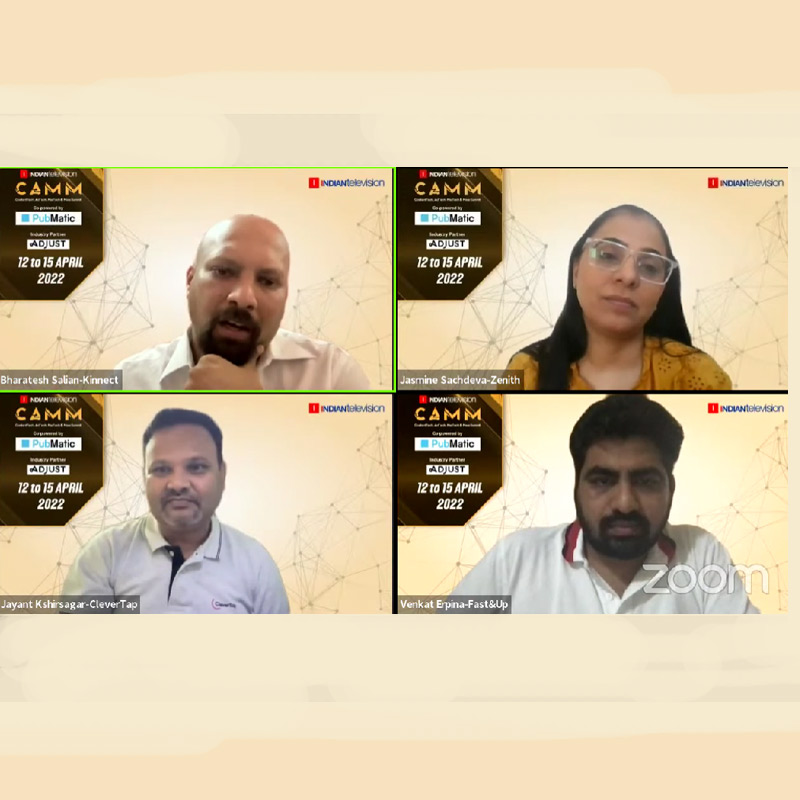
The session was led by Kinnect senior vice president marketing science and CX Bharatesh Salian who was joined by Zenith senior vice president Jasmine Sachdeva, Fast&Up vice president marketing Venkat Erpina and CleverTap senior vice president marketing Jayant Kshirsagar.

The last two years of the pandemic have changed the conversation around user experience and retention. Marketers’ decisions are more guided by data as customers. “Earlier, when the consumer was on digital or offline, we were guessing what they wanted,” said Zenith’s Jasmine Sachdeva. “We leveraged static data such as the Indian Readership Survey to understand who the customer is and where the probability is of finding them. Today, tools like AI and machine learning are supporting us to be able to predict customers’ future behaviour and connect with them. We’ve moved from guessing to predictive customer journeys.”

Advertisement

Fast&Up’s Venkat Erpina spoke about using purchase data to better understand the customer’s preferences. “Two years back, we entered the sports nutrition category with our product. If you have a strong retail customer base then it is easier to leverage them for future growth. So, we focused on customer satisfaction in terms of delivery time, packaging communication in various instances of product delivery and product quality. Then we segmented our customers into various cohorts. If a customer falls into a relevant cohort for a new product then we reach out to them and acquire new consumers,” he said.

The panellist suggested that there is a limit to how much you can nudge a customer towards a new product. The idea is to give customers value over selling them more products to drive retention. SaaS startups such as Clevertap are leveraging first party data to help brands create a seamless customer experience and purchase journey.

“All our customers are B2C companies with a digital native business model,” said Clevertap’s Jayant Kshirsagar. “Almost all of them have created a unique experience for their customers. Now they are focusing on creating value through experience.”

Advertisement

“They are refraining from spamming the customer instead they are personalising. Clevertap has created a platform where we use data, analytics and recommendations. Retention is important in terms of safeguarding the consumer base as every five per cent increase in retention helps operating margins by 40-70 per cent. The cost of acquiring a customer is far higher than the cost of retaining a customer. Offering experience plus value using technology is the key to retaining customers,” he added.

Click to comment

Leave a Reply

Your email address will not be published. Required fields are marked *

Brands

TV bills on the rise: JioStar, Sony, and Zee crank up prices by 10 per cent

Broadcasters tune into higher tariffs as JioStar, Sony, and Zee reveal new prices

Published

on

MUMBAI: If you were hoping for a cheaper night in front of the telly next year, you might want to look away from the remote. India’s broadcasting giants are flipping the script on pricing, with JioStar, Sony, and Zee all tuning into a new frequency of higher tariffs. Ahead of the 2026 financial year, the Big Three have released their updated Reference Interconnect Offers (RIOs), signalling a collective push that will see most monthly bills rise by roughly 10 per cent.

The synchronised move suggests that broadcasters are testing the price elasticity of their audience. In simpler terms, they are betting that your love for daily soaps and live sports is stronger than your annoyance at a slightly lighter wallet.

Sony is making a particularly bold play in the High Definition space. If you enjoy the crispness of Sony Entertainment Television HD or Sony SAB HD, your monthly bill for those channels will jump from 25 rupees to 30 rupees. The same 30-rupee price tag now applies to their sports heavyweights, including Sony Sports Ten 1, Sony Sports Ten 2, Sony Sports Ten 3 Hindi, and Sony Sports Ten 5.

Advertisement

However, Sony is also expanding its horizons. Fans of regional content have new arrivals to look forward to, provided they are patient. Sony Sports Ten 4 Kannada is slated for an April 2026 debut, while Sony Vizha and Sony Vizha HD are expected by June. By August, Sony Telugu and Sony Telugu HD should be live. To keep customers sweet until then, Sony is offering “proportionate discounts.” For instance, the Happy India 2026 Smart Tamil bouquet, normally 42 rupees, will cost just 29.91 rupees until the new Vizha channel officially joins the party.

On the standard definition front, Sony is keeping its “strategic mass price” at 19 rupees for big hitters like Sony Max, Sony Marathi, and Sony Aath. Smaller channels see minor tweaks: Sony Max 2 is nudging up from 2 rupees to 3 rupees, while Sony Yay! sits at 6 rupees and Sony Max 1 remains at 5 rupees.

Zee Entertainment is also getting in on the act with a comprehensive 10 percent hike. Their flagship Standard Definition channels, such as Zee TV, Zee Cinema, Zee Marathi, Zee Bangla, Zee Sarthak, Zee Kannada, and Zee Tamil, are all locked in at 19 rupees. Interestingly, they have matched this 19-rupee price point for many of their HD versions too, including &TV and &Pictures.

Advertisement

For those who prefer the all-you-can-eat bouquet approach, Zee’s All-in-One Hindi SD pack has risen to 58 rupees. Their Marathi and Bangla packs are now 64 rupees, while the Southern trio of Tamil, Kannada, and Telugu SD packs will set you back 85 rupees. If you want those same Southern packs in glorious HD, the price climbs to a steeper 131 rupees. Zee is also shuffling its deck by exiting English entertainment but entering the sports arena, with Zee Cafe and &flix seeing price adjustments to 7 and 8 rupees respectively.

JioStar is perhaps the most aggressive of the bunch when it comes to regional favourites. While they have kept core Hindi staples like Star Plus, Colors, and Star Gold at 19 rupees, they have pushed premium regional channels like Asianet, Colors Kannada, Vijay TV, and Maa TV up to 30 rupees. This move is significant because any channel priced over 19 rupees cannot be included in a discounted bouquet, meaning fans of these channels will have to buy them separately, potentially driving up the total cost of a monthly subscription.

Even the youngsters aren’t spared, with kids’ favourites like Nick SD and Nick HD+ now priced at 19 rupees. As we head towards April 2026, the ball is now in the court of the cable and dish operators. They must decide how much of these increases they can swallow and how much they will pass on to the person holding the remote. For the average viewer, the message is clear: premium content is getting a premium price tag.

Advertisement
Continue Reading

Advertisement News18
Advertisement All three Media
Advertisement Whtasapp
Advertisement Year Enders

Copyright © 2026 Indian Television Dot Com PVT LTD