MAM
PR is back: Gartner says AI is making earned media the hottest spend in the comms room
From chatbot town halls to narrative intelligence, Gartner’s five predictions for corp comms by 2029 are equal parts thrilling and terrifying.


MUMBAI: Move over, paid media. The press release is having its glow-up. In a sweeping set of five predictions stretching to 2029, Gartner has told the world’s chief communications officers (CCOs) what they probably suspected but were too polite to say at the board meeting: the old playbook is toast, AI is eating everything, and the comms function had better get its act together fast.
Gartner’s first prediction is a gift to every PR director who has spent a decade losing budget arguments to digital advertising types. By 2027, the research firm reckons, the mass stampede to public large language models (LLMs) as a replacement for traditional search will drive a 2x surge in PR and earned media budgets.
The numbers are delicious. AI-powered chatbots ChatGPT and Perplexity clocked year-on-year traffic increases of 608 per cent and 262 per cent respectively between the first half of 2024 and the first half of 2025. Google and Bing, meantime, slipped 1 per cent each. The crown is wobbling.
Here’s the kicker: AI search engines do not fancy your paid ads. More than 95 per cent of links cited in AI answers are non-paid mentions, with 27 per cent coming straight from earned media. In other words, if you want ChatGPT to say nice things about your brand, you need journalists and analysts to say nice things first. Welcome back, PRs. You were right all along.
CCOs already sensed the wind shifting. In late 2024, public relations topped the list of budget categories most likely to see an increase in 2025, with 36 per cent of CCOs anticipating a bump, ahead of corporate brand (34 per cent), public website (26 per cent), and external social media (23 per cent).
Gartner’s counsel: audit your target audiences’ preferred AI engines, benchmark what sources get cited, and build a proactive earned media machine that feeds the algorithm’s hunger for fresh, authoritative copy. Answer engine optimisation (AEO) is the new SEO and it lives in the comms department now.
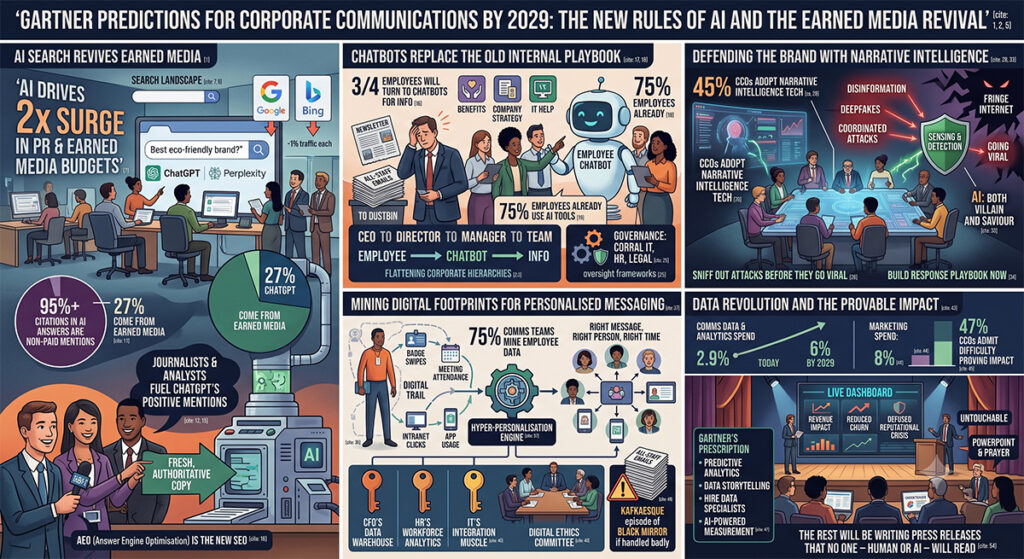
Prediction two will make many an internal comms manager reach for a stiff drink. By 2028, says Gartner, three quarters of employees will turn to chatbots not newsletters, not intranets, not their line manager to get the information they need.
The evidence is not subtle. Three quarters of employees already use AI tools at work, and 55 per cent do so regularly. Some 85 per cent of managers believe AI could meaningfully improve their team’s work. Corporate hierarchies are flattening as AI absorbs managerial tasks, meaning the age-old cascade CEO to director to manager to team — is losing its grip.
The upside: chatbots offer a surgical cure for information overload, a condition Gartner notes leaves employees 52 per cent less likely to want to stick around and 30 per cent less likely to understand the company strategy. Personalised, on-demand, conversational, these are the hallmarks of the new internal channel. The downside: hallucinations, misinformation, and fragmented messaging if governance is lax.
CCOs will need to corral IT, HR, and legal into robust oversight frameworks, retire the underperforming newsletter, and sell the change management story to an employee base that has grown rather attached to receiving information from a human being. No pressure.
Disinformation ranked as the top global risk for the second consecutive year according to the World Economic Forum, and Gartner is not mincing words about what it means for corporate reputation. By 2029, the firm predicts, 45 per cent of CCOs will have adopted narrative intelligence technologies sophisticated AI tools that can sniff out coordinated narrative attacks before they go viral.
The gap between the threat and the response is alarming. Legacy listening tools track keywords and mentions but miss the subterranean rumbles of damaging narratives fermenting on fringe corners of the internet. And yet only 14 per cent of communications leaders plan to invest in narrative intelligence platforms in the next 12 to 18 months. Blissful ignorance, or budget blindness?
AI is both villain and saviour here. The same technology that turbocharges disinformation campaigns by putting sophisticated deepfake and bot-generation tools in the hands of bad actors is also the CCO’s best hope of detecting, quantifying, and countering narrative attacks in near-real time. The firms that invest in the sensing capability and build the response playbook now will have a decisive edge. Those that wait will spend the next decade chasing stories they could have killed in the cradle.
Prediction four is either visionary or faintly dystopian, depending on your tolerance for surveillance capitalism applied to internal comms. By 2029, three quarters of communications teams will be mining employees’ digital footprints badge swipes, meeting attendance, intranet clicks, app usage to craft hyper-personalised messaging.
The rationale is solid enough. Some 94 per cent of employees use at least one digital channel for work, and every interaction leaves a data trail. CCOs who harness that trail can, in theory, deliver the right message to the right person at the right time in the right format and banish the blunderbuss all-staff email to the dustbin of communications history.
The catch: you will need the CFO’s data warehouse, HR’s workforce analytics, IT’s integration muscle, and probably a digital ethics committee to stop the whole enterprise looking like a Kafkaesque episode of Black Mirror. Handle it well, and information overload gets solved. Handle it badly, and the next disinformation crisis will be about your own company spying on its staff.
The fifth and final prediction may be the most uncomfortable for the comms fraternity. By 2029, Gartner expects communications spending on data and analytics to double, rising from a paltry 2.9 per cent of function budgets today to 6 per cent. For context, marketing already spends 8 per cent on measurement. The gap is both embarrassing and, frankly, self-inflicted.
The numbers are damning: 47 per cent of CCOs admit difficulty proving their function’s impact, while 34 per cent say they are still seen as cost centres rather than value drivers. In an era when data and analytics rank among the top three technologies CEOs consider critical to enterprise growth, a comms function that cannot quantify its contribution is a comms function on borrowed time.
Gartner’s prescription is bracing: shift from retrospective reporting to real-time predictive analytics, build data storytelling as a core team competency, hire data specialists, and redirect budgets from low-value activities — translation, manual media monitoring, editing drudgery towards AI-powered measurement. The CCO who can walk into a board meeting with a live dashboard showing exactly how communications drove revenue, reduced churn, or defused a reputational crisis will be untouchable. The one who cannot will keep fighting for budget with a PowerPoint deck and a prayer.
Taken together, Gartner’s five predictions paint a portrait of a communications function at an inflection point: more powerful than it has been in years, thanks to AI’s rehabilitation of earned media; more central to the business, thanks to the imperative to manage narrative attacks and personalise at scale; and more accountable than ever, thanks to the data revolution bearing down on every department. The CCOs who lean in will be writing the rules. The rest will be writing press releases that no one human or AI will read.