Hollywood
Could an Indian YouTuber pull off Hollywood’s hottest trick?
Will Obsession prove an inspiration for India’s creator community?

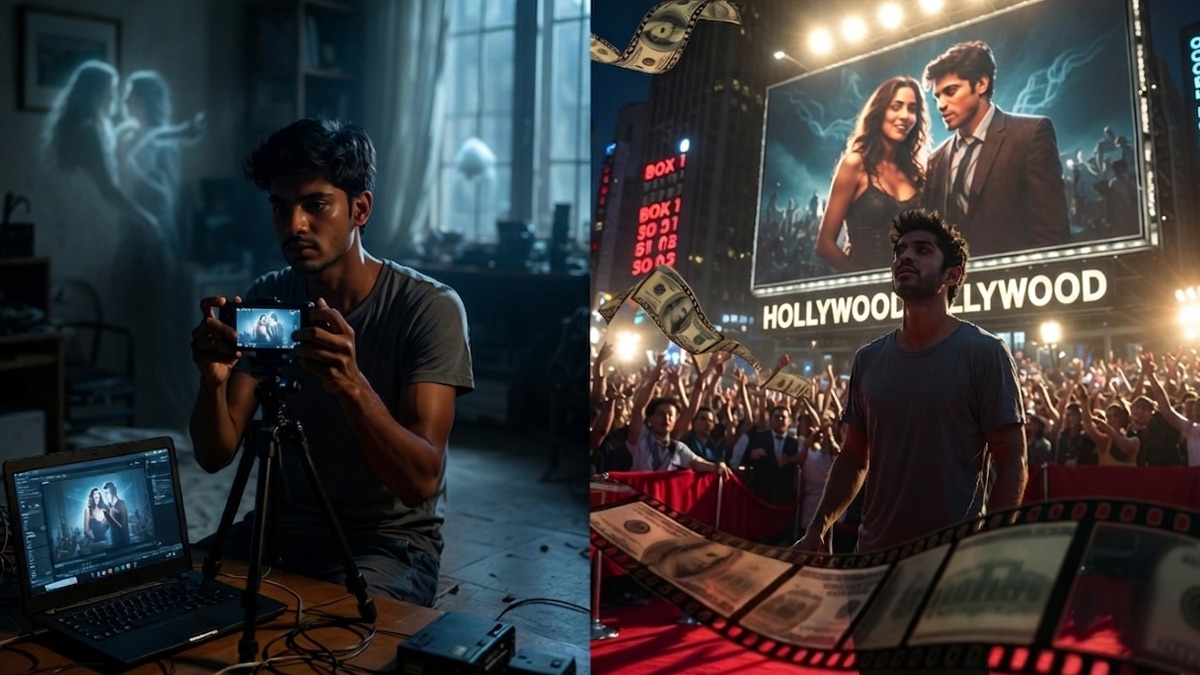
MUMBAI: Let’s start with the number that should make every studio executive in Mumbai choke on their cold-pressed juice: $750,000. That’s roughly what it cost Curry Barker to make “Obsession,” the supernatural horror-romance he wrote, directed, starred near, and edited in his pyjamas, more or less. Less than two years later it is Focus Features’ highest-grossing film of all time, north of $225 million worldwide and still climbing, with some industry trackers now whispering about $300 million. It has out-earned “Downton Abbey.” It has out-earned a Robert Eggers movie. It has out-earned the Coen brothers with George Clooney and Brad Pitt attached. A film that cost less than a modest Bandra wedding reception just beat two Oscar pedigrees and a vampire art-house hit at their own box office. Somewhere, a studio executive who greenlit a $200 million tentpole this year is quietly updating his LinkedIn.
The maths gets sillier the longer you stare at it. Barker’s previous project, a found-footage thriller called “Milk & Serial” about a pair of YouTube pranksters, cost $800, less than what a junior Hindi cinema assistant director spends on chai during a single shoot day. It went viral, agencies started calling, and within months Barker had signed with UTA, sold “Obsession” out of a bidding war between Focus, A24 and Neon for upwards of $15 million, and watched it break the record for the best fourth-weekend hold any horror film has ever had, eclipsing “The Blair Witch Project.” It became the first film since “E.T.” to grow its audience in both its second and third weekends. Hollywood now trusts this 26-year-old enough to hand him “The Texas Chainsaw Massacre” reboot at A24 and a new $5 million Blumhouse picture, “Anything But Ghosts,” co-starring Aaron Paul and Bryce Dallas Howard, a budget six times “Obsession’s,” for a film whose biggest risk factor used to be a sketch-comedy channel called “That’s a Bad Idea.” Somewhat amusingly, “Obsession” has already grossed $4.4 million in India, which means the country chasing its own Curry Barker is currently funding the original one.
And Barker isn’t even a unicorn. Kane Parsons, a 20-year-old who built an entire horror mythology called “Backrooms” out of liminal-space photographs and YouTube uploads, has his own A24 deal. Hollywood’s new theory of talent acquisition, in short, is: skip film school, skip the agency assistant years, skip the decade of unpaid favours, just check whoever has the most unsettling YouTube engagement numbers.
India’s creator class, which dwarfs America’s in raw scale even if it lags it in dollar terms, has noticed. The question is whether Mumbai, Chennai or Hyderabad can pull the same move. The honest answer remains: not quite yet, but the picture has actually moved a fair bit since this question was last asked, and most of the movement is instructive.
Take Ashish Chanchlani, the 42-million-subscriber comedy star from Ulhasnagar who spent the better part of two years teasing a “directorial debut.” That debut, “Ekaki,” a supernatural horror-comedy about seven friends whose weekend getaway to a haunted former asylum goes sideways, has now actually wrapped, finishing its run with a Final Chapter in February 2026 that pulled in cameos from the Hindi cinema director Rohit Shetty and voice cameos from the streamer-comedian Samay Raina and the actress Elli Avram. The finale was delayed by what Chanchlani, with the kind of cosmic shrug only a man with 42 million subscribers can afford, blamed on bad luck, “nazar,” in his words, was apparently real. The show now sits at a startlingly strong 8.3 on IMDb, the kind of rating most theatrically released Hindi horror-comedies would sell a kidney for. And Chanchlani did this the way Bhuvan Bam and Round2hell do everything: he wrote it, directed it, produced it, starred it, and then gave the whole thing away for free on his own channel, as a thank-you to his audience. It is, structurally, exactly what Curry Barker did. The difference is that Barker’s free upload turned into a festival premiere and a $15 million cheque, while Chanchlani’s free upload turned into, well, a free upload. Spectacular reach, zero studio capital extracted from it. That is the creator economy’s signature move: it monetises attention magnificently and converts it into ownership stakes almost never.
Then there’s Round2hell, the three-man outfit from Moradabad, Zayn Saifi, Nazim Ahmed and Wasim Ahmad, childhood friends whose channel name allegedly comes from a drifting accident one of them once described as “a round to hell,” which is either the best or worst origin story in Indian content depending on your tolerance for vehicular puns. They started in 2016 posting football montages to an audience of 120 people, the kind of number that makes a man reconsider his life choices, before pivoting to sketch comedy and going viral in 2017 with a bit mocking the end of Reliance Jio’s free-data offer, a premise so culturally specific it would baffle any American development executive, and so universally funny in India that it launched a 35-million-subscriber empire. Their genre instincts since have been uncannily Barker-like: “Zombie: The Living Dead” was YouTube India’s most-trended video of 2021; “Age of Water,” their 2022 alien-invasion short about, roughly, the importance of staying hydrated, carries a 9.1 on IMDb, a rating most theatrical sci-fi would commit light treason for. They write, shoot and edit everything themselves, credited collectively as “Team Round2hell,” which is about as close to a Hollywood-style writer-director hyphenate as Indian YouTube has produced. What they conspicuously do not have, even now, is anyone from the Indian equivalent of a UTA combing their back catalogue for IP to option. Hollywood’s talent scouts are out there right now refreshing TikTok for the next Barker. Nobody in Mumbai appears to be refreshing Round2hell’s upload schedule with the same hunger, despite the fact that three friends from Moradabad have, completely free of charge, already demonstrated the exact creative instinct the genre-film industry claims it cannot find.
Bhuvan Bam remains the most interesting control case, because his story has actually advanced furthest institutionally, and shows precisely where the institutional embrace stops. India’s first solo creator to cross ten million subscribers has now signed his official Hindi movie debut, “Kuku Ki Kundali,” under Karan Johar’s Dharma Productions, alongside Wamiqa Gabbi, a milestone so significant that Johar accidentally announced it himself mid-podcast before catching himself and apologising for the slip. It is a lovely, very Hindi cinema moment: the gatekeeper getting visibly excited and blowing his own surprise. But look at the actual credits sheet. “Kuku Ki Kundali” is directed by Sharan Sharma, who made “Gunjan Saxena,” and written by professional screenwriters Mohak and Kunal Aneja; Bam is credited only with contributing to the story and creative direction, alongside his role as lead actor. It’s the same pattern as his earlier hits “Dhindora” and “Taaza Khabar,” Bam as star, co-producer, sometimes co-writer of dialogue, but never sole auteur with final cut. Indian cinema, in other words, is delighted to let creators in as bankable faces and built-in fan bases; it is considerably less delighted to hand them the director’s chair on a Dharma-budget film. Compare that to Blumhouse handing a 26-year-old sketch comedian total creative control of a tentpole horror franchise on the strength of one viral short, and the gap in institutional trust becomes almost comically stark.
Zoom out, though, and the more durable Indian story isn’t an individual creator at all, it’s a company. The Viral Fever, started in 2010 by an IIT-Kharagpur engineer named Arunabh Kumar who couldn’t get a single TV pitch greenlit, has spent fifteen years turning YouTube sketches into “Panchayat,” “Kota Factory” and “Aspirants,” all of which graduated from YouTube to Amazon Prime Video and Netflix. TVF Motion Pictures, its feature-film arm, is no longer dabbling in small, sincere streaming dramas either: this year it’s co-producing “VVan – Force of the Forest,” a big mythological thriller starring Sidharth Malhotra and Tamannaah Bhatia, in partnership with Balaji Telefilms. That’s a genuine star vehicle with genuine theatrical ambitions, not a humble web series about exam coaching, which means TVF has effectively run the entire Curry Barker pipeline in reverse and in slow motion: prove the format works cheaply on YouTube, build the audience-data muscle, then graduate to studio-scale budgets and movie stars, except as a company rather than as one photogenic 26-year-old. It is less romantic than a lone wunderkind storming TIFF. It may also be the model that actually survives contact with the Indian box office.
Why hasn’t India produced its own TIFF-to-multiplex express lane yet? Three structural gaps still explain most of the difference, and all three are, encouragingly, narrower than they were even a year ago.
First, distribution. Barker’s path ran in a straight line from the Toronto International Film Festival’s Midnight section into a bidding war among three genre-hungry studios, because a packed festival crowd screaming on cue is, to a studio executive, as good as a focus group and a market test rolled into one. India is finally building something analogous: PVR Inox, the country’s dominant exhibitor with 1,683 screens across 360 properties, launched “MAMI Independent,” a weekly Wednesday-night screening series at PVR Lido in Juhu, curated by the festival figure Shivendra Singh Dungarpur, explicitly designed to scout independent and regional titles and then carry the winners into national theatrical release. It is, candidly, a more modest affair than TIFF: a single screen in Juhu on a Wednesday evening, competing for the city’s attention against a 9pm Hindi cinema release and the eternal Mumbai question of whether it’s worth the drive in monsoon traffic. But the stated ambition, confirmed in trade reporting this April, is to turn PVR Inox itself into the distributor for whatever the series discovers, leaning on India’s freshly crossed 10,000-screen milestone as the infrastructure case for going national. It is a TIFF-to-multiplex pipeline in its larval stage, not yet built with YouTube talent specifically in mind, but it is real, it has a name, and it has a Wednesday night slot. Watch this space, or rather, watch PVR Lido, Juhu, 7pm, every Wednesday.
Second, the money is still flowing into a different pipe entirely. India’s influencer economy, worth an estimated Rs 3,375 crore by EY’s count and compounding at 18–25% a year, remains overwhelmingly a brand-sponsorship and direct-to-consumer commerce machine, the same gravitational pull that sent Kusha Kapila into shapewear and Diipa Khosla into Ayurvedic skincare rather than into a director’s chair. Blumhouse exists specifically to underwrite cheap, high-concept genre bets on unproven talent; India’s equivalent risk capital is, for now, much happier funding the next influencer-marketing agency or D2C beauty brand, because those returns are faster, better understood, and don’t require anyone in a Mumbai boardroom to bet eight figures on whether a 23-year-old’s eerie short film will play in Bhopal.
Third, the audience itself pulls the other way, though, charmingly, “Obsession” itself complicates this argument every week it stays in Indian cinemas. Indian theatrical-going remains stubbornly star-driven and song-friendly even as streaming eats multiplex footfalls, and a stripped-down, dialogue-light psychological horror film of Barker’s kind is a tougher sell to a Friday-night Mumbai crowd than to small-town Ohio. The Central Board of Film Certification adds a layer of friction that YouTube simply doesn’t impose on Chanchlani or Round2hell, who can put out whatever bloodied, profane, gloriously unsanitised cut they like at 11pm on a Tuesday with zero committee involved.
None of this means the leap is impossible, only that it will probably arrive sideways. The smartest bet remains a regional one rather than a Hindi-language Mumbai creator: Tamil and Malayalam cinema have long been friendlier to unproven writer-directors with no star pedigree, and their festival-to-OTT-to-theatrical pipelines run looser and faster than the guild-bound Mumbai system. A Round2hell-calibre talent surfacing out of Chennai or Kochi, scooped up by a regional studio hungry for a YouTube-sized audience it doesn’t have to build from scratch, looks considerably more plausible than a Mumbai equivalent of Curry Barker landing an A24 deal off a viral short.
For now, the Indian rubicon actually being crossed is a slightly different, less cinematic one: influencer-to-founder (Kapila, Khosla), influencer-to-mogul with a guild-supervised acting career bolted on (Bam), and content-shop-to-full-blown-studio (TVF, now bankrolling Sidharth Malhotra movies). It’s a less glamorous leap from the ring light than “26-year-old sketch comedian directs his own A24 franchise,” but it’s arguably a sturdier one, corporate infrastructure tends to outlast any single creator’s algorithm luck. Still, given how fast Chanchlani went from teasing a project to landing a Hindi cinema director as a cameo, and how fast PVR Inox went from “we should really do something about this” to an actual weekly slot with a festival pedigree, it would be unwise to bet against India crossing this particular rubicon faster than anyone currently expects. Curry Barker certainly didn’t see it coming either, and he had eight months and a One Wish Willow to figure it out.