MAM
GUEST COLUMN: Why users are blocking ads and what it means for the future of digital advertising
As ad blockers rise, brands must earn attention through better experiences

MUMBAI: Advertising has long been the economic engine of the internet, funding everything from news websites and social media platforms to streaming services and mobile applications. Yet, despite its ubiquity, advertising remains one of the most disliked elements of the digital experience, with millions of users actively skipping, muting, blocking, or ignoring ads every day. As consumers become increasingly protective of their time, attention, and privacy, the industry faces a critical question: is the problem advertising itself, or the way advertising is designed? In this article, Akash Sharma, chief strategy officer at Admerly, argues that the future of effective advertising lies not in more aggressive targeting or greater visibility, but in creating ad experiences that respect users, integrate seamlessly with content, and earn attention rather than demand it. Through a user experience lens, he explores why people reject intrusive ads, what brands can learn from the rise of ad blockers, and how thoughtful design can transform advertising from an interruption into a welcomed part of the digital journey.
There are specific moments that plays out billions of times a day. A page loads, an ad fires and a hand moves to the skip button, the mute icon, the close X and then to the browser extension that makes the whole problem disappear.
That reflex is the most honest feedback the ad tech industry receives and for a very long time we mostly ignored it. We spent an inconsiderate amount of time figuring out “who” and “how” to target better. But hardly spent time thinking about the experience of witnessing the ad. And so, the result is a generation that has learned to treat advertising as something intrusive rather than something to pay attention to.
The scale of that defence is worth sitting with for a moment.
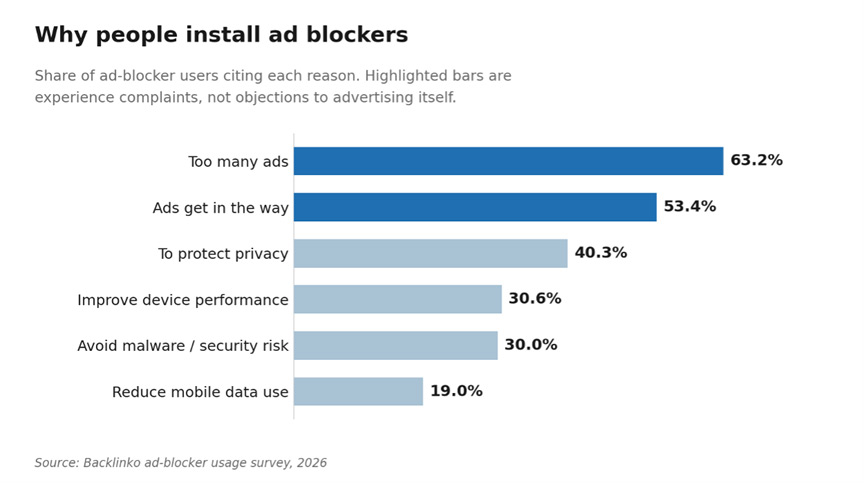
Almost 1/3rd of internet users now run an ad blocker and when you ask them why, the answers aren’t ideological. The top two reasons are simply that there are too many ads and that they get in the way of the content. Other than this, privacy, performance and security reasons follow. It’s interesting to note what’s not on their list. Almost nobody says “I don’t want companies to advertise to me.” What they object to is how ads make them feel. This isn’t brand hostility, it’s a design review and we keep failing it.
Hate is a behaviour, not a category
After researching on this for a while, I can vouch that there are a few formats viewers have always revolted against. Full screen pop-ups (interstitials), autoplay video with sound have always made people dismiss them well before they can read a single word. These ads also take up the screen or move things around when you are in the middle of reading a sentence.
The Coalition for Better Ads has come up with an entire standard around cataloguing these intrusive ads. Chrome too now polices the worst offenders by default.
The common thread isn’t the medium and it isn’t even the message. It’s the behaviour. Each of those formats does one of three things: it interrupts a task, it takes away control of the user or it imposes a cost of time, attention, data or battery. Strip the jargon away and the principle is almost embarrassingly simple.
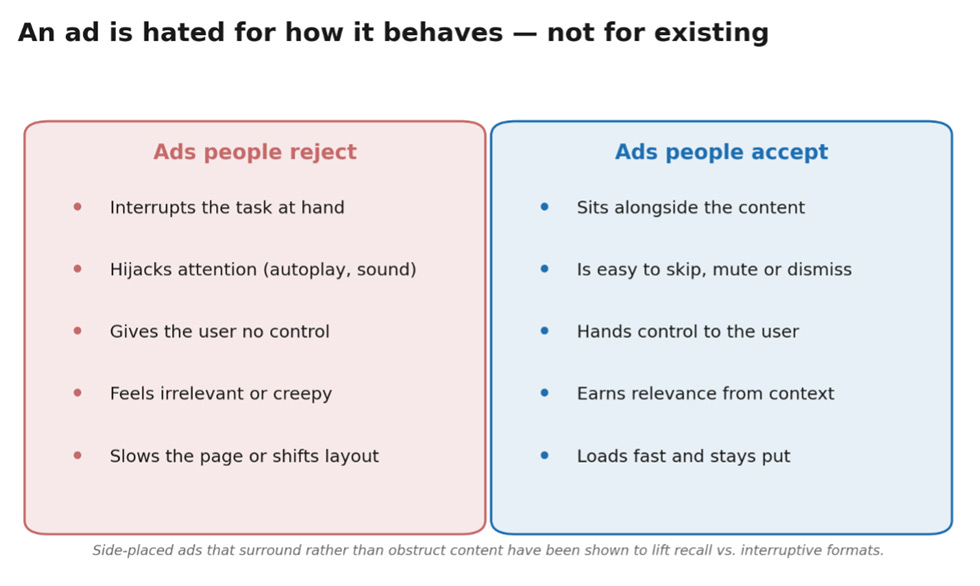
If you flip all of those things, you get a description of the kind of advertising people can quietly live with and occasionally even welcome. These are the ads that sit beside the content instead of on top of it. These are comparatively easy to skip, mute or close. And are often relevant from the context they appear in rather than from an unsettling depth of personal data. And there is good evidence that this works: ad placements that surround rather than obstruct content have been shown to increase ad recall substantially. Respect for the user and commercial performance should not work in opposite direction. The idea that they do is what has gotten us to where we’re now.
Designing ads people don’t hate
If you treat the ad unit as a product surface which is exactly what it is, a few principles fall out and they’re more actionable than the usual plea to “make better ads.”
- Treat frequency as a budget you can overspend – People do not complain about an ad, they complain about seeing too many ads. So put a cap on the frequency and measure fatigue, not just incremental reach
- Give the user control – A visible skip, a working mute and a close button, can make a huge difference.
- Design for the page, not over it – Fast-loading, layout-stable, content-respecting placements outlast the ones that win a click by ambushing someone. A cumulative layout shift is a UX bug, not a media tactic.
- Earn relevance, don’t force it – The page, the moment and the intent are a more sustainable and far less infringing source of relevance than ever-deeper tracking. Context ages better than surveillance.
- Measure attention and sentiment, not only impressions. – This is the shift I’d push hardest. In our own work at Admerly, the campaigns that scored highest on genuine attention were almost never the most interruptive ones. A click tells you someone reacted but it hardly tells you how the brand felt to be near.
The truth is that the ad blocker is the best-attended focus group in the world and its verdict has been clear for years: people aren’t rejecting advertising, they’re rejecting bad advertising. The brands and platforms that finally internalise this will stop treating UX as a constraint on their media and start seeing it as the thing that makes the media work at all. Designing ads people don’t hate isn’t a creative requirement or a compliance checkbox. In an era when it has never been easier for someone to make you vanish with a single click, it is simply how attention gets earned.
Note: The views expressed in this article are solely the author’s and do not necessarily reflect our own.