Brands
Ola Electric eyes strong Q1 comeback with registrations surpassing Q4
Electric vehicle pioneer plugs into profits with record efficiency and slashed costs

BENGALURU: For a business designed to break the speed limit of the internal combustion engine, Ola Electric has spent the last year learning that sometimes you have to anchor the brakes to successfully clear a hazardous bend. India’s flagship electric two-wheeler disruptor has wrapped up Financial Year 2026 not with a roaring sprint in volume, but with a calculated economic reset that prioritises the health of its balance sheet over raw delivery tallies. While the top-line numbers display a distinct deceleration, the underlying machinery has been aggressively tuned, leaving the firm with an industry-leading consolidated gross margin of 38.5 per cent for the fourth quarter.
The early signs of that reset are now beginning to reflect in demand recovery. Ola Electric has already recorded 22,600 VAHAN registrations in Q1 FY27 so far, overtaking the entire Q4 FY26 tally of 22,221 units despite nearly 40 days still remaining in the quarter. April registrations climbed 20 per cent month-on-month to 12,166 units even as the broader electric two-wheeler industry contracted by 22 per cent, while May volumes are trending towards the 14,000 to 15,000-unit range. Management indicated that order inflows are now accelerating ahead of registrations, signalling a stronger revival in underlying consumer appetite after the operational disruptions that weighed heavily on the March quarter. The company is guiding for 40,000 to 45,000 orders and consolidated revenues between Rs 500 crore and Rs 550 crore in Q1 FY27, positioning the quarter as the opening chapter of a more disciplined scale-up cycle following FY26’s restructuring-led reset.
“Financial Year 2026 was a year in which volumes were lower than where we wanted to be, but it was also a year in which the fundamentals of Ola Electric became materially stronger,” observed chief financial officer Deepak Rastogi during the company’s post-results analysis. Founder, chairman, and managing director Bhavish Aggarwal was equally bullish on the company’s structural pivot, declaring: “Q4 was a low volume quarter, but it also showed the reset working… This is the milestone we had set for ourselves in the current quarter and we have delivered the promise”.
A granular dissection of the full-year figures reveals the stark magnitude of Ola’s transitional phase. Consolidated revenue from operations for FY26 landed at Rs 2,253 crore, down from the Rs 4,514 crore posted in FY25. Total vehicle deliveries for the year reached 173,794 units, a sharp reduction from the 307,846 deliveries recorded in the preceding fiscal cycle. The compression was particularly evident in the final quarter (Q4 FY26), where revenue trickled in at Rs 265 crore on the back of 20,256 deliveries.
Yet, where the top line shrank, the margin profile expanded exponentially. Ola’s consolidated gross margin for the full year stood at 30.6 per cent, culminating in that striking Q4 apex of 38.5 per cent (which rests at a comfortable 33.5 per cent even when stripping away Production Linked Incentive benefits). This marks a monumental leap from the 13.7 per cent gross margin recorded in Q4 FY25.
Crucially, Q4 marked Ola’s inaugural entry into operating cash-flow positive territory, generating a consolidated CFO of Rs 91 crore. The automotive segment alone generated an operating cash flow of Rs 213 crore and free cash flow of Rs 173 crore during the quarter. This performance drastically curbed full-year cash depletion: consolidated CFO deficit narrowed from -Rs 2,391 crore in FY25 to -Rs 775 crore in FY26, while consolidated free cash flow improved from -Rs 3,367 crore to -Rs 1,492 crore. However, the bottom-line net profile remains deep in the red, with a full-year loss after tax (PAT) of Rs 1,833 crore (up from a loss of Rs 2,253 crore in FY25) and a Q4 PAT loss of Rs 500 crore.
The catalyst behind this cash turnaround is a ruthless operational cost-cutting drive. Consolidated quarterly operating expenses, including lease rentals, were virtually sliced in half, plummeting from Rs 844 crore in Q4 FY25 to Rs 428 crore in Q4 FY26. Management plans to squeeze this figure down further to approximately Rs 350 crore per quarter.
“This came from network rationalisation, tighter sales and service costs, lower fixed overheads and stronger operating governance,” Rastogi detailed, highlighting that a lower cost base heavily reduces the company’s structural break-even volumes. With adjusted operating EBITDA losses sitting at -Rs 1,203 crore for the full year and -Rs 326 crore for Q4, Ola expects that operating breakeven is now achievable at an attainable run-rate of 20,000 to 25,000 units per month.
For much of FY26, the primary bottleneck constraining consumer demand wasn’t production capacity, but a bottlenecked service network that dented brand trust. In response, management enacted an 88 per cent reduction in average service turn-around time (TAT), compressing it from 9 days in October 2025 to a swift 1 day by March 2026. Backlog queues were similarly cut down from 14 days to 6 days, and same-day repair closures climbed to 87 per cent.
This operational overhaul has yielded significant financial relief. The transition to robust, diagnostic-led “Gen 3” vehicle architectures chipped away at recurring product failures. Consequently, Ola’s aggregate warranty expenses plunged from a painful Rs 555 crore in FY25 to a mere Rs 59 crore in FY26.
As service queues evaporated, consumer demand experienced a dramatic V-shaped rebound. April registrations rallied to 12,166 units, a 20 per cent month-on-month expansion achieved against the backdrop of a broader electric two-wheeler market collapse of 22 per cent. This regional recovery proved broad-based, spanning Uttar Pradesh, Bihar, and West Bengal, alongside traditional strongholds like Maharashtra, Karnataka, and Tamil Nadu.
In an unorthodox operational shift, Ola has successfully woven a proprietary Artificial Intelligence stack directly into its day-to-day corporate fabric. The firm’s AI models currently process roughly 200,000 automated customer calls daily, entirely managing outbound lead reactivations, multilingual sales engagements, test-ride bookings, and technician workflow schedules. Management notes that these digital agents are actively outperforming human staff on key conversion funnels while systematically lowering localised overheads.
Beyond its core EV scooter lineup, Ola is methodically expanding into a broader energy ecosystem. The newly introduced ‘Roadster’ motorcycle series has rapidly captured a 50 per cent market share in India’s nascent electric motorbike segment, contributing 15 per cent of total gross orders in April.
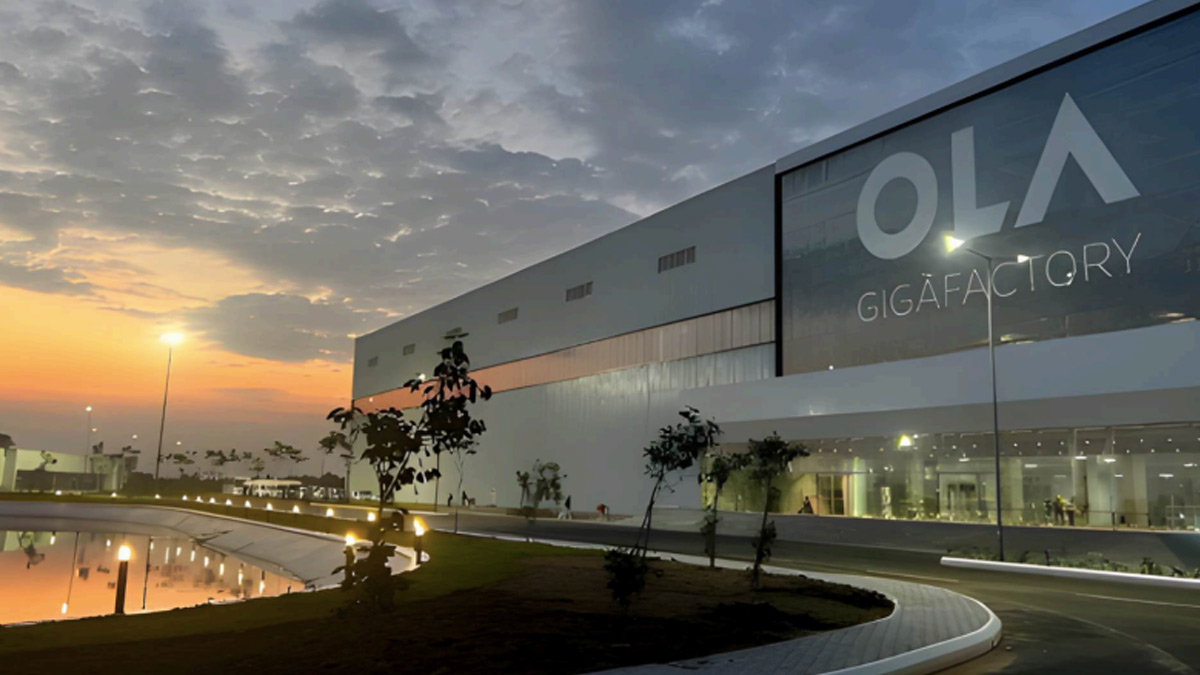
Simultaneously, the company’s internal commercial architecture is shifting towards deep battery localisation via its Gigafactory asset base. Around 15 per cent of recent customer orders utilise Ola’s homegrown, high-performance 4680 “Bharat Cell”, with a comprehensive internal transition across all product lines scheduled for completion by September 2026. This shift expands scooter battery capacity from 4 kWh to 5.2 kWh, boosting range by over 30 per cent, and equips premium motorcycles with massive 9.1 kWh packs capable of a certified 500+ km range.
Looking beyond individual mobility, the Gigafactory’s 6 GWh Phase 1 footprint is being leveraged to introduce external energy storage verticals under the ‘Shakti’ (retail backup and distributed storage) and ‘Mahashakti’ (utility-scale grid storage) product banners. With a gross block asset footprint already 5 times larger than its pure-play EV peers, Ola claims its existing factory framework can comfortably support Rs 15,000 crore to Rs 20,000 crore in annual revenue scale without needing any fresh capital expenditure injections. The company aims to aggressively scale this platform infrastructure to 20 GWh by early next year through targeted cell-entity capital raises.
Equipped with lean inventory buffers and an active product backlog, Ola enters the first quarter of Financial Year 2027 projecting consolidated revenues between Rs 500 crore and Rs 550 crore alongside an order volume of 40,000 to 45,000 units, effectively doubling its Q4 operational run-rate. Geopolitical frictions and raw commodity inflation may trigger transient margin compression in the near term, but Aggarwal insists the company holds the financial buffer required to remain hyper-aggressive. For an automotive pioneer that spent months trapped in an operational pit stop, Ola Electric has emerged with a leaner, meaner, and far more capital-efficient machine.