AD Agencies
Goafest 2026 day 2: AI is everywhere, but human creativity is not going anywhere
From AI washing to data wars, the second day of South Asia’s biggest advertising festival delivered sharp, unsettling and occasionally uncomfortable truths about where the industry is headed

GOA: If day one of Goafest 2026 was about resetting Brand India, day two was about resetting the industry’s relationship with the technology it keeps talking about but barely understands. Session after session, a consistent message cut through the noise: AI is a tool, not a replacement, and the companies pretending otherwise are fooling nobody.
Calling out the AI bluster
The morning opened with a session bluntly titled ‘AI Washing: The Truth About AI’, presented by Mediakart in association with The Times of India and Vijas Digital, moderated by Shubhranshu Singh, member of the board of directors of the Effie LIONS Foundation and Forbes most influential global CMO 2025.
Gulrez Alam, chief revenue officer of Affle, cut straight to it. “AI is meaningful only when it delivers results and efficiency for clients; creativity and planning mean little without outcomes,” he said. Built on the principle of garbage in, garbage out, AI depends on quality data that must evolve from a rearview mirror into a GPS, he argued. As automation accelerates and bots increasingly dominate online traffic, advertisers will need to identify real human audiences while also engaging with AI bots working on behalf of humans.
Niraj Ruparel, creative technology lead at WPP and WPP Media, was equally direct about both AI’s promise and its limits. “AI is unlocking massive opportunities for rapid prototyping and innovation, enabling creative and tech teams to build solutions faster and democratise access to creativity at scale,” he said. Combined with faster internet, AI will accelerate immersive, personalised 3D and spatial experiences. But technology alone is not enough. “Human creativity and original thinking will remain the true differentiators,” he said.
Smriti Mehra, chief executive of English and business news at Network18, offered a media lens on the same questions. “AI will transform news from information dissemination to intelligence-led storytelling, making content more personalised and multilingual, while human editorial judgment remains critical,” she said. Most companies are still in the experimental or partially deployed stage of AI adoption, she noted, even as brands face the growing challenge of engaging the remaining genuine human audience online. Premium experiences, she added, may increasingly move behind paywalls.
Google’s agent provocateur
Google’s keynote, ‘There’s an Agent for That: Excelling in the AI Era’, gave the industry a glimpse of what the next phase looks like. Satya Raghavan, director of marketing partners at Google India, told delegates that consumer behaviour has moved well beyond the traditional funnel, with people simultaneously searching, streaming, scrolling and shopping. Six generations can now coexist in one household, from boomers to Gen Beta, and the central idea of the moment is simple: there is an agent for that.
“An agent is essentially a system that performs tasks on behalf of someone else, and in that sense, agencies have always functioned as agents by solving business problems for brands and consumers,” Raghavan said. AI agents are valuable only when tied to the right use case, helping automate repetitive tasks so humans can focus on higher-value creative work. His parting thought carried an edge of reassurance: “We are now moving from the generative era to the agentic era, where you no longer need to know coding, only how to communicate and instruct. The goal of AI is not to replace humans but to help them work faster and smarter.”
The hook, the culture, the conversation
NDTV’s session, ‘The Hook: The Craft, The Culture, The Conversation’, took the temperature of storytelling in an age of shrinking attention spans, featuring Darshana Shah, chief marketing officer of Aditya Birla Capital; Rahul Kanwal, chief executive and editor-in-chief of NDTV; Rana Barua, group chief executive of Havas India, SE Asia and North Asia; Rohit Kapoor, chief executive of Swiggy; and Sam Balsara, chairman of Madison World, moderated by Alex Matthew, associate executive editor of NDTV Profit.
Shah made the case for speed without sacrificing substance. “Campaigns must capture attention within the first few seconds, with ideas rooted in long-term brand positioning and deep consumer understanding,” she said. Moment marketing works best when brands fit naturally into cultural conversations, she added, and always-on content drives memorability, engagement and commerce in real time.
Kanwal delivered the session’s most vivid observation. “Cultural moments today can emerge instantly on social media and become massive movements overnight,” he said, citing the Cockroach Janta Party as a viral phenomenon that gained traction within hours, and describing how unexpected moments like ‘Melody’ become branding that money cannot buy. “The advertising world is moving from campaign-led storytelling to culture-led storytelling,” he said.
Barua sharpened the argument. “Brands today must decide whether they want to be meaningful or merely desirable, because without emotional connection or relevance in people’s lives, no amount of marketing can succeed,” he said. AI can facilitate conversations and execution, but it cannot create original ideas or cultural understanding. “The real ideas still come from humans who understand culture, behaviour, and context.”
Kapoor brought the perspective of a brand that lives inside the feed. “Gen Z is not a single audience, and brands must balance virality with clear guardrails, embracing trends quickly but dropping them just as fast, since today’s ads may last only around ten days,” he said. Long-term brand building still requires consistency: brands are built over years while trends are built in days.
Balsara closed the loop on a theme that ran all day. “Many brands today are overfocused on performance marketing at the cost of brand building,” he said. “Ads today also need far more frequent refresh cycles than earlier, when campaigns could run for years; now they may need to change every month.”
Measuring the unmeasurable
Comscore’s keynote, ‘AI, Audiences and Cross-Platform Clarity’, added an analytical edge. Smriti Sharma, executive vice-president of analytics and managing director of Custom IQ at Comscore, argued that consumers are no longer searching traditionally but asking conversational queries. “In this jugaad ecosystem, Indian users trust creators and communities over polished advertising, pushing marketers to move from placement-led strategies to influence-led ecosystems powered by connected data,” she said.
The big picture on Indian advertising
A conversation between Dheeraj Sinha, chief executive of the McCann Group, and Annurag Batra, chairman and editor-in-chief of BW Businessworld and founder and editor-in-chief of exchange4media, ranged freely across the past and future of Indian advertising.
Batra offered the boldest projection of the day. “The Indian advertising industry is expected to grow from Rs 75,000 crore to over Rs 2 lakh crore in the coming years,” he said. “Advertising is not dying; more businesses and brands are using it to drive growth.” The agency of the future, he argued, will evolve into a marketing transformation company integrating strategy, media, content, AI, digital and consulting. Global capability centres will emerge as a major growth engine for India’s marketing services industry. His warning was pointed: “Excessive reliance on performance marketing is unsustainable. Brands are built over years, while trends are built in weeks.”
Sinha was equally bullish, if more measured. “Every few years, advertising is declared dead, and AI is expected to replace jobs, yet India remains one of the world’s most optimistic advertising markets,” he said. AI is simplifying operations and enabling leaner, more flexible agency models. “India is also emerging as a major global hub for marketing and creative services, powered by growing talent, technology, and entrepreneurial energy.”
The war on data
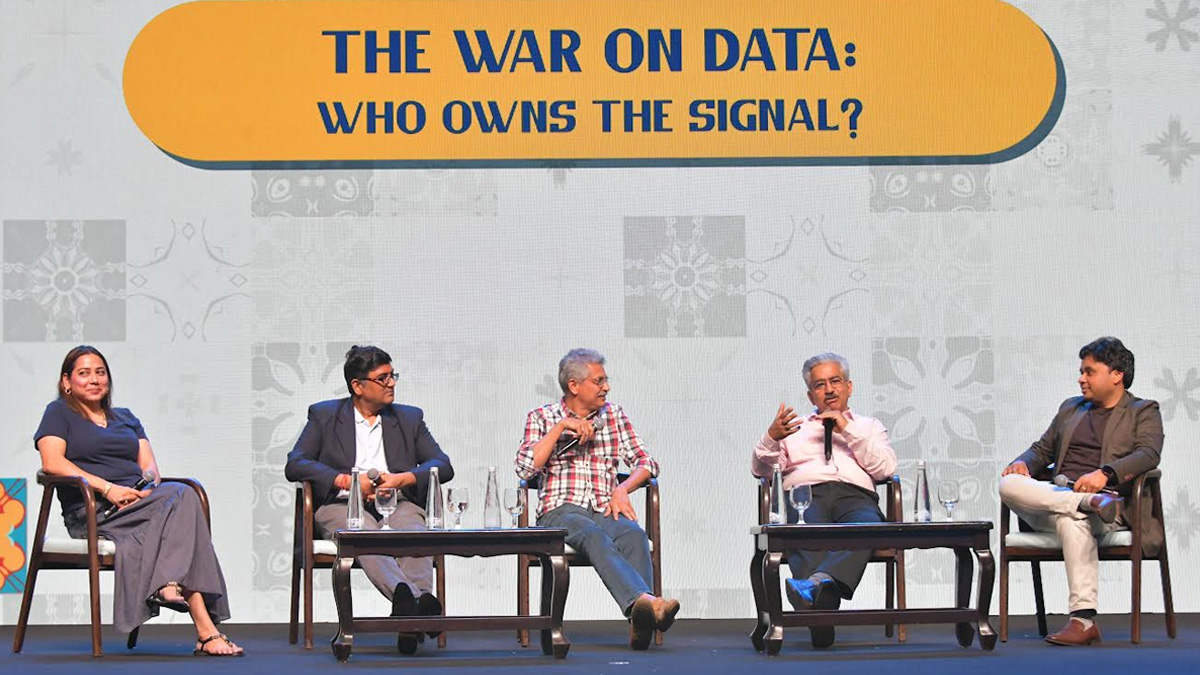
The first half of day two concluded with ‘The War on Data: Who Owns the Signal?’, presented by Saptharushi and moderated by its founding chief executive Gowthaman Ragothaman. The panel brought together Mayank Shah, vice-president at Parle Products; Anjali Madan, director of consumer experience and global marketing at Mondelez International; Sanjay Sindhwani, chief executive of Indian Express Online; and Saikat Sinha, director of consumer experiences at The Coca-Cola Company.
Shah grounded the debate in FMCG reality. “Data-driven customisation works best for high-involvement categories, while FMCG still relies heavily on mass branding and top-funnel awareness,” he said. The DPDP rollout, he added, is making explicit consumer consent and responsible data usage increasingly important.
Madan made a case for consolidation. “Performance marketing and brand building should not be treated separately, as consumers don’t distinguish between performance and equity marketing,” she said. Over-focusing on return on ad spend and conversions can weaken long-term brand equity and increase future acquisition costs.
Sindhwani described how publishers are adapting. “Indian publishers are moving from anonymous audiences to first-party data ecosystems built through sign-ups, subscriptions, whitepapers, and downloads,” he said. Platforms like Google Analytics offered scale and insights, he noted, but did not provide ownership of consumer data.
Sinha brought the conversation back to culture. “Beverage brands are built on deep consumer and cultural understanding, with ecosystems across retail and distribution playing a critical role,” he said. Real-time signals, contextual understanding and partner ecosystems help brands identify the right consumer moments.
On the sidelines
Day two also featured a run of masterclasses: LinkedIn on building content, credibility and community; the Asian Federation of Advertising Associations on the stories machines cannot tell; Mediakart on rich media; MICA on content in an attention-deficit economy; and brand communication strategist Shaziya Khan on why small is the new big. Lunch was presented by Vijayavani.
The day’s message was clear enough. Indian advertising is growing, AI is accelerating and the data wars are intensifying. The only thing nobody could automate, session after session insisted, was the original idea. The industry seemed to find that both comforting and quietly terrifying.






