MAM
Goafest 2026 spotlights Google’s AI-powered search reset
Google says AI search is rewriting discovery, ads and ROI playbooks.

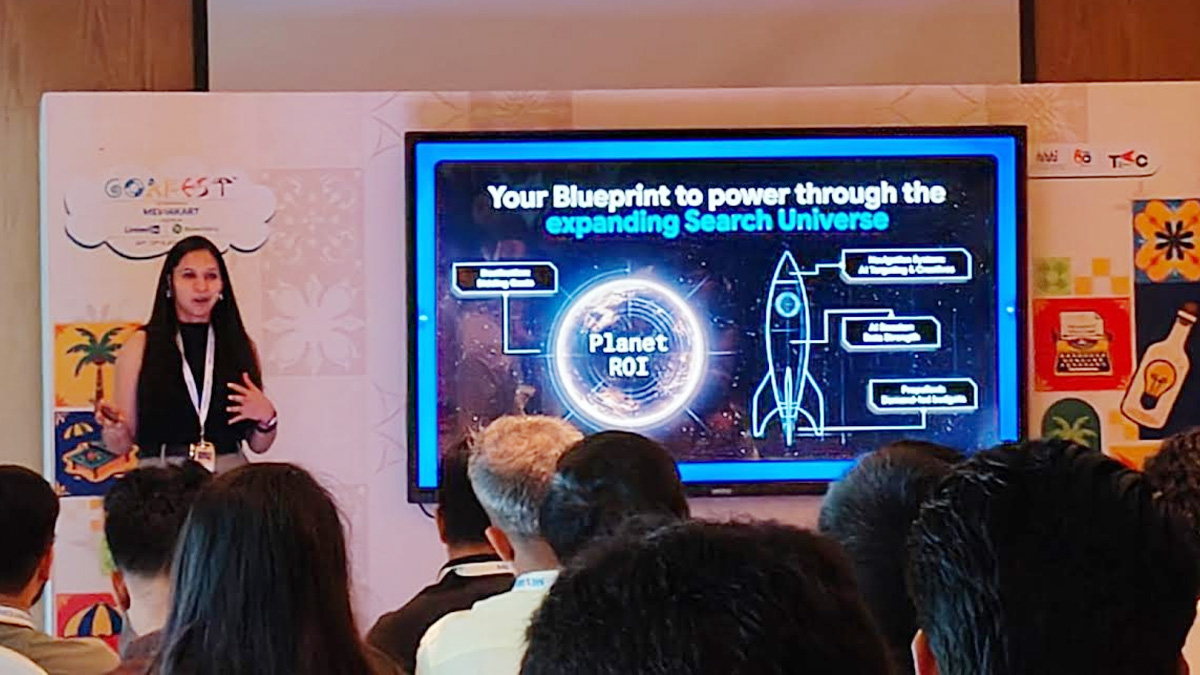
MUMBAI: The search bar is having an identity crisis and Google seems perfectly happy about it. At Goafest 2026, amid the sea breeze and brand banter at the Taj Cidade De Goa Horizon, Google delivered a clear message to marketers, agencies and brands: search is no longer just a place where users type keywords and click links. It is rapidly becoming a living, conversational ecosystem powered by artificial intelligence, multimodal discovery and predictive intent. And if brands are still treating search like a spreadsheet exercise from the last decade, they may already be falling behind.
At the masterclass titled Reset. Rethink. Reignite: How to Grow in the New Era of AI Search, Neha Nupur, Head of Search & Shopping at Google India, and Radhika Mehta, Performance Specialist at Google India, unpacked how AI is reshaping consumer behaviour, digital advertising and the very mechanics of online discovery.
The tone of the session was less “future of search” and more “the future has already logged in.”
From conversational AI and multimodal discovery to AI-generated creatives and predictive lead generation, Google outlined a sweeping transformation that could fundamentally alter how brands think about visibility, performance marketing and consumer journeys.
And while the presentation featured plenty of technical frameworks and product references, the underlying message was surprisingly human: the brands that win in the AI era will not necessarily be the loudest. They will be the most useful.
For years, search marketing revolved around keywords, bidding strategies and carefully engineered SEO tactics. But Google suggested that consumer behaviour is evolving far beyond those traditional mechanics.
Users are increasingly interacting with AI-driven systems through natural language conversations rather than fragmented keyword phrases. Queries are becoming longer, more detailed and more contextual. Instead of searching “best MBA colleges”, users are now asking layered questions involving fees, placements, hostel facilities, internships and location preferences in a single interaction.
That behavioural shift, according to Google, is already happening at enormous scale.
Neha Nupur revealed that more than 2 billion users globally are now engaging monthly with AI-powered search experiences, while conversational search interactions continue to grow rapidly.
And unlike earlier phases of search evolution, this one is not confined to text.
“Search has become multimodal,” Nupur explained, highlighting how users are increasingly discovering information through voice, images, video and AI-assisted browsing experiences.
That means consumers may search for products through Google Lens, ask questions conversationally through Gemini, consume discovery content through YouTube and eventually complete purchases through AI-enhanced recommendation flows. For marketers, the implication is enormous: websites and campaigns can no longer be optimised purely for typed keywords. They now need to cater to multiple forms of user intent across multiple formats simultaneously.
Interestingly, Google’s advice during the session was not entirely about advertising technology. A large portion focused on content quality and website experience — areas many brands have deprioritised in the race for short-term performance metrics.
Nupur stressed that in the AI era, a brand’s website effectively becomes its identity layer within AI-powered search systems.
As AI Overviews and conversational search tools summarise and recommend content to users, Google’s systems increasingly evaluate whether a website is genuinely useful, trustworthy and authoritative on a topic. That means brands need to rethink content beyond SEO-driven keyword stuffing. Google repeatedly emphasised the importance of “unique and authentic content”, warning against overdependence on generic AI-generated copy that risks making websites indistinguishable from one another.
The irony was impossible to miss. Even as AI becomes central to digital marketing, Google argued that purely machine-generated content may actually weaken discoverability if it lacks originality or genuine expertise.
“What is unique is the way you guys bring your understanding of the user,” Nupur said, underlining the need for human insight alongside AI tools.
The company also urged brands to invest in richer multimodal content ecosystems including podcasts, video explainers and interactive experiences because AI systems increasingly understand user preferences across formats rather than plain text alone.
In practical terms, the future SEO strategy may look less like technical optimisation and more like holistic content publishing. Of course, Google did not spend an hour discussing AI search without addressing the obvious commercial question, where do ads fit into all this? The answer, almost everywhere.
Nupur confirmed that advertising integrations are already live within AI Overviews, while broader AI Mode monetisation capabilities are being tested and expanded internationally.
That means the next generation of search ads may not appear as traditional sponsored links at all. Instead, they could become context-aware recommendations woven directly into conversational AI experiences. Google framed this evolution as an opportunity rather than a disruption. If users are spending more time interacting with AI-generated responses, advertisers need to rethink not just where they show up, but how they communicate within those interactions.
“The best ads are just answers,” Nupur remarked during the session.
That single line perhaps captured the biggest philosophical shift of the afternoon. Traditional digital advertising has often focused on interruption banners, pop-ups and aggressive targeting. AI-led search, however, increasingly rewards relevance, context and helpfulness. In other words, ads may start behaving more like recommendations than promotions. If the first half of the session focused on changing consumer behaviour, the second half shifted gears into campaign execution.
Radhika Mehta introduced what she jokingly described as Google’s “rocket ship” framework for navigating the expanding AI search universe.
And yes, there were repeated references to planets, navigation systems and fuel propellants. But beneath the playful metaphors sat a serious point: traditional campaign management methods are becoming increasingly unsustainable in an AI-driven ecosystem.
With trillions of searches happening annually and roughly 15 per cent of them entirely new manually managing keyword lists and static creatives simply cannot keep pace anymore. Google’s proposed solution lies in products such as AI Max and Performance Max, which increasingly automate targeting, creative generation and optimisation.
Mehta described AI Max as effectively “keywordless”, capable of understanding landing pages, existing content and behavioural signals to automatically identify relevant user intent without requiring advertisers to manually upload exhaustive keyword lists.
That automation extends to creatives as well. Instead of manually building dozens of ad variations, Google’s systems can now dynamically generate highly customised ad copy aligned with complex conversational search queries. If a user searches for a highly specific product combination, AI systems can theoretically generate matching creative messaging in real time. For agencies accustomed to endless campaign optimisation cycles, the pitch was clear: AI is moving from assistant to co-pilot.
Despite all the AI buzzwords, one of Google’s strongest messages revolved around something far less glamorous: data infrastructure.
Again and again, Mehta returned to a brutally simple phrase, “Quality in, quality out. Garbage in, garbage out.” Her point was that AI systems are only as effective as the signals brands provide them.
Google encouraged businesses to unify websites, apps, CRM systems, analytics platforms and customer databases into integrated ecosystems capable of feeding richer behavioural data into campaign optimisation engines.
Without strong data infrastructure, even the smartest AI systems risk optimising toward weak outcomes. The company also urged brands to move beyond simplistic conversion metrics and instead communicate actual business value signals back to Google’s systems. Rather than merely tracking clicks, brands should indicate which customers deliver higher lifetime value, stronger profitability or more meaningful engagement.
In theory, that allows AI systems such as Gemini to optimise not just for traffic volume, but for higher-quality business outcomes. For performance marketers chasing ROI in increasingly fragmented media environments, that capability could become a major differentiator.
One of the most intriguing moments during the session came when Google discussed the future of AI-powered lead generation. Today’s standard lead form experience static fields asking users for phone numbers and email addresses may soon feel painfully outdated. Google showcased conversational AI agents capable of interacting with users before collecting leads, answering detailed questions about products, services or educational programmes in real time.
The company revealed that such systems are already being tested in sectors including education, real estate and automobiles in India. One example involved prospective students interacting with AI systems about MBA programmes, hostel facilities and internships before eventually submitting their enquiry.
By the time the lead reaches a sales team, the user has effectively pre-qualified themselves through AI interaction. For businesses drowning in low-quality leads, the model could significantly improve conversion efficiency.
The session also reinforced how tightly interconnected Google’s broader ecosystem has become. While Search remains central to conversions, Google argued that discovery increasingly happens across Youtube, Gemini, Chrome and AI-powered browsing experiences simultaneously. According to the company, 93 per cent of Indian consumers oscillate between Google and Youtube during their brand discovery journeys. That means brands can no longer treat search and video as isolated marketing silos. Discovery, recommendation and conversion are increasingly blending into a single AI-enhanced ecosystem.
By the end of the masterclass, one thing had become unmistakably clear, Google no longer views search as a list of blue links. It increasingly sees search as an intelligent assistant capable of understanding context, predicting intent, answering questions, generating recommendations and even facilitating transactions.
For marketers, that transformation could be both exhilarating and unsettling. The rules are changing quickly. Keywords are losing dominance. AI-generated conversations are becoming discovery layers. Ads are evolving into contextual answers. And websites are being evaluated less like technical assets and more like knowledge systems.
At Goafest 2026, Google’s message landed with the force of a browser refresh. The future of search, it seems, is not waiting for marketers to catch up. It is already typing the next query.






